
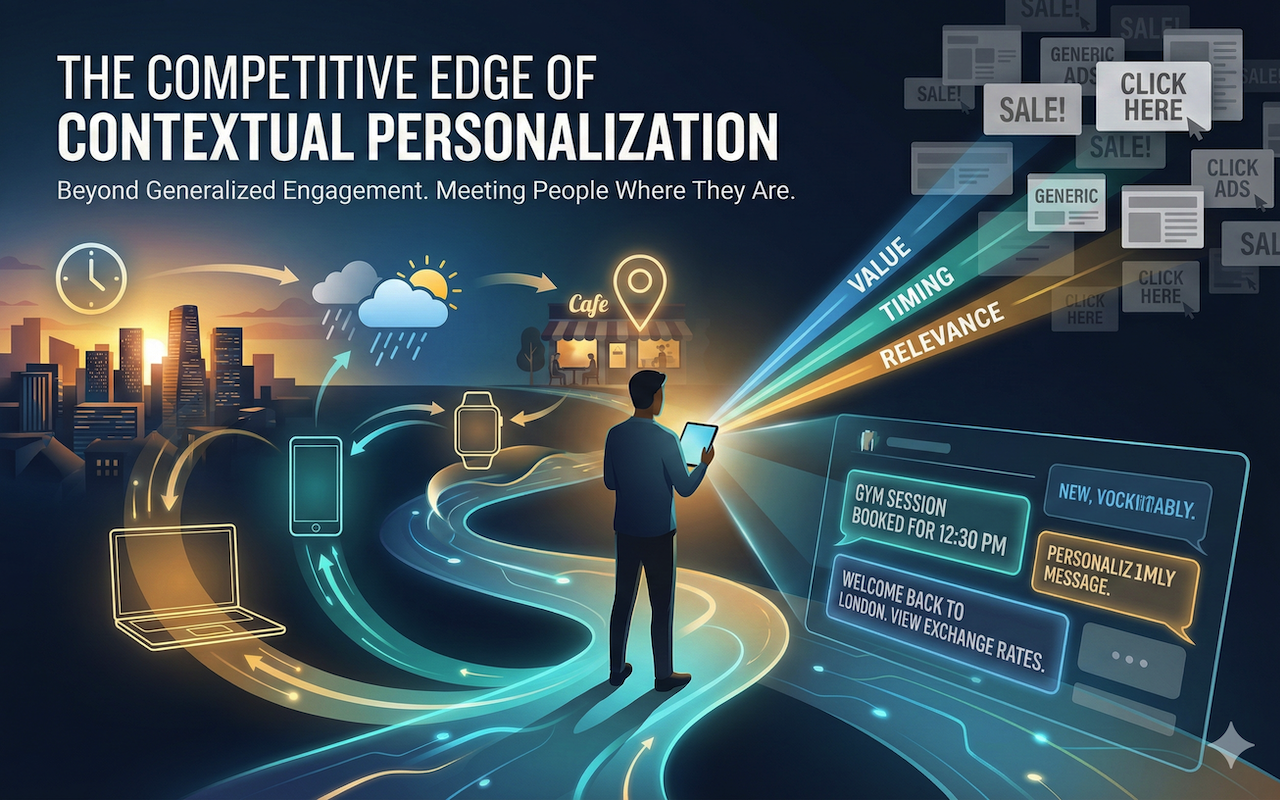
Beyond Generalized Engagement
Digital experiences used to follow a formula: segment users broadly, send a campaign, and wait for clicks. But customer expectations have changed. They no longer settle for generic greetings or blanket offers. Users expect experiences to adapt to their behavior, location, device, and timing. They want brands to know who they are, without overstepping.
That’s where contextual personalization comes in.
It’s more than using a first name in an email. It’s about recognizing when someone logs in from a new device, how often they visit specific features, or which content formats they prefer. Context matters because it reflects reality. When platforms understand context, they can respond to intent in real time, and that’s the difference between noise and value.
Why Timing and Relevance Matter More Than Ever
Contextual personalization isn’t only about demographics. It’s about understanding where someone is in their journey and what’s happening around them.
Think about a fitness app that sends a push notification during lunch hours when users are most likely to book a gym session. Or a fintech platform that recognizes when a user logs in from a foreign country and prompts multi-factor authentication while highlighting exchange rate features.
Relevance isn’t just about the content; it’s also about the moment. That’s why personalization needs to consider device type, location, time of day, behavior patterns, and even weather conditions. Every touchpoint becomes an opportunity to respond with intent-matching content or offers.
This level of personalization used to be complex and costly. But now, many tools offer it out of the box—even several Mailchimp alternatives have begun integrating behavior- and location-based triggers into their workflows, allowing smaller businesses to compete with enterprise-level personalization engines.
Where Traditional Segmentation Falls Short
Traditional customer segmentation relies on static attributes: age, gender, income, location. But behavior is dynamic. A 35-year-old in Los Angeles and another in Chicago might both fit your customer profile, but they could be experiencing completely different engagement patterns based on their surroundings, schedules, and recent actions.
Contextual personalization uses data in motion. It doesn’t just ask, “Who is this person?”—it asks, “What are they doing right now, and how can we help?”
That distinction is critical in avoiding churn. People don’t abandon platforms because they’re misclassified. They leave because the experience fails to meet them where they are, when they need it most.
Behavioral personalization, triggered by context, increases retention by aligning interactions with user expectations. And while tools like Mailchimp still cater to traditional lists, many Mailchimp alternatives have prioritized behavioral logic and multi-channel integrations, making it easier for growing companies to adapt in real time.
Contextual Data Points That Drive Smart Personalization
To make contextual personalization work, teams need to tap into a range of real-time signals. Some of the most useful include:
- Device Type and Screen Size: Tailoring visuals, calls-to-action, and interaction patterns based on whether someone is on mobile, tablet, or desktop.
- Geolocation and IP Intelligence: Adjusting content based on user region, time zone, or known geographic behaviors.
- Engagement History: Not just page visits, but time on page, scroll depth, and feature usage patterns.
- Referral Source: Whether the user came from a paid ad, social media, or an organic search changes what they expect.
- Time of Day and Day of Week: Messaging can align with productivity windows, lunch breaks, or weekend planning.
These inputs allow platforms to create logic flows that feel intuitive, not robotic. The goal isn’t to impress with complexity; it’s to be useful in a way that feels human.
Applications Across Industries
The beauty of contextual personalization is that it scales across nearly every vertical. Here’s how it plays out:
- E-commerce: Showing temperature-based clothing recommendations or location-based shipping times.
- Healthcare: Suggesting appointment reminders based on past visit patterns or time-of-day preferences.
- Education Platforms: Recommending study modules based on course completion rates or time spent in specific subjects.
- Travel and Hospitality: Delivering hotel upgrade offers only after flight bookings or check-in confirmations.
What unites these examples is their user-centric logic. The personalization doesn’t interrupt, it enhances. When done right, users don’t even notice the logic. They just feel understood.
Balancing Automation with Human Touch
One of the most persistent fears in digital engagement is that personalization becomes too robotic. If everything is automated, does the brand lose its human voice?
Not necessarily.
Contextual personalization, when used intentionally, empowers teams to scale personal attention, not replace it. Automation handles timing, channel, and trigger logic, freeing humans to focus on voice, tone, and strategy.
For example:
- A customer might receive an email reminder to complete a course after three days of inactivity. That trigger is automated, but the language is empathetic and helpful—, ot mechanical.
- A user who constantly logs in from a particular city might receive travel recommendations for nearby destinations, written with a local flair.
Automation is a tool. It becomes cold only when the team behind it forgets to use emotional intelligence in the content itself.
Privacy and Consent in the Age of Personalization
As personalization becomes more granular, the question of consent becomes more urgent. Users are increasingly aware of how their data is used and they’re demanding clarity.
The solution isn’t to avoid personalization. It’s to explain it, give users control, and use their data with respect.
Let users opt in to contextual tracking. Show them what value they gain. Offer transparency dashboards outlining what’s collected and how it enhances their experience.
When users see clear benefits—faster support, more relevant recommendations, fewer irrelevant messages—they’re far more willing to share data. But if a platform crosses into manipulation or excessive surveillance, the relationship breaks.
Smart personalization must always be paired with ethical data stewardship. That’s the long game.
Getting Started: Small Steps Toward Contextual Excellence
You don’t need a full AI-driven personalization engine to begin leveraging context. Many entry-level platforms now offer basic behavior-based workflows that are easy to set up.
Start small:
- Trigger follow-up messages based on session inactivity.
- Localize promotions based on country or city.
- Adjust messaging based on time zone to avoid sending emails at midnight.
Then iterate. Layer in more variables. Monitor what works. Contextual personalization is an evolving process, not a switch you flip.
Even if your current platform doesn’t support deep behavioral logic, many Mailchimp alternatives prioritize intuitive automation and user behavior, making it easy to test and scale contextual strategies without disrupting your systems.
The Business Impact of Getting It Right
Contextual personalization isn’t just a “nice-to-have.” It drives meaningful business outcomes.
- Higher Conversion Rates: Users who feel seen are more likely to act. A personalized offer based on recent behavior dramatically outperforms a generic blast.
- Lower Churn: When users receive timely, relevant nudges, they’re less likely to disengage or switch platforms.
- Increased Lifetime Value: Personalization deepens relationships. The more value users perceive over time, the more loyal they become.
- Operational Efficiency: Smart workflows reduce manual intervention. Your team can focus on strategy while automation handles timing and delivery.
Even small improvements in retention or conversion compound over time, especially when driven by a system that responds to context, not just identity.
Final Thought: Meet People Where They Are
The promise of modern experiences is convenience, customization, and control. But generic messaging, mass campaigns, and one-size-fits-all interactions have dulled that promise.
Contextual personalization restores it.
It tells users: we see you, we understand you, and we respect your time. It delivers value in the right way, at the right moment, through the right channel.
That’s not just good UX. That’s competitive advantage.
Featured Image generated by Google Gemini.
Share this post
Leave a comment
All comments are moderated. Spammy and bot submitted comments are deleted. Please submit the comments that are helpful to others, and we'll approve your comments. A comment that includes outbound link will only be approved if the content is relevant to the topic, and has some value to our readers.
Comments (0)
No comment