
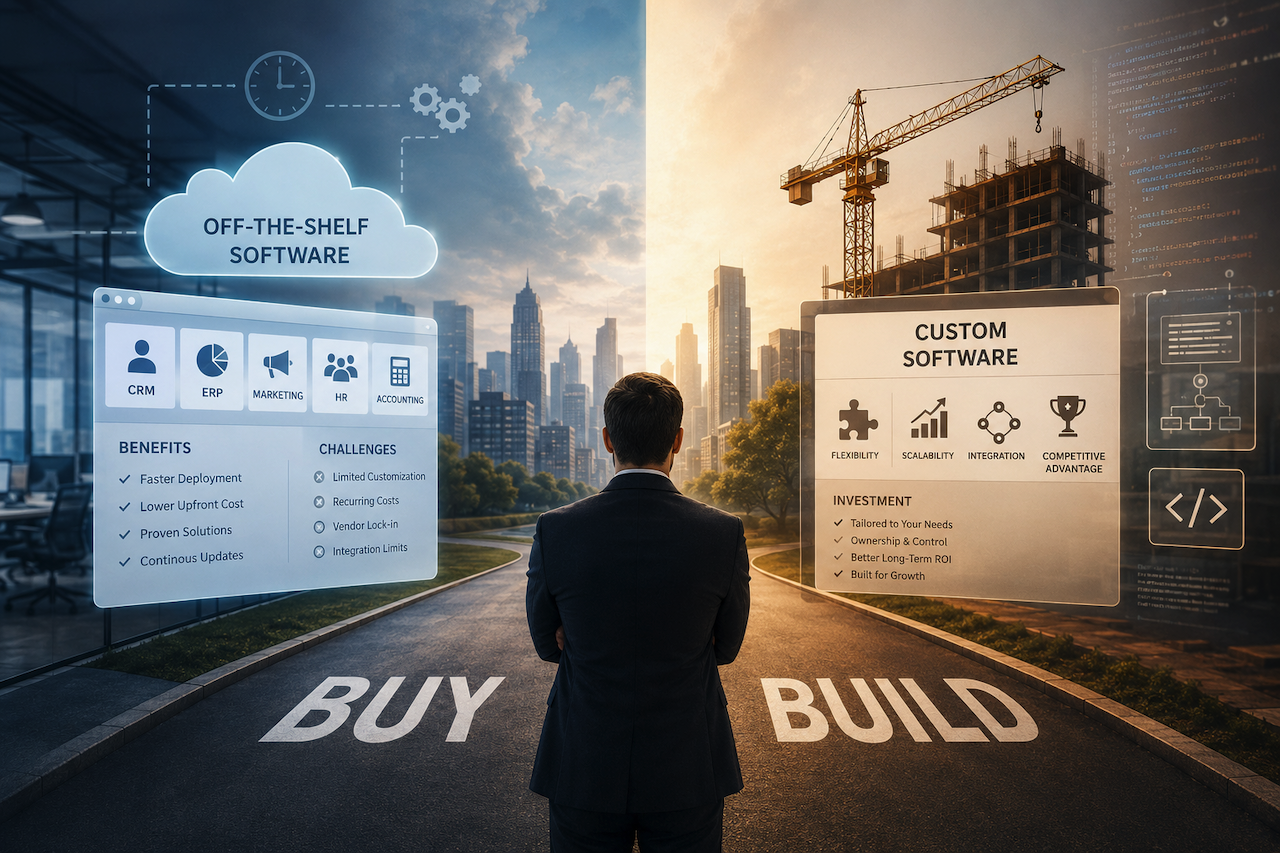
Companies are moving faster than ever in 2026. Markets shift quickly, customer expectations continue to evolve, and technology now shapes business strategy rather than simply supporting operations.
That is exactly why the build-versus-buy debate has become more relevant than ever.
Should businesses rely on existing software platforms, or invest in custom software development tailored to their operational requirements?
There is no one-size-fits-all answer.
For some organizations, existing software platforms offer speed, convenience, and lower upfront costs. For others, custom software creates flexibility and operational advantages that standard tools cannot easily provide.
The real question is not simply whether to build or use existing software.
It is determining what approach makes the most practical sense for your business in 2026.
This guide explores both approaches, where each works best, how the software development lifecycle influences decision-making, and why many organizations are increasingly combining both strategies rather than relying entirely on one.
Understanding the Build vs Buy Decision
At its core, the decision comes down to two different approaches.
Using Existing Software Platforms
This approach involves selecting established software products such as SaaS platforms, CRMs, ERPs, workflow tools, or industry-specific systems and adapting operations around those platforms.
Examples include:
- Using Salesforce for customer management
- Using Shopify for e-commerce
- Using HubSpot for marketing automation
- Using prebuilt HR or accounting platforms
The appeal is straightforward. Organizations can deploy systems faster, reduce upfront investment, and avoid many of the complexities associated with software creation. However, convenience and speed can also come with trade-offs.
Building Custom Software
Custom software development involves creating solutions tailored to specific workflows, business models, operational requirements, users, and long-term goals. Instead of adjusting operations around software limitations, the software is designed around the business itself.
Custom development may involve:
- Web or mobile applications
- Enterprise platforms
- AI-powered business tools
- Workflow automation systems
- Customer portals and internal operational platforms
Custom solutions typically require more planning and implementation time, but they can provide greater flexibility, ownership, scalability, and integration capabilities.
When Existing Software Platforms Make More Sense
Despite the rise of custom solutions, existing software platforms remain practical in many scenarios.
- Your needs are standardized: If your requirements involve common business functions such as payroll, accounting, project management, or email marketing, existing platforms may already solve those problems effectively.
- Speed matters more than differentiation: Startups and growing businesses often prioritize rapid deployment. Existing platforms can help organizations launch operations without long implementation timelines.
- Budget limitations matter: Custom development can involve larger upfront investment. Subscription-based software may provide a more manageable starting point for businesses with limited capital.
- Proven stability is important: Established platforms often include mature support systems, tested security, and continuous updates. For some businesses, reliability matters more than extensive customization.
The Hidden Costs of Existing Software Platforms
Existing software solutions often appear less expensive initially, but long-term operational costs can increase over time.
Common hidden costs include:
- Growing subscription fees
- Per-user licensing costs
- Integration limitations
- Expensive add-ons and extensions
- Vendor lock-in
- Operational inefficiencies caused by workarounds
Many organizations eventually discover they are adapting operations around software limitations instead of using technology that fully supports their workflows. That is often where custom development becomes more attractive.
When Custom Software Makes More Sense
Custom development often becomes more valuable when businesses require flexibility, integration, scalability, or operational differentiation.
- Your workflows are unique: Specialized processes may not align well with standardized software. Custom solutions can support the way a business already operates instead of forcing procedural changes.
- Technology supports competitive advantage: If software directly influences customer experience, operational efficiency, or revenue generation, ownership and flexibility become more important. Industries such as fintech, healthtech, logistics, and marketplaces often require more specialized platforms.
- Scalability matters: Businesses frequently outgrow packaged software. Custom systems can scale alongside long-term growth without requiring disruptive migrations later.
- Integration is critical: Modern organizations depend on interconnected technology ecosystems. Custom software can unify APIs, CRMs, ERPs, AI tools, and legacy systems more effectively than disconnected software stacks.
Why the Software Development Lifecycle Matters
The build-versus-buy decision should never ignore the software development lifecycle (SDLC). A strong SDLC helps transform software initiatives from risky projects into long-term business assets.
For organizations asking, “What is SDLC?”, the answer largely involves understanding how structured development processes reduce uncertainty and improve long-term outcomes.
A typical software development process includes:
- Planning and discovery: Business goals, requirements, user needs, and technical feasibility are defined.
- Design and architecture: System workflows, UX, and technical architecture are mapped for scalability.
- Development: The product is created using iterative or agile methods.
- Testing and quality assurance: Security, usability, and performance are validated.
- Deployment: The software moves into production environments.
- Maintenance and optimization: Updates, improvements, integrations, and scaling continue over time.
Following a mature SDLC reduces project risk, improves implementation timelines, and supports long-term software success.
What Is Changing in 2026?
The build-versus-buy conversation looks very different today than it did several years ago.
AI-assisted engineering, low-code development tools, automation, and composable architectures are reshaping development economics.
- Custom development is faster than before: AI-assisted development tools and agile frameworks have significantly reduced implementation timelines. Building software is no longer as inaccessible as it once was.
- Fragmented software ecosystems create challenges: Organizations operating dozens of disconnected SaaS tools often face inefficiencies, data silos, integration problems, and rising operational costs.
- Hybrid approaches are increasing: Many businesses no longer rely exclusively on either custom software or packaged solutions. Instead, they combine both approaches.
Examples include:
- Using existing infrastructure while building customer-facing systems
- Connecting SaaS platforms with custom integrations
- Extending existing products through custom workflows and modules
For many organizations, hybrid approaches are becoming the most practical option in 2026.
Questions to Ask Before Deciding
Before choosing a direction, organizations should evaluate several important questions:
- Does this software support a core business differentiator?
- Are existing tools limiting growth or efficiency?
- What will ownership cost over the next three to five years?
- Will current systems scale alongside the business?
- Do operational requirements demand flexibility that standardized platforms cannot provide?
- Would a hybrid approach make more sense?
These questions often clarify the most practical path forward.
Build or Buy?
Existing platforms often work best if:
- Your requirements are standardized
- Speed is the top priority
- Budget limitations are significant
- Customization needs are minimal
Custom software often works best if:
- Technology supports competitive advantage
- Your workflows are highly specialized
- Long-term scalability matters
- Integration complexity is high
- You require greater ownership and flexibility
Hybrid approaches often work best if:
- You need both speed and flexibility
- Existing tools solve only part of the problem
- You want to modernize operations gradually
Why Planning and Execution Matter
Even strong software decisions can fail without realistic planning, operational alignment, and disciplined execution.
Organizations evaluating software initiatives often consider not only implementation costs, but also long-term maintenance, scalability, security, integration complexity, and operational fit.
Successful software projects typically depend on:
- Clear business objectives
- Strong stakeholder communication
- Structured SDLC practices
- Realistic implementation timelines
- Long-term maintenance planning
Careful planning helps reduce risk, improve adoption, and ensure technology decisions align with broader business goals.
Conclusion
The build-versus-buy debate is not purely about technology. It is ultimately about business strategy.
Existing software platforms can help organizations move quickly.
Custom software can provide flexibility and differentiation.
Combining both approaches may offer the strongest balance.
What actually works in 2026 depends on operational requirements, growth objectives, scalability needs, and long-term business strategy. The best software decisions are rarely about software alone. They are about building systems that can support a business reliably as it evolves over time.
Featured Image generated by ChatGPT.
Share this post
Leave a comment
All comments are moderated. Spammy and bot submitted comments are deleted. Please submit the comments that are helpful to others, and we'll approve your comments. A comment that includes outbound link will only be approved if the content is relevant to the topic, and has some value to our readers.
Comments (0)
No comment