

Secure Financial Data Consolidation for Multi-Entity Businesses
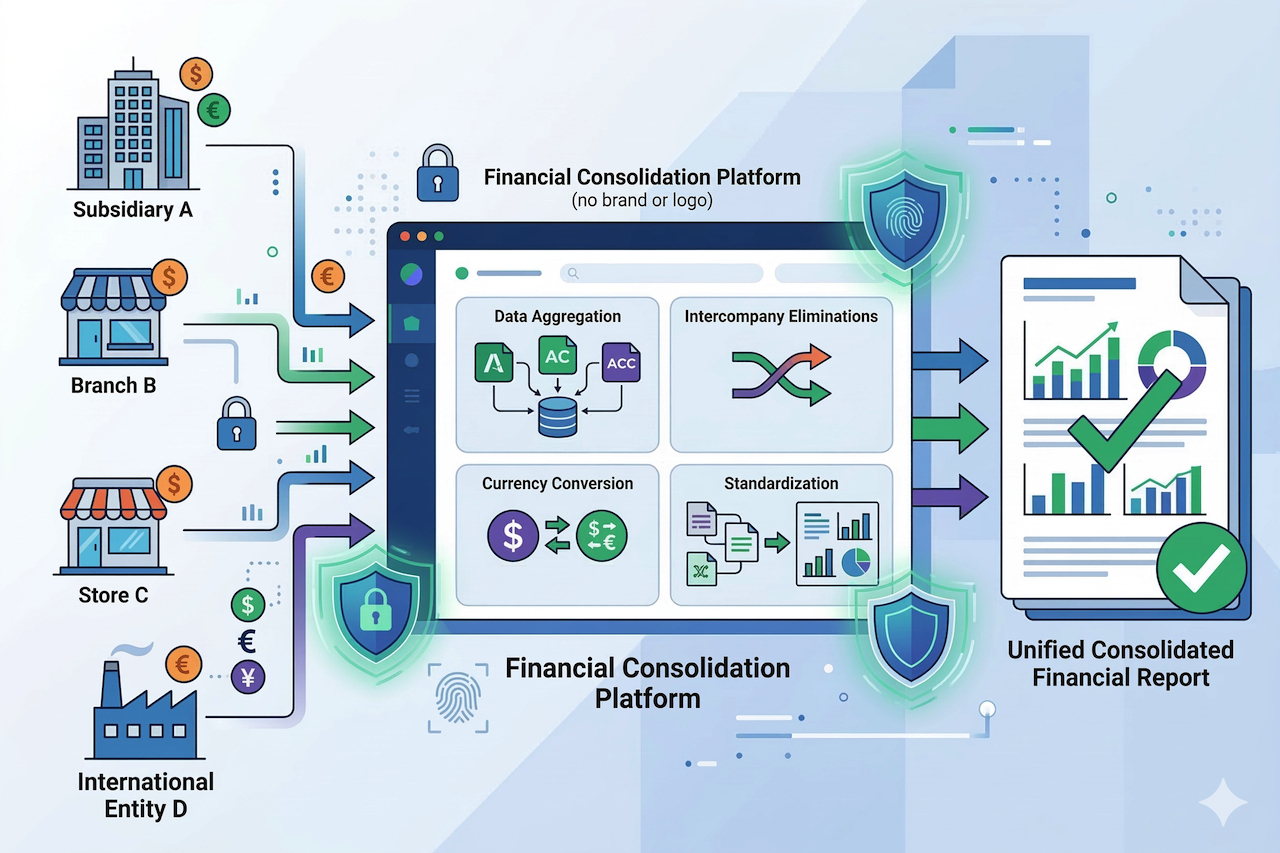
Multi-entity businesses collect financial data from many branches, stores, or subsidiaries. Each entity may use a different accounting system or reporting process. Finance teams must gather these numbers, organize them, exclude internal transactions, and produce a single clear financial report for the entire company.
When these processes rely on spreadsheets or disconnected tools, the impact is huge. Research from IBM estimates that poor data quality costs organizations about $12.9 million every year, often caused by fragmented data systems and reporting errors.
Financial consolidation software helps manage this process by consolidating financial data from multiple systems into a single place and standardizing reporting across entities.
In this article, we explain how multi-entity businesses consolidate financial data, the common challenges they face, and the systems and practices that help maintain accuracy and security across entities.
How Financial Data From Multiple Entities Gets Combined
Businesses that operate across multiple entities must consolidate financial data from each branch into a single, complete financial report. Finance teams collect information such as revenue, expenses, assets, liabilities, and cash flow from every entity and organize it into a consistent reporting structure.
During consolidation, teams also remove intercompany transactions. These are transactions that occur between branches or subsidiaries within the same company. Eliminating them ensures the final report reflects the company’s true overall performance.
However, combining financial data across entities is not always straightforward. Many organizations face challenges such as disconnected accounting systems, inconsistent reporting structures, and spreadsheet-based workflows. These issues make consolidation slower and increase the risk of reporting errors.
As businesses grow and add more entities, managing financial data through manual processes becomes increasingly difficult.
5 Steps in the Financial Consolidation Process
Consolidating financial data across multiple entities usually follows a structured process. Each step ensures that financial information from different branches can be combined accurately and consistently.
1. Collect Financial Data From Each Entity
The first step is gathering financial reports from every branch, subsidiary, or business unit. These reports typically include revenue, expenses, assets, liabilities, and cash flow information.
Because entities may use different accounting systems, finance teams often need to extract data from multiple sources before consolidation can begin.
2. Standardize Financial Data
Once the data is collected, it must be organized into a consistent structure. This usually involves aligning the chart of accounts so that similar financial categories match across entities.
Standardization ensures that revenue, expenses, and other financial elements are classified consistently throughout the organization.
3. Convert Currencies if Required
For organizations operating in multiple countries, financial data may be recorded in different currencies. Before consolidation, these values must be converted into a single reporting currency using standardized exchange rates.
This step allows financial statements from different regions to be combined without distortion.
4. Eliminate Intercompany Transactions
Transactions between branches or subsidiaries must be removed during consolidation. These internal transfers may include sales, loans, or service charges between business units.
Eliminating intercompany transactions prevents duplicate revenue or expense entries in the consolidated financial statements.
5. Generate Consolidated Financial Statements
After the data is aligned and validated, finance teams generate consolidated financial statements. These reports present the financial performance and position of the entire organization as a single entity.
The final output typically includes consolidated income statements, balance sheets, and cash flow statements. These reports help leadership understand the company’s overall financial health.
Security Considerations When Consolidating Financial Data
Financial consolidation involves handling sensitive financial records from multiple entities. As this data moves between systems, strong security controls are necessary to protect it from unauthorized access.
Access Control
Only authorized users should be able to view or modify financial data. Role-based access control allows organizations to define who can access specific financial records and reporting systems. This helps prevent unauthorized changes to financial statements.
Secure Data Transfers
Financial data often moves between accounting systems, financial databases, and reporting platforms during consolidation. Secure transmission methods, such as encrypted connections, help protect financial information during transfer.
Audit Trails
Maintaining audit trails allows organizations to track changes made to financial data during the consolidation process. These records help finance teams verify adjustments and identify discrepancies if issues arise.
Secure Financial Systems
Financial consolidation systems should operate within secure IT environments. Network monitoring, secure authentication methods, and controlled system access help protect the financial reporting infrastructure from unauthorized access.
How Financial Consolidation Software Supports the Process
As businesses grow and operate across more entities, managing financial consolidation manually becomes difficult. Financial consolidation software helps simplify the process by automating data collection, standardizing financial structures, and improving reporting accuracy.
Centralized Data Collection
Financial consolidation software connects with accounting systems, enterprise resource planning (ERP) platforms, and financial databases used by different entities. This allows financial data to be collected automatically and stored in a centralized system.
Having all financial data in one place helps finance teams monitor reporting and reduce the need for manual data gathering.
Automated Intercompany Reconciliation
Transactions between subsidiaries or branches can create duplicate entries during consolidation. Consolidation software can automatically identify these intercompany transactions and remove them during the reporting process.
This helps ensure that consolidated financial statements accurately represent the company’s external financial performance.
Real-Time Financial Visibility
Centralized consolidation systems allow finance teams to view financial information from multiple entities on a single dashboard. Instead of waiting for spreadsheets from each branch, teams can access updated financial data more quickly.
This improves visibility and allows organizations to monitor financial performance across entities.
Built-In Validation Checks
Financial consolidation software often includes validation rules that detect missing entries, inconsistent classifications, or reporting errors. These checks help finance teams identify problems early in the reporting process.
Automated validation reduces the risk of inaccuracies in the final consolidated financial statements.
Best Practices for Accurate Financial Consolidation
Organizations that manage financial data across multiple entities can improve consolidation accuracy by following structured financial management practices.
- Standardize the chart of accounts: A consistent chart of accounts ensures that financial data from different entities follows the same structure. This makes it easier to combine revenue, expenses, and other financial categories across branches.
- Integrate financial systems: Connecting accounting platforms and financial databases reduces the need for manual data transfers. Integrated systems allow financial information to flow directly into consolidation workflows.
- Maintain consistent reporting timelines: Each entity should follow the same reporting schedule. When financial data is submitted within a consistent timeline, consolidation can be completed more efficiently.
- Perform regular data validation: Validation checks help ensure that financial data is complete and correctly classified before consolidation begins. Early validation reduces the risk of errors in final reports.
- Protect financial data with secure infrastructure: Financial systems should operate within secure IT environments that include encrypted connections, controlled access permissions, and secure authentication methods.
Why Secure Financial Consolidation Matters for Growing Businesses
Managing financial data across multiple entities requires a structured and secure approach. As businesses expand, financial information often comes from different systems, reporting formats, and operational processes. Without a clear consolidation framework, maintaining accuracy and consistency becomes difficult.
By standardizing financial structures, following clear consolidation steps, and using secure systems to handle financial data, organizations can more reliably combine financial information from multiple entities. Modern financial consolidation software further supports this process by improving visibility, reducing manual effort, and enabling finance teams to produce accurate financial reports across the entire organization.
Disclaimer
This article is intended for informational purposes only and does not constitute financial, accounting, or legal advice. The information provided is based on general industry practices and publicly available sources. Organizations should consult qualified financial, accounting, or legal professionals before implementing financial consolidation strategies or selecting financial management software. The author and publisher are not responsible for any decisions made based on the information presented in this article.
Comments
Comments are available to signed-in users and are moderated to keep the discussion useful and respectful. Spam, automated submissions, and low-value promotional comments are removed. Outbound links may be approved when they are relevant and genuinely helpful to readers, but they are displayed as plain text rather than clickable hyperlinks.
No comments have been published yet.
Please sign in to submit a comment.