
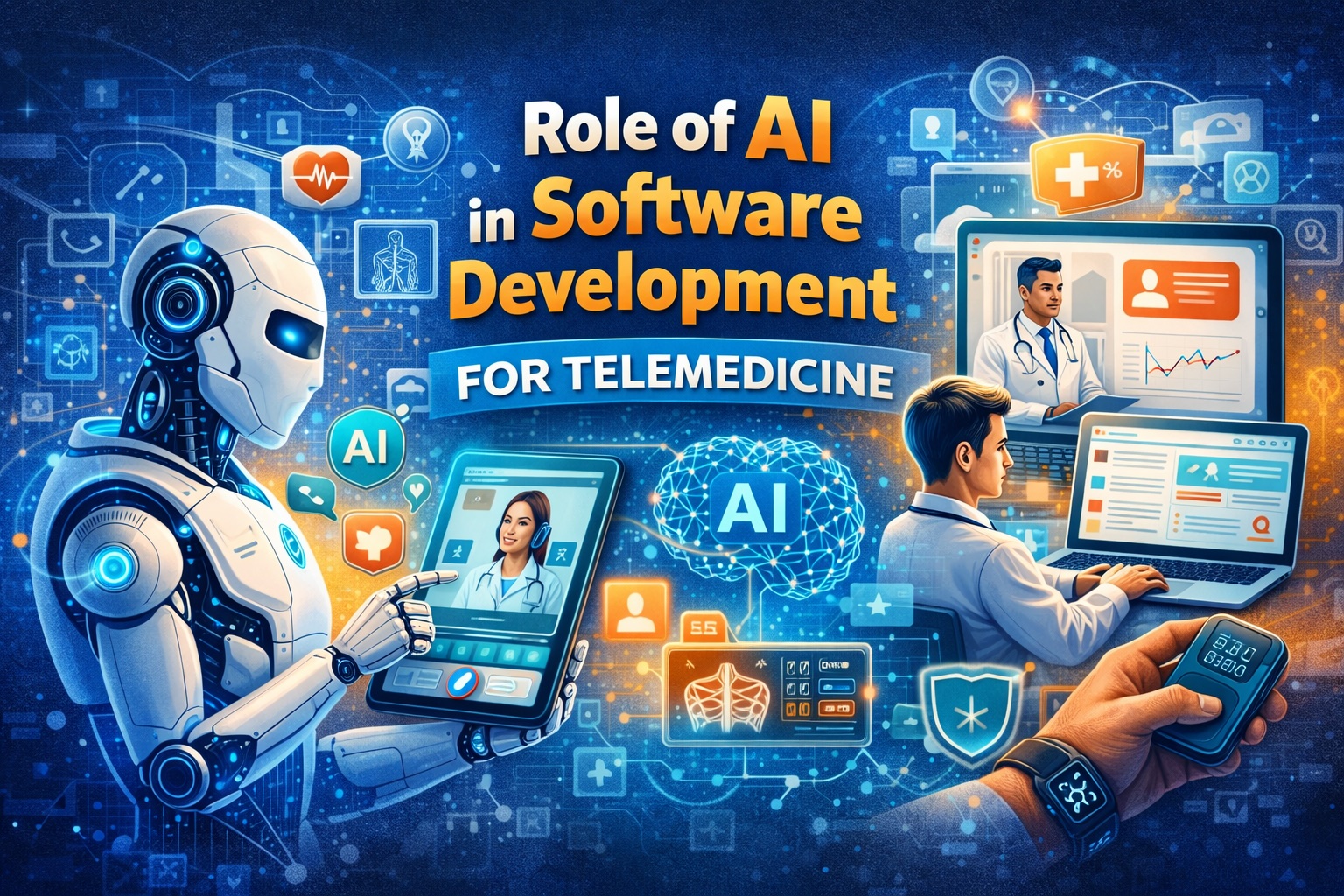
Artificial intelligence is no longer just an emerging trend in software development. It has become a foundational force reshaping how modern applications are designed, built, and optimized. Across industries, AI is being used to automate complex workflows, enhance decision-making, and create systems that can learn and improve over time. From intelligent code generation and predictive analytics to real-time personalization, AI is fundamentally changing what software can do and how efficiently it can operate.
One of the most compelling examples of this transformation can be seen in healthcare, particularly within telemedicine. As digital healthcare platforms expand, the demand for smarter, faster, and more responsive systems continues to grow. Telemedicine software, which enables remote consultations, diagnostics, and patient monitoring, has become a critical part of modern healthcare delivery. However, it is the integration of AI that elevates these platforms from simple communication tools to intelligent healthcare ecosystems.
By embedding AI into telemedicine software development, companies are enabling features such as automated patient interactions, predictive diagnostics, real-time monitoring, and personalized treatment recommendations. These capabilities not only improve operational efficiency but also enhance patient outcomes and accessibility. As a result, telemedicine serves as a clear, real-world illustration of how AI is redefining software development—transforming static systems into adaptive, data-driven solutions that continuously evolve.
This article explores the role of AI in telemedicine software development, highlighting its key applications, benefits, challenges, and the future direction of AI-driven healthcare innovation.
Telemedicine Software: What's It?
Healthcare specialists can discuss, diagnose, and treat patients remotely through digital structures using telemedicine software. Usually, these solutions have features like:
- Video consultations
- Making an appointment
- E-prescriptions
- Management of patient information
- Monitoring from a distance
Even if those functions are strong on their own, combining them with AI raises the bar for telemedicine by making it extra realistic, effective, and individual-focused.
The Significance of AI in Telemedicine
Conventional telemedicine structures usually depend upon human intervention and guided approaches. By including automation, predictive abilities, and data-driven decision-making, AI improves the one systems.
Here's why AI is so essential:
- Will increases the precision of the prognosis
- Lessens the pressure for scientific personnel
- Improves the experience of patients
- Allows faster decision-making
- Promotes healthcare prevention
To put it clearly, AI makes telemedicine structures smarter and more adaptable.
Important Uses of AI in Software Development for Telemedicine
1. AI-Powered Virtual Assistants
AI digital assistants and chatbots are revolutionizing patient communication. They are capable of:
- Respond to easy scientific questions
- Assist patients with their signs and symptoms
- Make appointments
- Remind people to take their medications.
Patients can obtain prompt help without having to wait for a medical professional, as they offer 24/7 availability.
2. Astute Diagnosis and Guidance
AI structures can evaluate patient records, clinical histories, and signs to assist physicians in making a particular prognosis.
For instance:
- Based on symptoms, AI can propose potential ailments.
- High-risk times might be flagged for brief intervention.
- It lessens the opportunity of human mistakes.
This serves as a robust support system instead of taking the function of physicians.
3. Monitoring Patients Remotely
AI is critical for far-flung patient monitoring by wearable technology and networked systems.
It aids in:
- Monitoring crucial symptoms, consisting of blood pressure, coronary heart rate, and oxygen levels
- Real-time anomaly detection
- Notifying physicians at the time of an emergency
Patients with long-term illnesses will particularly benefit from this.
4. Tailored Therapy Plans
AI generates individualized therapy guidelines by using analyzing full-size quantities of patient information.
Rather than an everyday method, patients are given:
- Tailored drug regimens
- Lifestyle guidelines
- Suggestions for preventive care
Patient satisfaction and treatment efficacy both increase as a result.
5. Medical Images Analysis
Medical images like CT, MRI, and X-rays may be processed and analyzed by using AI.
It aids in:
- Early infection detection
- Finding patterns that human beings might forget
- Accelerating the prognosis
In telemedicine, where physical examination is scarce, that is very helpful.
6. Natural Language Processing (NLP)
Systems are capable of realizing human language thanks to AI-powered NLP.
Applications encompass:
- Transforming physician-patient discussions into organized records
- Clinical documentation automation
- Improving patient-provider communication
This increases productivity and lessens the administrative burden.
7. Predictive Analytics
Based on beyond facts and trends, AI is able to predict possible health risks.
For example:
- Recognizing people who are prone to chronic ailments
- Forecasting readmissions to hospitals
- Suggestions for preventive measures
As a result, healthcare turns into proactive rather than reactive.
Benefits of AI in Telemedicine Software Development
1. Improved Patients Experience
AI ensures faster reactions, individualized treatment, and clean interactions, improving patients' overall experience.
2. Enhanced Productivity
Healthcare people can focus more on patient care when repetitive tasks like data input, appointment scheduling, and compliance are automated.
3. Increased Precision
By exactly comparing considerable datasets, AI reduces mistakes in prognosis and treatment suggestions.
4. Cutting Expenses
AI lowers operating and treatment expenses by automating strategies and eliminating the need for in-person visits.
5. Improved Accessibility
People in remote or underserved locations can now get healthcare by using AI-powered telemedicine services.
Challenges of Using AI in Telemedicine
Although AI has many benefits, developers and healthcare experts must triumph over some limitations.
1. Security and Privacy of Data
Data related to healthcare is extremely sensitive. It is essential to ensure secure transmission and storage.
2. Adherence to Regulations
Software for telemedicine ought to abide by the help of local healthcare guidelines.
3. Exorbitant Development Expenses
AI integration calls for a very sophisticated technology, extraordinarily qualified personnel, and a significant investment.
4. Integration with Current Systems
AI integration is complex due to the fact that many healthcare providers hold to using old structures.
5. Adoption and Trust
At first, docs and patients might be reluctant to consider recommendations made with the help of AI.
The Best Methods for Including AI in Telemedicine Software
Consider the following while implementing AI in telemedicine software development:
- Focus on data quality: The effectiveness of AI structures relies on the data they use.
- Assure adherence: Observe healthcare rules and recommendations.
- Put security first: Put strong encryption and data protection mechanisms in the region.
- Start small: Start with positive use instances and work your way up.
- Maintain transparency: Give a clean rationalization of how AI makes judgments.
Future of AI in Telemedicine
AI trends may have a huge impact on telemedicine in the future. We can assume:
- Real-time and MORE-specific diagnostics
- Advanced predictive medical structures
- IoT and wearable tool integration
- Completely automated virtual medical assistants
- Enhanced accessibility to healthcare internationally
AI will advance telemedicine right into a complete digital healthcare ecosystem, going beyond easy consultations.
Final Thoughts
AI is remodeling telemedicine software development by improving the speed, intelligence, and accessibility of healthcare. A modern telemedicine software development company uses AI to enhance every aspect of the telemedicine system, from digital assistants to predictive analytics.
The benefits significantly exceed the drawbacks, even though troubles like data security and integration nevertheless exist. AI becomes ever more significant in figuring out the route of digital healthcare as the technology develops.
Adopting AI in telemedicine is now a strategic step closer to offering better, more powerful patient care for businesses and healthcare providers.
Featured Image generated by ChatGPT.
Share this post
Leave a comment
All comments are moderated. Spammy and bot submitted comments are deleted. Please submit the comments that are helpful to others, and we'll approve your comments. A comment that includes outbound link will only be approved if the content is relevant to the topic, and has some value to our readers.
Comments (0)
No comment