
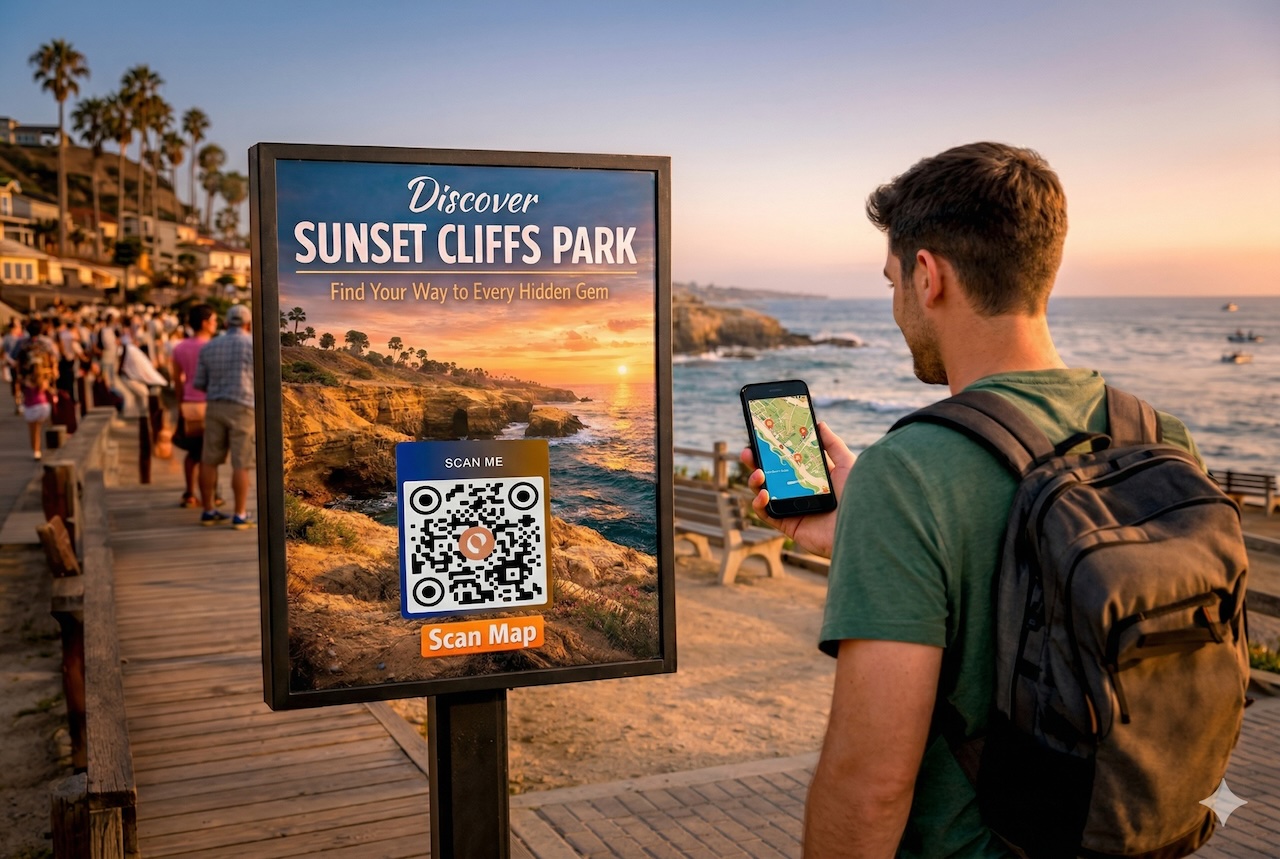
Clear directions are no longer a convenience; they are the standard.
Travel is now mobile-first and increasingly self-guided, with travelers relying on their smartphones for navigation and real-time information.
A location QR code helps bridge physical travel touchpoints, such as tickets and signage, with digital maps and directions.
By simplifying navigation and reducing confusion, arrival accuracy improves, traveler confidence is enhanced, and a smoother, more efficient travel experience is achieved.
What is a QR code for location?
A QR code for location is a smartphone-scannable barcode that links directly to precise digital maps, guiding people to meeting points, attractions, or routes without requiring manual searches or additional apps.
Anyone can create them for free using a map QR code generator on the web.
Key differentiator:
Unlike printed maps, QR codes are both physical and digital. They can be virtually anywhere and lead people straight to digital content.
The advantages of QR-enabled maps become even clearer when compared to traditional printed maps:
| Feature | Printed Maps | Map QR Codes |
|---|---|---|
| Updates | Static; becomes outdated and needs manual replacement | Can be dynamic; updates in real time |
| Accuracy | Prone to errors, missing changes | Precise GPS-based locations |
| Accessibility | Requires physical handling | Scannable instantly on smartphones |
| Language Support | Limited | Multilingual options available |
| Analytics | None | Tracks scans, engagement, and location usage |
| Scalability | Reprint required for each change | One code serves many travelers |
| Convenience | Manual search and interpretation | Direct navigation with a single scan |
The role of QR codes in the modern travel industry
QR codes have become a core utility in travel by simplifying how information is delivered and accessed on the move.
As travelers navigate unfamiliar destinations, QR codes reduce friction by removing the need for manual searches, printed materials, or app downloads.
In practice, map-based QR codes enable travel providers to:
- Deliver instant access to maps, itineraries, and attraction details
- Support multilingual, device-agnostic experiences through mobile browsers
- Update information in real time without reprinting physical materials
- Scale location-based guidance across tours, attractions, and destinations
- Reduce operational friction by minimizing navigation-related support inquiries
Within this ecosystem, QR codes function as a lightweight but powerful layer that connects physical travel touchpoints to digital navigation tools.
Core use cases of QR codes across the travel industry
travel QR code is most effective when applied at moments where travelers need clear, immediate direction.Below are high-impact scenarios where QR-enabled maps improve both traveler experience and operational efficiency.
| Travel Scenario | QR Code Function | Traveler Benefit |
|---|---|---|
| Guided tours | Opens the exact meeting point on a digital map | On-time arrivals, less confusion |
| City attractions | Links to the entrance location and directions | Easy self-navigation |
| Multi-stop experiences | Displays full route with sequential stops | Clear, structured itineraries |
| Hotels & accommodation partners | Shows nearby tours and pickup points | Better local discovery |
| Transport hubs (airports, stations) | Highlights pickup and drop-off zones | Reduced stress on arrival |
| Event-based experiences | Directs users to temporary or pop-up locations | Accurate navigation to non-permanent sites |
| Self-guided walking tours | Opens the mapped trail with landmarks | Independent exploration |
| Group travel coordination | Shares a single reference map for all guests | Consistent arrival points |
| Rerouted or delayed tours | Updates the map to fallback locations | Continuity despite disruptions |
Across these scenarios, the value is consistency. A single scannable map link serves as a contactless travel solution, reducing errors and support requests, and ensuring travelers reach their destination on time.
Why map QR codes matter for experience marketplaces
In travel marketplaces, navigation clarity directly influences the overall guest experience.
QR codes for travel provide accurate, easy-to-access maps that reduce confusion, helping travelers reach the right locations on time and without frustration. Key benefits include:
- Higher customer satisfaction: Clear directions make experiences smoother and more enjoyable.
- Fewer support requests: Reduced “where do I go?” inquiries lighten operational load.
- Improved punctuality: Travelers arrive on time for tours and activities, keeping schedules on track.
- Stronger trust signals: First-time visitors feel more confident and supported, boosting platform credibility.
- Operational efficiency: Streamlines staff workflow by minimizing on-the-spot guidance.
- Data-driven insights: Scan analytics reveal popular routes and locations for better planning.
- Enhanced upselling opportunities: QR codes can seamlessly link to add-on experiences or nearby attractions.
The future of QR codes in the travel industry
Map QR codes are evolving beyond navigation, becoming powerful experience-enabling tools for the travel industry.
Emerging technologies and new use cases are expanding the impact of QR codes for travel:
- Integration with AR wayfinding: Travelers can scan a QR code to view augmented reality directions overlaid on the real world.
- AI-personalized travel maps: QR codes can deliver dynamic routes tailored to individual preferences, interests, or schedules.
- Real-time crowd and traffic overlays: Travelers can access up-to-the-minute data on congestion to optimize their routes.
- Deeper analytics for destination optimization: Scan data can inform operators about popular routes, peak times, and traveler behavior.
- Seamless ticketing and check-ins: QR codes can link directly to digital tickets, allowing faster entry to attractions and transport.
- Multi-language, adaptive content: Travelers can receive map instructions, tips, and notifications in their preferred language automatically.
- Integration with loyalty and upsell programs: QR scans can trigger personalized offers for nearby tours, restaurants, or experiences.
Best Practices for using a Location QR code
To maximize the impact of QR codes for location, travel providers should follow these expert recommendations:
- Use dynamic QR codes. Ensure routes and locations can be updated without reprinting materials, keeping information accurate and up to date. This keeps travelers guided with the most accurate information at all times.
- Label QR codes clearly. Add concise instructions, such as “Scan for meeting point map,” to guide travelers and reduce confusion. Clear labeling increases scan rates.
- Test across devices. Verify compatibility on both iOS and Android smartphones to avoid accessibility issues. Testing ensures all travelers can access self-guided tour maps seamlessly.
- Provide a fallback link. Pair QR codes with short URLs in case scanning fails or travelers prefer manual entry. This ensures no traveler is left without directions.
- Strategic placement. Position QR codes at eye level in high-traffic areas, like hotel lobbies, ticket counters, and signage. Placing codes where travelers naturally pause increases engagement.
- Include contextual cues. Add icons, mini-maps, or arrows near the QR code to indicate what it links to, improving scan rates. Visual cues help travelers instantly understand the purpose of the scan.
- Track engagement. Monitor scans and usage data to optimize placement, understand traveler behavior, and enhance future mobile navigation for tourists.
Turning Navigation into a Travel Advantage
For every traveler, seamless navigation and instant access to accurate information are always essential.
A reliable map QR code generator enables travel providers and stakeholders to deliver real-time, precise location data.
With a QR code for location, basic navigation becomes a business strategy that improves traveler satisfaction, streamlines operations, and gives travel providers a competitive edge with innovative, tech-driven experiences.
Share this post
Leave a comment
All comments are moderated. Spammy and bot submitted comments are deleted. Please submit the comments that are helpful to others, and we'll approve your comments. A comment that includes outbound link will only be approved if the content is relevant to the topic, and has some value to our readers.
Comments (0)
No comment