

Enterprises today face constant pressure to deliver products faster without increasing long-term risk. Choosing the right delivery model directly impacts speed, quality, and return on investment.
Two common approaches dominate enterprise discussions: staff augmentation and product extension pods. Understanding how each model works helps leaders make better decisions. To understand better, let’s conduct a product extension pods vs staff augmentation comparison.
Understanding the Core Difference Between the Two Models
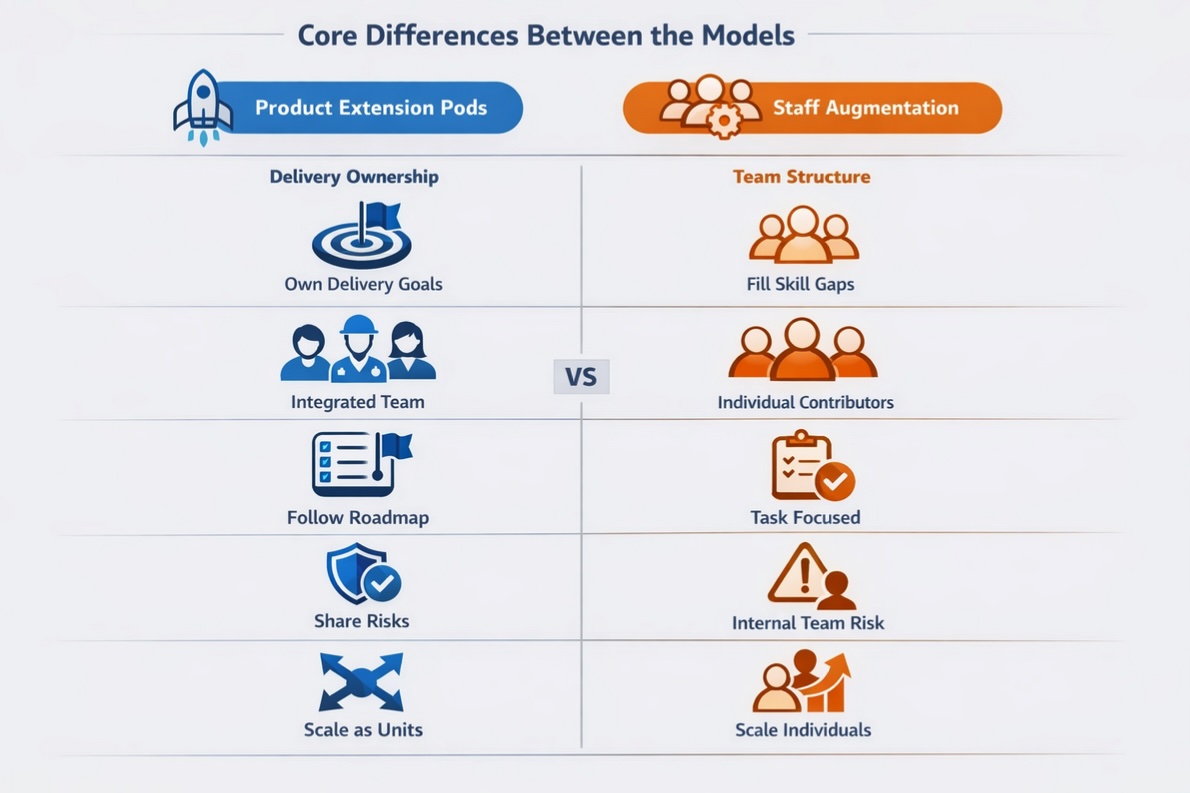
Enterprises often confuse delivery models because both appear similar on the surface. The real difference lies in ownership, accountability, and outcome focus.
Delivery Ownership
Product extension pods own delivery goals rather than completing isolated tasks within a larger workflow.
The staff augmentation model focuses on filling skill gaps without owning delivery outcomes.
Pods operate as independent units aligned with product success metrics.
Augmented staff depends heavily on internal managers for direction and priorities.
Team Structure
Product extension pods include engineers, QA, and leadership working together toward shared objectives.
Staff augmentation provides individual contributors working under client supervision.
Pods reduce coordination overhead by working as one accountable unit.
Augmented resources increase management load for internal teams.
Execution Style
Pods follow product roadmaps and sprint goals tied to business results.
Augmented staff executes assigned tasks without influencing the delivery strategy.
Pods proactively solve problems before delays appear.
Augmented teams wait for instructions to proceed.
Risk Distribution
Pods absorb delivery risks through defined ownership and shared accountability.
Augmented staff pushes delivery risk back to internal teams.
Pods reduce dependency on internal micromanagement.
Augmentation increases exposure to delivery inconsistency.
Scalability Approach
Pods scale as complete units without breaking existing workflows.
Augmentation scales individuals, increasing coordination complexity.
Pods preserve velocity during expansion.
Augmented scaling slows teams as size increases.
This difference sets the stage for understanding how ROI is realized in each model.
How Product Extension Pods Accelerate Time to ROI?

Enterprises care about results, not just resource availability. Faster ROI depends on how quickly teams produce usable outcomes.
Outcome-Based Delivery
Product extension pods improve ROI by aligning delivery directly with business objectives.
Pods focus on shipping features that impact revenue or efficiency.
Success metrics remain visible and measurable.
ROI becomes predictable rather than estimated.
Reduced Ramp-Up Time
Pods activate with defined processes and roles from day one.
No time is lost aligning individual contributors.
Work starts immediately with minimal onboarding friction.
Enterprises see value earlier in the engagement.
Fewer Delivery Gaps
Pods reduce handoffs between internal and external teams.
Clear ownership eliminates confusion during execution.
Issues are resolved inside the pod.
Delivery cycles remain smooth and consistent.
Stable Velocity
Pods maintain consistent output across sprints.
Dependencies are managed internally.
Productivity does not drop during team expansion.
Enterprise timelines stay intact.
Long-Term Value Creation
Pods improve systems, documentation, and workflows over time.
Knowledge remains within the pod structure.
Value compounds with continued engagement.
ROI grows beyond short-term delivery wins.
This efficiency becomes clearer when compared directly with staff augmentation limitations.
Where Staff Augmentation Slows Enterprise ROI?

Staff augmentation appears flexible, but it often delays real returns. Enterprises face hidden friction that reduces speed and efficiency.
Management Overhead
The staff augmentation model requires constant internal supervision.
Managers spend time coordinating tasks instead of driving strategy.
Productivity depends heavily on internal bandwidth.
ROI slows due to leadership distraction.
Fragmented Accountability
Augmented staff does not own the delivery success.
Responsibility remains spread across multiple teams.
Delays become harder to trace.
Enterprises absorb delivery failures internally.
Inconsistent Output
Skill levels vary across individual contributors.
Quality depends on internal review capacity.
Output fluctuates between sprints.
Enterprises face delivery unpredictability.
Slower Scaling
Adding more people increases coordination needs.
Communication overhead grows with team size.
Scaling does not guarantee faster delivery.
ROI diminishes as complexity rises.
Knowledge Silos
Augmented staff retain knowledge individually.
Context is lost when resources rotate.
Documentation becomes inconsistent.
Enterprises face continuity risks.
These limitations highlight why enterprises explore pod-based delivery for scalable growth.
Why Enterprises Prefer Product Extension Pods for Scale?

Scaling enterprise products requires structure, not just more people. Pods align better with enterprise growth goals.
Built for Growth
Scalable product teams adapt without breaking delivery rhythm.
Pods expand as complete units.
Scaling remains controlled and predictable.
Enterprise systems stay stable.
Product-Centric Thinking
Pods operate as product-focused engineering teams rather than task executors.
Decisions support long-term product health.
Technical debt is managed proactively.
Products mature faster.
Strategic Alignment
Pods align execution with business roadmaps.
Priorities remain clear across stakeholders.
Delivery supports enterprise KPIs.
ROI aligns with strategic outcomes.
Reduced Dependency Risk
Pods function independently with minimal internal reliance.
Internal teams regain focus on core initiatives.
Dependency risk drops over time.
Enterprises gain operational confidence.
Enterprise-Grade Governance
Pods follow defined processes and reporting standards.
Transparency remains consistent across delivery stages.
Risk management becomes systematic.
Enterprise compliance stays intact.
This structure prepares enterprises for complex product environments.

Final Thoughts
Delivery ownership is a virtue that enables enterprises to increase the ROI without increasing the headcount. The product extension pods vs staff augmentation comparison clearly shows the virtues and vices of both. However, the virtues of product extension pods overshadow those of staff augmentation. The applicability of both models makes them best suited for distinct applications. ValueCoders partners with enterprises across both engagement models to deliver governed, scalable engineering capacity. The result is execution clarity, measurable ROI, and sustainable product growth aligned to long-term business goals.
Share this post
Leave a comment
All comments are moderated. Spammy and bot submitted comments are deleted. Please submit the comments that are helpful to others, and we'll approve your comments. A comment that includes outbound link will only be approved if the content is relevant to the topic, and has some value to our readers.
Comments (0)
No comment