
Extrusion is a manufacturing process widely used in the plastics industry, although it is also used in other sectors (such as the food industry). It is a highly advanced technology in which, through various stages, thermoplastic polymers are transformed into finished products with shapes and properties that vary according to the materials used and the end-use sectors.
Among the various examples are pipes for drainage or water transport used in agriculture, cable ducts used in the automotive sector, sewage pipes for transporting gas and oil, for heating, for sewage and drinking water used in construction, tubes and bags used in the medical field, protective layers for fiber optic cables used in telecommunications, and much more.
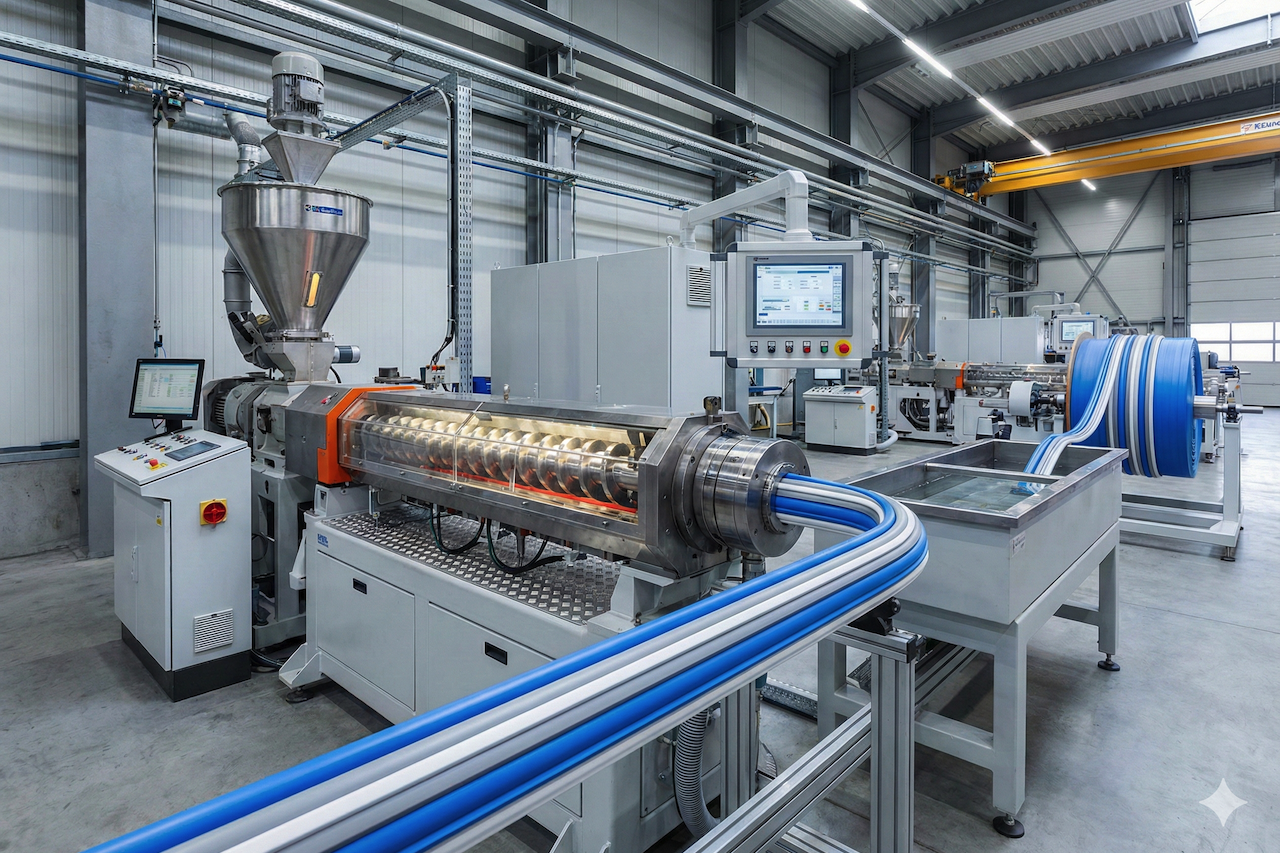
The core of this sophisticated industrial manufacturing process is the extrusion machine, a large device consisting of a heated cylinder and one or more screws that, when rotated, transform the raw material from a solid to a molten state, allowing it to take on the desired shape.
There are different types of extrusion machines, and the choice depends on the application requirements. Here is a brief guide.
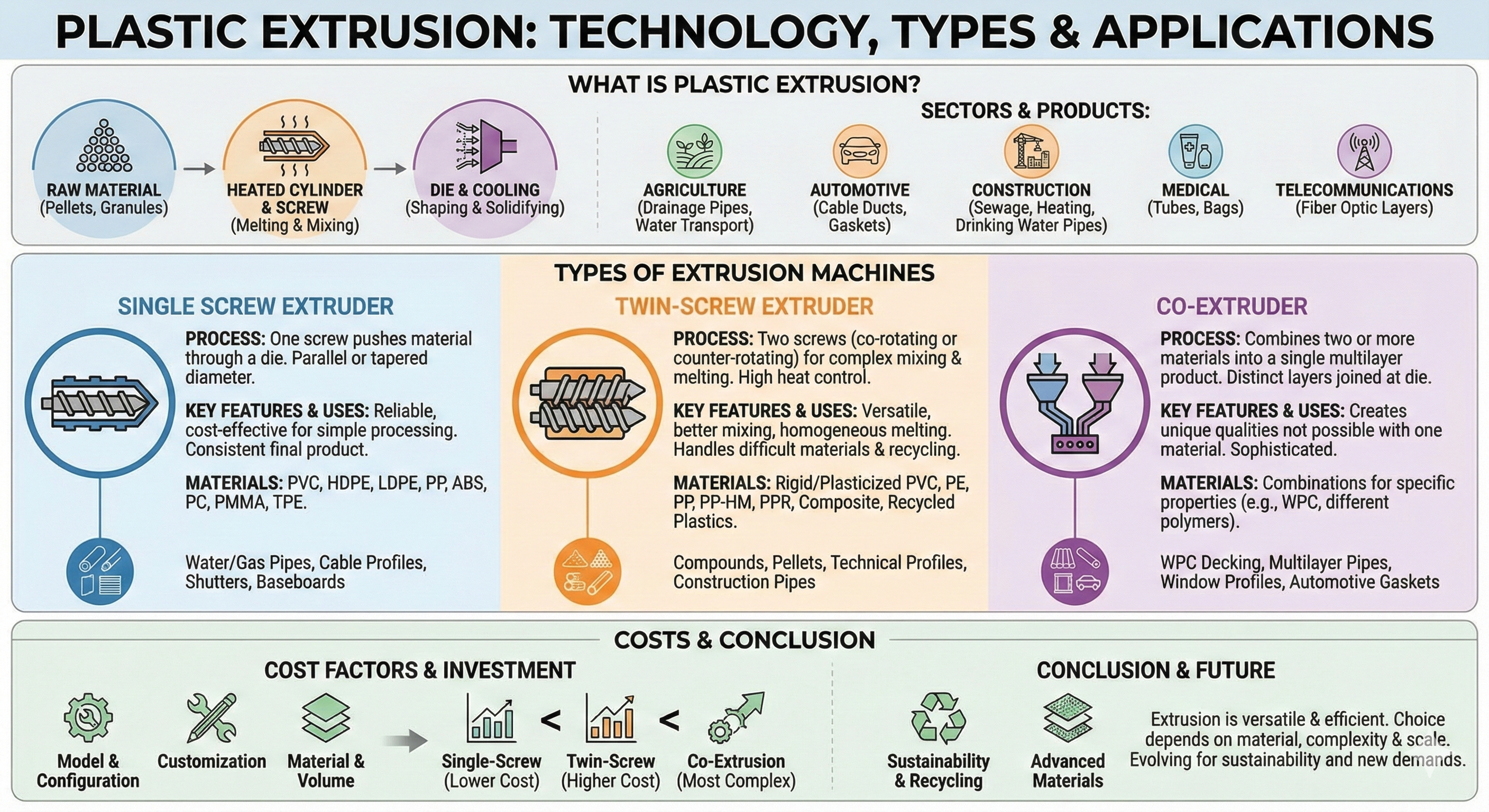
Image generated by Google Gemini.
Single Screw Extruder
The single screw extruder is one of the most widely used solutions in the plastics industry. Inside the heating cylinder, a screw pushes the raw material into a mold, giving it the desired shape.
Single-screw extrusion machinery can have a parallel screw (i.e., with the same diameter along its entire length) or a screw with a diameter that increases proportionally to the length of the screw itself.
Single-screw extruders are the ideal choice for extruding materials that are easy to process and do not require excessive blending.
Among those that can be processed with this type of machine, there are PVC (polyvinyl chloride), HDPE (high-density polyethylene), LDPE (low-density polyethylene), PP (polypropylene), ABS (acrylonitrile butadiene styrene), PC (polycarbonate), PMMA (polymethyl methacrylate), TPE (thermoplastic elastomers), etc. The most common products include water pipes, gas pipes, electrical cables, conduit profiles, roller shutters, baseboards, furniture components, and so on.
Even though they are less versatile than twin-screw extruders, they are reliable machines that guarantee total consistency in the final product.
Twin-Screw Extruder
When materials require more complex processing, the most suitable choice for the extrusion process is a twin-screw extruder, which is inevitably more expensive than a single-screw machine.
Within this category, there are extruders with co-rotating screws and counter-rotating screws. In the first case, the two screws rotate in the same direction, while in the latter, they rotate in opposite directions. The screws may be either interchangeable or non-interchangeable.
A twin-screw extruder offers a wide range of functions in both the raw materials it can process and the operating conditions. They also guarantee extensive mixing capacity, homogeneous melting, and high heat control.
The range of materials that can be processed is particularly wide: PVC, both rigid and plasticized, PE, PP, PP-HM (high modulus polypropylene), PPR (random copolymer polypropylene), HDPE, LDPE, ABS, and composite materials, including post-industrial and post-consumer regranulation materials, i.e., recycled plastics that, instead of being disposed of, are mechanically recycled and transformed back into granules. These extruders are a suitable solution for the production of a wide range of products, including compounds and pellets used in various sectors, technical profiles for the window and door and automotive industries, pipes for the construction industry, and much more.
It is worth briefly mentioning the laboratory-scale twin-screw extruders, which are smaller extruders used for testing and sampling. They can replicate the conditions of an industrial plant exactly, with minimal material, to verify whether a given design is transferable to large-scale production.
Co-Extruder
The co-extruder is a highly sophisticated machine that allows two or more different materials to be combined into a single multilayer product. This process is undoubtedly more complex than that used in other types of extruders.
In co-extrusion, the materials are transported and melted separately, then joined at the die exit in distinct layers. This technique enables the production of products with qualities that would not be achievable with a single material.
Co-extruders are used in the production of WPC (Wood Plastic Composite) profiles for outdoor floors (decking), window and door profiles, multilayer pipes, automotive gaskets, medical components, etc.
The Costs of an Extruder
The costs of extrusion equipment are extremely variable and depend on the model, configuration, and customization. The cost of single-screw machines is usually lower than that of twin-screw extruders for industrial production. Even cheaper than both are laboratory-scale twin-screw extruders, depending on their size and purpose.
The choice of extruder is influenced by several factors that should be carefully examined, given the investment's value. These include the nature of the material to be processed, the required features of the final product, and production volumes.
Conclusion
Plastic extrusion remains one of the most versatile and efficient manufacturing technologies across a wide range of industries. From construction and automotive to medical and telecommunications, its ability to produce continuous, high-quality components makes it a fundamental process in modern industrial production.
Choosing the right extrusion machinery depends on several factors, including material characteristics, product complexity, and production scale. While single-screw extruders offer reliability and cost efficiency, twin-screw and co-extrusion systems provide greater flexibility, advanced mixing capabilities, and the ability to create high-performance multilayer products.
As sustainability, recycling, and advanced materials continue to shape the future of manufacturing, extrusion technology is evolving to meet these demands. For companies planning long-term investments, selecting the appropriate equipment and scalable solutions is essential to ensure efficiency, product quality, and competitiveness in a rapidly changing market.
Featured Image generated by Google Gemini.
Share this post
Leave a comment
All comments are moderated. Spammy and bot submitted comments are deleted. Please submit the comments that are helpful to others, and we'll approve your comments. A comment that includes outbound link will only be approved if the content is relevant to the topic, and has some value to our readers.
Comments (0)
No comment