
Every phone tap leaves a trace. Every delivery route draws a line. Cities breathe through signals, timestamps, and coordinates. What once looked like scattered dots on a map has become a living system that can be read, tested, and improved. This is where mapping precision begins.
Geolocation is no longer just about knowing where something is. It is about understanding why it is there, how it got there, and what should happen next. With intelligent analytics, location data becomes a decision-making tool. Quietly powerful. Often invisible. Very practical.
From Raw Location Data to Meaning
Coordinates alone solve little. Value emerges when data analytics is introduced.
Modern platforms combine GPS signals, Wi-Fi data, sensor input, and IP tracking to create reliable location models. This process is similar to solving a complex mathematical problem with many variables. Instead of handling each variable manually, systems automate the process in much the same way a free math solver processes inputs and produces structured results. Attempting to analyze this volume of data by hand would be extremely difficult and time-consuming.
According to industry reports, over 80% of companies using location data say that analytics significantly improves operational decision-making. This isn't a theory; it's logistics arriving on time. Its services reach the correct address. It risks being spotted early.
Data analytics filter noise. It compares patterns across time. It spots anomalies that the human eye would miss. A map stops being static. It starts asking questions.
IP Tracking and Contextual Location
Not all location data comes from satellites.
IP tracking adds context when precise GPS is unavailable or unnecessary. It helps estimate user location based on network data. For digital platforms, this matters. Content delivery networks rely on it. Cybersecurity teams use it to detect unusual access. Media companies adapt information to regional needs.
Statistics show that roughly 70% of online services use some form of IP-based geolocation to personalize or secure the user experience. When combined with other signals, accuracy increases. Precision improves without invading detail.
Used carefully, IP tracking supports more innovative systems rather than intrusive ones.
Geolocation Tools in Everyday Problem Solving
Geolocation tools are no longer the domain of engineers.
Urban planners use them to reduce traffic congestion. Retailers analyze foot traffic to choose store locations. Emergency services map response times to save minutes. Those minutes matter.
A clear example: cities that adopted real-time geolocation analysis for traffic management reported congestion drops of up to 25% within two years. Less waiting. Lower emissions. Better flow.
Digital problem-solving often starts small. A heat map. A cluster. A repeated delay. Then action follows.
Smart Mapping as a Thinking Process
Intelligent mapping is not just about better visuals.
It is layered insight. Data stacked on data. Movement over time. Behavior across space. With intelligent mapping, questions change. Instead of “Where is the problem?” teams ask, “Why does it keep appearing here?”
Retail chains use intelligent mapping to adjust supply chains. Health researchers track disease spread patterns. Environmental groups monitor deforestation and water usage.
In all cases, the map becomes a shared language. Clear. Visual. Decisive.
Studies indicate that teams using visual geospatial analytics solve location-based problems up to 40% faster than those using tables alone. Seeing patterns accelerates understanding.
Digital Problem Solving Across Industries
Location intelligence travels well.
In logistics, route optimization using live geolocation tools reduces fuel costs by an average of 15%. In agriculture, precision mapping improves crop yields by up to 20% through better irrigation planning. In media and communications, regional insights guide content relevance and distribution timing.
Digital problem solving thrives on feedback loops. Measure. Adjust. Measure again. Location data fits perfectly into this cycle because space rarely lies.
The key is integration. Geolocation data must connect with business data, user behavior, and external signals. Only then does it move from information to solution.
Ethics, Accuracy, and Trust
Precision brings responsibility.
Intelligent analytics must respect privacy. Aggregation matters. Anonymization matters. Transparency matters. Users are more willing to share location data when they understand its purpose and limits.
Surveys show that nearly 60% of users accept location tracking if it clearly improves service quality and data protection is explained. Trust, once lost, is difficult to regain.
Sound systems balance usefulness with restraint. They solve problems without creating new ones.
The Road Ahead: Smarter, Smaller, Faster
Geolocation is becoming lighter and faster.
Edge computing processes location data closer to the source. AI models predict movement rather than record it. Intelligent mapping evolves into scenario testing: What happens if we change this route? This policy? This timing?
As datasets grow, simplicity becomes a strength. Clear visuals. Simple language. Direct outcomes.
Mapping precision is not about complexity for its own sake. It is about clarity under pressure.
Conclusion: When Place Becomes Insight
Geolocation turns space into strategy.
Through data analytics, IP tracking, geolocation tools, and intelligent mapping, location data becomes a problem-solving engine. Quiet. Reliable. Effective.
The future will not ask whether we know where things are. It will ask what we do with that knowledge.
And the most thoughtful answers will come from those who know how to read the map.
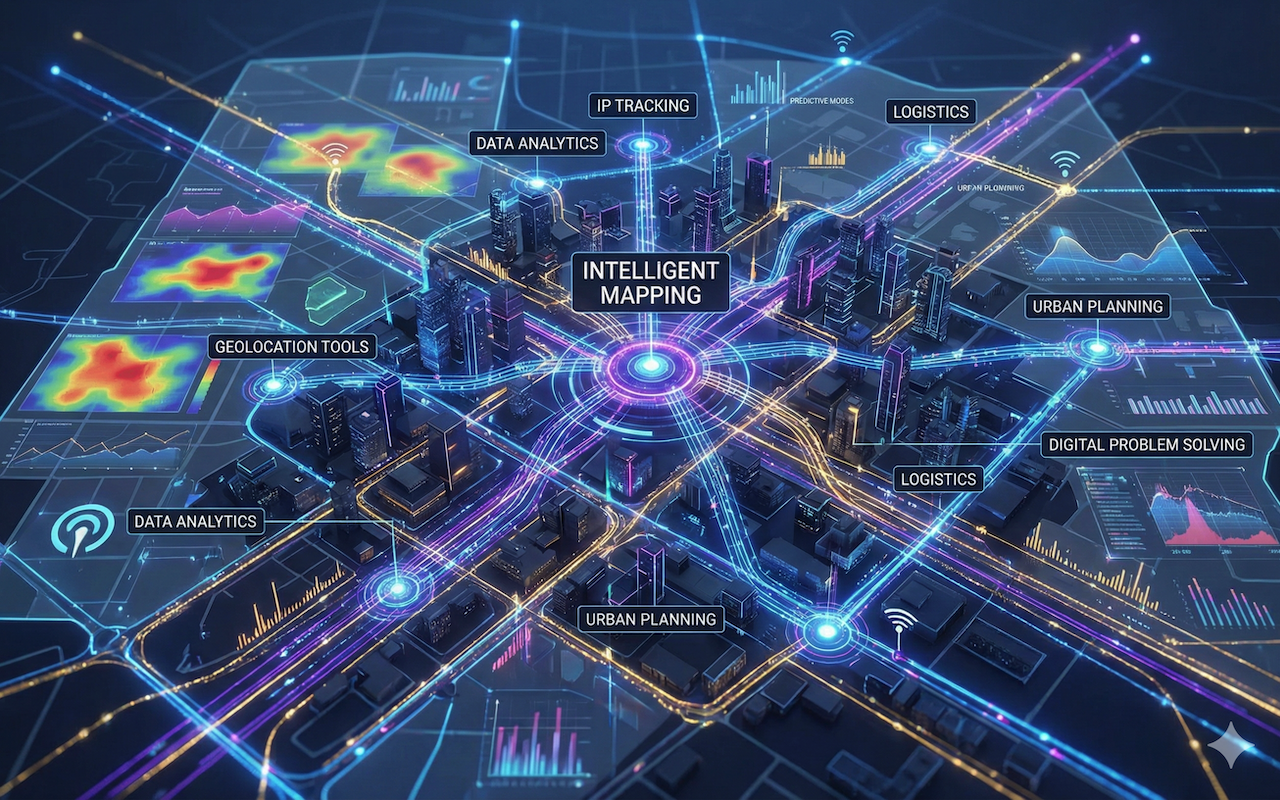
Featured Image generated by Google Gemini.
Share this post
Leave a comment
All comments are moderated. Spammy and bot submitted comments are deleted. Please submit the comments that are helpful to others, and we'll approve your comments. A comment that includes outbound link will only be approved if the content is relevant to the topic, and has some value to our readers.
Comments (0)
No comment