
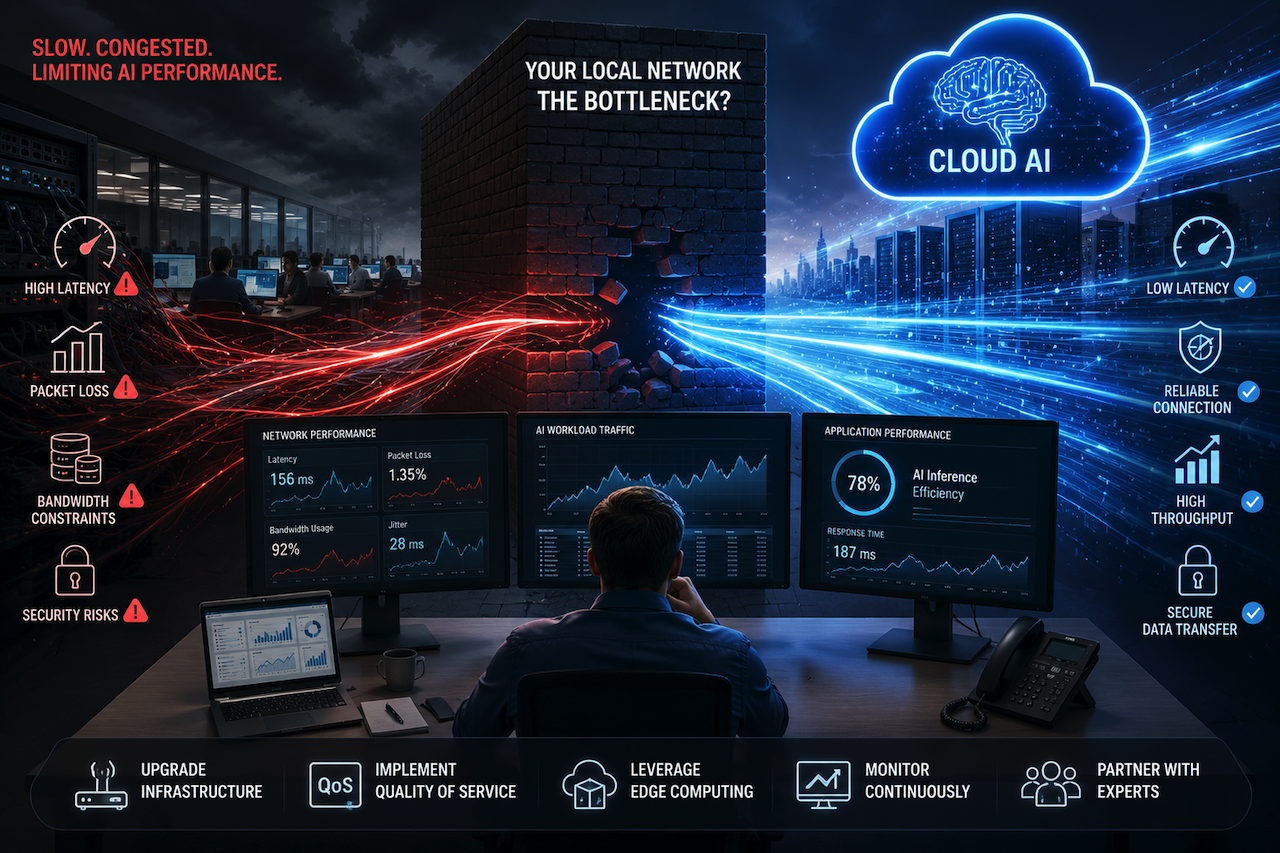
Understanding the Cloud AI Network Challenge
As businesses increasingly adopt cloud-based artificial intelligence (AI) solutions, a critical question arises: Is your local network the limiting factor in maximizing cloud AI performance? Cloud AI promises scalable computing power, advanced analytics, and real-time insights. However, these benefits can be undermined if the local network infrastructure cannot keep pace.
Cloud AI workloads rely heavily on the seamless transfer of data between local devices and cloud servers. Even with powerful AI models hosted remotely, slow or unstable local networks create bottlenecks, leading to latency, reduced throughput, and a degraded user experience. According to a recent report, 60% of organizations identified network performance as a major challenge in their cloud adoption journey. This statistic underscores the widespread nature of network-related issues in cloud AI deployments.
The importance of evaluating and optimizing your local network to fully leverage cloud AI capabilities cannot be overstated. Whether you are a small enterprise or a large corporation, ensuring your network is not the weak link is essential. In fact, another survey found that businesses experiencing network bottlenecks saw up to a 30% decrease in AI application efficiency, highlighting the tangible impact of network performance on AI outcomes.
Many organizations lack the internal resources or expertise to perform comprehensive network assessments for cloud AI environments. Some businesses work with managed IT teams such as Bryley to help evaluate network performance, identify infrastructure bottlenecks, and support optimization strategies tailored to AI-related traffic demands.
Moreover, collaboration between IT and AI teams is vital to align network capabilities with application requirements. Some organizations rely on managed IT teams, such as the IT team at PCS, to support areas like continuous monitoring, proactive troubleshooting, and network optimization for AI-focused environments.
Diagnosing Your Network’s Role in AI Performance
Before assuming the issue lies with cloud AI performance itself, it is crucial to analyze your local network’s performance metrics. Key indicators such as bandwidth utilization, packet loss, jitter, and latency should be monitored under both typical and peak AI workloads.
Identifying whether the network is the bottleneck involves detailed testing and analytics. Tools that simulate AI traffic patterns help reveal weak points in the infrastructure. For instance, measuring round-trip time and jitter during AI inferencing tasks can pinpoint latency spikes that degrade performance. Packet loss statistics reveal whether retransmissions are causing data flow interruptions, which is especially critical for real-time AI applications such as voice assistants or autonomous systems.
Key Network Factors Affecting Cloud AI
Several technical aspects of local networks can directly influence the cloud AI experience:
- Bandwidth Capacity: AI applications often involve large data sets, especially for training or inference tasks. Inadequate bandwidth throttles data throughput, leading to delays. For instance, video analytics AI can consume up to 10 Mbps per camera stream, quickly saturating networks without proper capacity planning. This demand multiplies rapidly in environments with multiple sensors or IoT devices feeding data to the cloud.
- Latency: Real-time AI applications such as voice recognition or autonomous systems require minimal latency. High round-trip times to cloud servers degrade responsiveness and user satisfaction. Latency beyond 100 milliseconds can cause noticeable delays in interactive AI services, reducing their effectiveness.
- Reliability and Packet Loss: Intermittent connectivity or packet drops cause retransmissions and errors, disrupting AI workflows. Even a 1% packet loss rate can severely impact AI data streams, leading to performance degradation and increased error rates.
- Network Segmentation and Security: Efficient segmentation isolates AI traffic from other network loads, preventing congestion. Additionally, secure configurations protect sensitive AI data in transit. With cyberattacks on the rise, protecting AI data from interception and tampering is not only a performance issue but also a necessity for compliance and risk management.
Understanding and addressing these factors is necessary to prevent your local network from becoming the bottleneck that limits the benefits of cloud AI.
Strategies to Optimize Local Networks for Cloud AI
Optimizing your network is not a one-time fix but an ongoing process aligned with evolving AI workloads. Consider adopting the following strategies:
- Upgrade Infrastructure: Assess whether your current hardware, such as switches, routers, and wireless access points, supports high throughput and low latency. Investing in gigabit or multi-gigabit Ethernet and Wi-Fi 6/6E can future-proof your network. Modern hardware handles AI traffic patterns more effectively and reduces bottlenecks caused by outdated equipment.
- Implement Quality of Service (QoS): Prioritize AI-related traffic to reduce latency and avoid congestion caused by other applications. Quality-of-service policies ensure that critical AI data streams receive priority over less time-sensitive traffic, such as bulk file transfers or standard web browsing.
- Leverage Edge Computing: Deploying edge AI nodes can reduce dependency on constant cloud connectivity, offloading critical processing closer to data sources. This approach minimizes latency and bandwidth consumption by processing data locally when possible and sending only summarized or critical information to the cloud.
- Regular Network Audits: Continuous performance monitoring helps detect emerging bottlenecks before they impact AI services. Scheduled audits and real-time analytics enable proactive management rather than reactive troubleshooting.
- Ongoing Network Management: Maintaining visibility into network performance, traffic patterns, and infrastructure utilization can help organizations better support evolving AI application demands over time.
Furthermore, adopting software-defined networking (SDN) can provide dynamic control over network resources, enabling real-time adjustments to accommodate fluctuating AI workloads. SDN enables automation and granular traffic management, which is increasingly critical as AI applications become more complex and distributed.
Measuring Success: The Impact of Network Optimization on Cloud AI
Organizations that invest in network optimization report measurable improvements in cloud AI performance. A study found that optimizing network infrastructure reduced AI application latency by up to 40%, significantly enhancing user experience and operational efficiency.
In addition, improved network reliability translates to higher uptime and fewer disruptions for AI workflows, supporting business continuity. Companies also benefit from better cost control by avoiding overprovisioning and minimizing cloud resource waste from inefficient data transfers. For example, one enterprise reduced data transfer costs by 25% after implementing targeted network improvements aligned with its AI traffic patterns.
Tracking key performance indicators (KPIs) such as latency, throughput, and error rates before and after optimization provides tangible evidence of improvements. Moreover, employee productivity and customer satisfaction often rise as AI-driven applications become more responsive and reliable.
Final Thoughts: Don’t Let Your Network Hold Back Your Cloud AI
As cloud AI becomes integral to business innovation, ignoring the role of your local network can jeopardize your investment. By proactively assessing, upgrading, and managing your network environment, you ensure that cloud AI delivers its full potential.
If your local network may be limiting cloud AI performance, identifying potential bottlenecks and optimizing infrastructure can improve reliability and responsiveness for AI-driven applications. Approaches such as network audits, performance monitoring, and infrastructure optimization help support more consistent AI performance over time.
Remember, the power of AI in the cloud depends not only on algorithms and data centers but equally on the network that connects them. Don’t let your local network hold you back.
Featured Image generated by ChatGPT.
Featured Image generated by ChatGPT.
Share this post
Leave a comment
All comments are moderated. Spammy and bot submitted comments are deleted. Please submit the comments that are helpful to others, and we'll approve your comments. A comment that includes outbound link will only be approved if the content is relevant to the topic, and has some value to our readers.
Comments (0)
No comment