
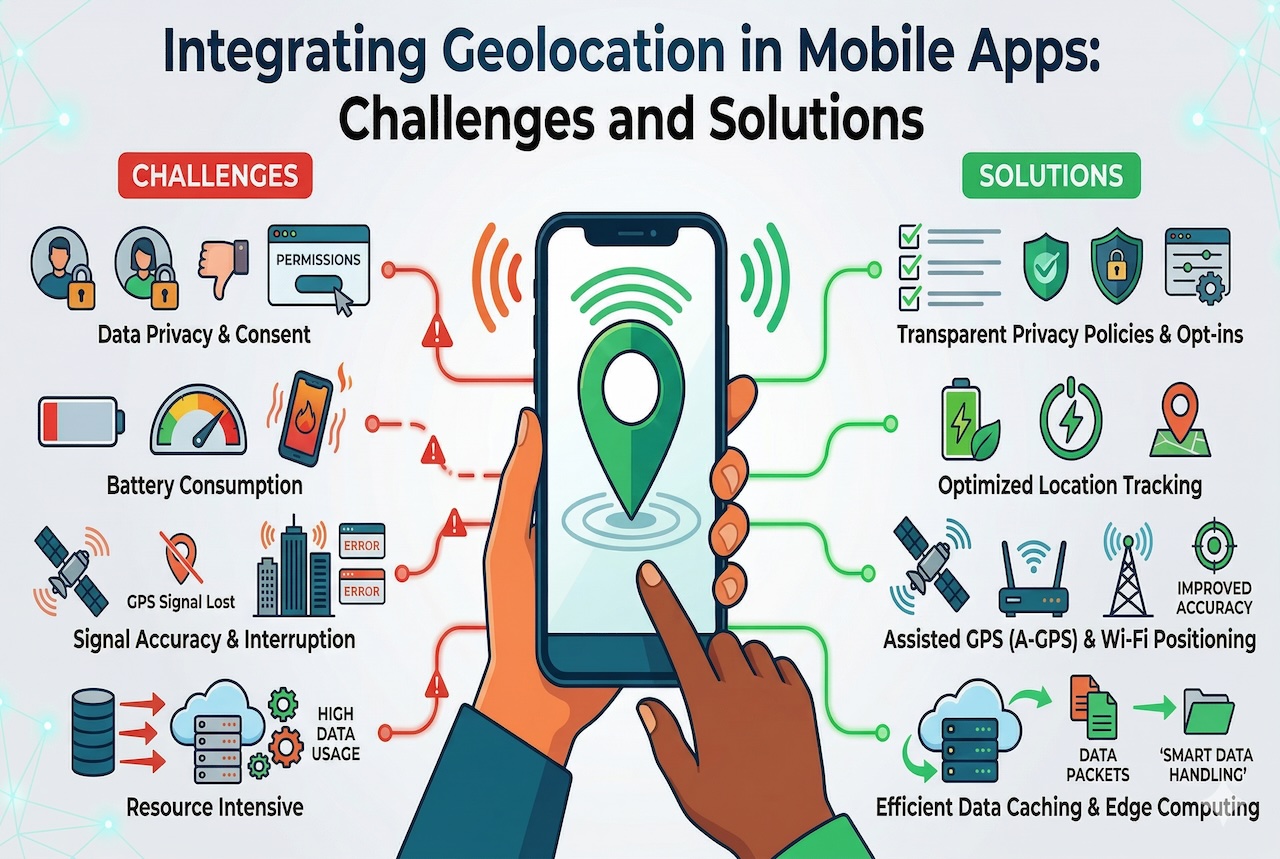
From delivery apps to navigation apps and even e-commerce apps, use geolocation services to provide accurate location and precise data. Nowadays, companies are using geolocation concepts to enhance app performance and user experience.
But integrating apps with geolocation is not straightforward. Mobile app developers often face difficulties in providing accuracy, battery consumption, and user privacy. To create easy-to-use geolocation apps, developers need to upgrade their knowledge regarding these issues and their solutions. In this blog, we will cover these parameters to help developers integrate geolocation into location-based mobile apps.
Understanding How Geolocation Works
Geolocation in an app is the technology that identifies the physical location of a device through a mixture of technologies. GPS (Global Positioning System) is the most common method, using satellites to determine precise outdoor locations. While GPS is highly accurate, it may be less effective indoors and can consume significant battery power.
To supplement this, apps often use Wi-Fi positioning, which estimates location based on nearby networks, and cell tower triangulation, which determines position using signals from multiple cellular towers. These methods provide reasonable accuracy, especially when GPS is unavailable.
Another widely used method is IP address geolocation. This approach identifies a user’s approximate location based on their internet connection. By analyzing the IP address, apps can determine details such as country, region, city, and sometimes the internet service provider. While IP-based geolocation is less precise than GPS, it is useful for web-based applications, location-based content delivery, fraud detection, and personalization without requiring direct access to device sensors.
Key Use Cases of Geolocation in Mobile Applications
Geolocation has transformed mobile apps and user interaction by enabling real-time, context-aware experiences. Location data plays a key role in improving both functionality and engagement, from navigation to personalized marketing. The following are some of the most effective applications developed through custom software development services across different industries.
Navigation and Mapping Apps
Geolocation is what makes the navigation applications direct you to the correct path in real-time, scanning traffic, and showing you the best path. They help individuals to travel where they are required to go at a quick and hassle-free rate.
Taxi-Booking and Delivery Apps
Uber and DoorDash operate on the geolocation principle and serve to match drivers or delivery partners and users at a centralized location. Additionally, geographical information assists in the optimization of dispatch systems, the reduction of waiting time, and the effectiveness of the service.
Health And Fitness Tracking Apps
Application of Geolocation apps such as Strava gives users routes, distances, times, and speed of their exercise. This assists in monitoring the workouts and health goals of people. These applications also contain insights, detailed reports, and route comparison to make sure that the users will be motivated and engaged.
Major Challenges in Integrating Geolocation
Geolocation is good for mobile apps, but developers need to think about a number of things before they use it. The app's bugs could make it run more slowly and harder to use. This is really important for making location-based apps that consumers can trust.
Accuracy and Reliability Limitations
The accuracy of geolocation may be different in the environment. Indoors or within densely populated cities with high-rise buildings, the GPS signal can be very weak or lacking. This is potentially harmful as it causes wrong location information, thus diminishing the user experience and trust towards the application.
Battery Consumption Issues
The battery of a gadget can be very depleted with frequent tracking of location. The user may complain of high battery consumption among applications that require a lot of GPS. A mobile app equipped with a GPS should be power efficient to provide the best user experience.
Data Privacy and Security Concerns
As data privacy becomes more readily recognized, users are doubtful about giving their location. Bad handling of location information is both legally and reputationally risky to businesses. Such a standard as GDPR and policies of the platform make it crucial to treat data both responsibly and publicly.
Network Dependency and Connectivity Issues
Numerous geolocation applications are reliant on the internet. The coverage of the network may slow down or interfere with location updates, particularly in rural locations. This has the ability to impact real-time services like tracking, wayfinding, and updates in the form of delivery.
Platform-Specific Restrictions (iOS vs Android)
Android and iOS have very strict rules in terms of personal location services. For example, Apple Inc. has restricted privacy rules, so you should have a good reason to follow someone's whereabouts. If developers don't follow these standards for their platform, their apps may be rejected, or their features may be limited.
API Integration Complexities
The integration of the geolocation API needs special attention to permissions, error states, and data synchronization. The crashes of the apps or incorrect data can occur because of misconfigurations. The developers must also ensure that the API is being utilized in a proper manner to prevent performance and reliability problems.
Real-Time Data Processing
Apps that demand real-time location updates include taxi booking as well as logistics apps. It could be hard from a technological point of view to handle and sync this data between servers. The speed is essential since the latency is minimal and the accuracy is great, which makes the user experience smooth.
Scalability and Backend Synchronization
With a high number of users, it becomes difficult to handle large amounts of location data. Scalable backend systems should also be developed by developers to support real-time updates without performance problems. Cloud infrastructure and efficient data pipelines are useful in addressing this issue.
Best Practices and Solutions for Effective Integration
Startups follow best practices and strategies to overcome challenges created by geolocation integration. These methods contribute to the accuracy, performance improvement, and trust in the user. Their adoption will enable the massive success of location-based apps.
Hybrid Location Tracking Approach
Developers use a combination of techniques from Wi-Fi, IP Address, Cell Towers, and GPS to enhance accuracy and reliability for users. It is a combination strategy that makes it more effective in various settings. It also assists in the maintenance of continuity in tracking, even in tricky surroundings such as indoors.
Battery Optimization Techniques
Reducing battery consumption can be done by enabling location updating only when absolutely needed, changing the frequency of updates depending on how actively it is being used, and turning on low-power modes when high accuracy is not needed. Such methods assist in ensuring a tradeoff between performance and energy, towards user satisfaction.
Privacy-First Development Strategies
Developers must provide an appropriate argument for why they need location data. They need to collect only the data they need, and employ strong encryption and safe storage. Being open like this builds trust, keeps users coming back, and follows international privacy rules.
Offline Capabilities and Data Caching
Enabling applications to work without internet connectivity can make the user experience much better. The stored location information and cached maps also facilitate a minimal level of functionality even without an internet connection. This feature will help users who often use such apps in low-connectivity regions.
Popular Tools and APIs for Geolocation Integration
To ensure the integration of geolocation, it would be necessary to select the appropriate tools and APIs. These platforms offer developers a scalable and advanced platform with reliable GPS software development. Some of the most popular industry solutions are discussed below.
Google Maps Platform
It is one of the most popular tools and provides opportunities such as maps, routes, geocoding, and real-time traffic information. It is very dependable and well-documented. It also offers the scalability of applications with wide customization and worldwide coverage.
Apple Core Location
Apple Core Location serves the iOS applications in the form of GPS tracking, region tracking, and geofencing services. It is deeply integrated into the Apple ecosystem and ensures great performance and security.
OpenStreetMap
An alternative that is open-source and thus open to customization, OpenStreetMap, enables developers to create low-cost solutions using community-provided map data. It is specifically applicable to those projects that need to be customized but are not very expensive to license.
Conclusion
The use of geolocation in mobile apps creates unlimited opportunities in terms of innovation and user interaction. Location-based features have become the core of the digital world today, whether it is in terms of navigation and delivery services, fitness tracking, or personalized marketing.
Nevertheless, its implementation should be planned and undertaken. The limitations of the accuracy, battery life, privacy issues, and technical complexities should be discussed as the challenges to fight against. Such hurdles can be addressed by businesses using best practices such as hybrid tracking, privacy-first development, and constant optimization.
The future of geolocation in mobile applications is even more promising as technology changes, as 5G, AI, and real-time data processing evolve. A mobile app development company investing in powerful and consumer-friendly geolocation applications will be in a better position to provide smooth and effective online experiences.
Featured Image generated by ChatGPT.
Share this post
Leave a comment
All comments are moderated. Spammy and bot submitted comments are deleted. Please submit the comments that are helpful to others, and we'll approve your comments. A comment that includes outbound link will only be approved if the content is relevant to the topic, and has some value to our readers.
Comments (0)
No comment