
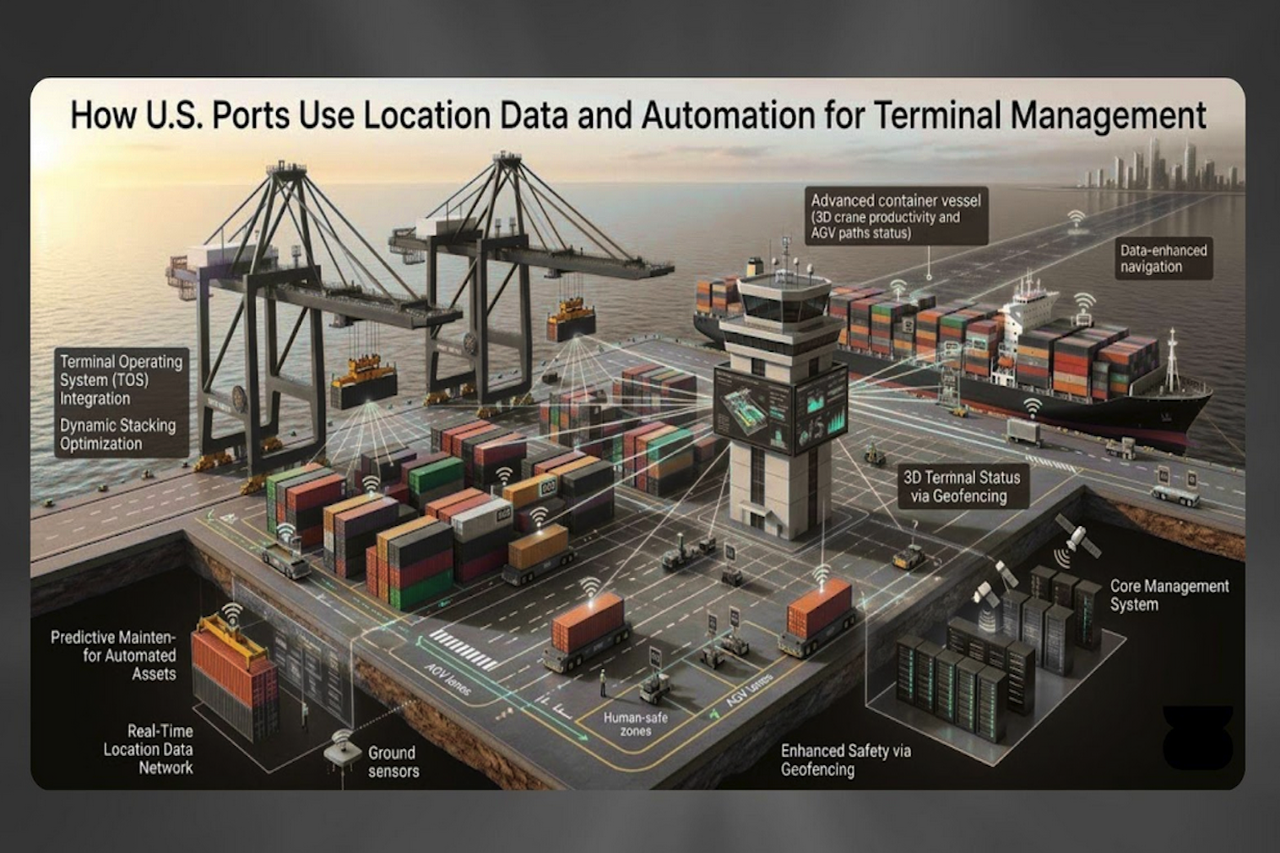
The global smart ports market reached USD 2,746.91 million in 2025 and is on track to reach USD 9,407.33 million by 2035. That is a 13.1% compound annual growth rate through the forecast period.
Why the surge? Because U.S. ports are adopting modern terminal automation solutions, finally retiring manual processes and paper trails. Virginia and Seattle facilities utilize real-time location systems, automated stacking cranes, and predictive analysis to coordinate ship schedules and cargo movement.
This shift matters. The cost of every movement of a container, every yard shuffle, and every gate transaction increases millions of lifts a year. Location data and automation have visible benefits for operators: faster turnaround for the ship, more efficient use of yard space, and fewer misplaced containers.
Here is how leading U.S. ports apply these technologies today.
What Is Location Data in Port Operations
Location data gives port operators the real-time position of every moving part across the terminal. GPS devices, IoT sensors, and GIS mapping track vessels at berth, containers in the yard, and equipment moving between them.
The terminal uses this data to ensure it knows the location of each asset at all times. Geofencing establishes digital boundaries that can trigger a notification whenever trucks move outside them. Asset management systems monitor crane performance and schedule maintenance before a breakdown occurs.
These capabilities feed directly into modern ports and terminals automation solutions, which rely on precise location data to operate effectively. Together, they eliminate paper-based processes and reduce reliance on radio communication, streamlining overall operations.
The result? Fewer people working on equipment, faster ship turnarounds, and an increase in the number of containers moving through the same space.
Key Technologies in U.S. Port Automation
Modern terminals run on a stack of technologies that work together. Here is how each one contributes to port automation solutions.
- Artificial Intelligence: Analyzes ship schedules and yard capacity to determine where to stack containers. Machine learning informs cranes where to stack boxes for easy access. Delays are predicted earlier.
- Cloud Computing: Stores massive port datasets and scales computing power up or down as needed. Operators access real-time yard maps from anywhere.
- Internet of Things: Sensors attach to cranes, trucks, and containers. They continuously broadcast position and equipment health, forming the data backbone for port logistics automation.
- Digital Twin Technology: Builds virtual copies of terminals. Operators test layout changes in software before moving concrete and steel.
- 5G Networks: Carry data between sensors and control rooms without lag. High-speed connectivity lets terminals add more automated equipment without bandwidth constraints.
- Blockchain: Creates tamper-proof records for customs docs and cargo transfers. Every handoff carries a timestamp no one can alter.
Automation at Major U.S. Ports
Port of Los Angeles
The Port of Los Angeles uses AI to cut costs, reduce waste, and drive economic growth. Its two full-time GIS specialists maintain accurate spatial data across a geographically disparate port complex. This work introduces greater efficiencies for multiple stakeholders in a business worth over $300 billion annually.
The Port of Long Beach
Automation and AI in the Port of Los Angeles are altering cargo movement. Automated Guided Vehicles (AGVs) are autonomous trucks that reduce manual labor and enable the port to operate 24/7. Machine learning examines historical and real-time information to forecast which ships are likely to arrive, where traffic may require them to stall, and how to allocate resources more effectively to enable faster ship exits.
Port of Savannah
The Port of Savannah expects to increase its traffic to nearly 9 million container units annually by 2035. GPA employs technology to monitor ship work rates, truck wait times, the proportion of containers moved twice, and container time on trains, all in real time. This data guides process improvements and infrastructure investments to enhance fluid logistics and cargo visibility.
Port Houston
Port Houston is improving its operations by using tools that predict traffic jams, plan with AI, and monitor containers in real time with RFID. A freight company with a cloud-based transport system reported experiencing 20 percent fewer route issues and 15 percent more on-time shipments. A chemical operator deployed blockchain technology to enable full chain-of-custody traceability.
Benefits of Location Data and Automation
Ports that deploy location data and automation gain measurable advantages across every operational layer.
Infrastructure and Planning
GIS technology transforms the construction and expansion of ports. Planners map roads, water lines, and property boundaries correctly. Environmental management becomes proactive rather than reactive. Weather monitoring transmits current weather data to assist with port operations.
Operational Efficiency
Automated port operations run 24/7 without fatigue. Cranes and vehicles keep moving while human operators sleep. The result is faster vessel turnaround, reduced congestion, and higher throughput through the same physical footprint.
Location data enables intermodal management that actually works. Trucks, trains, and ships coordinate arrivals instead of waiting on one another. RFID and geofencing track containers from gate to gate with no manual checks. A modern port terminal management system ties all these moving pieces into one view.
Safety and Security
Robotic systems replace human operators in dangerous environments. Automated container terminal designs keep workers clear of heavy lifts. Security operations gain real-time awareness of who, what, and where they move. Emergency response teams access accurate facility maps instantly.
Cost and Performance
The initial investment is high, but long-term savings follow. Terminal automation solutions lower personnel needs and optimize energy consumption. Real-time data from AI tools and sensors tracks every bottleneck. Managers make decisions based on facts, not guesses.
Sustainability Gains
Automated electric engines prevent diesel pollution at the dock. Enhanced traffic management reduces the number of idle trucks and fuel consumption. Ships spend less time in the dockyards. Their auxiliary engines operate less.
Supply Chain Impact
Faster handling means ships leave sooner. Reduced vessel dwell times ripple through the entire global supply chain. Cargo reaches warehouses and stores on schedule. Importers and exporters gain the reliability they cannot get from manual terminals.
Future Outlook for the U.S. Smart Port Market
The U.S. smart port market enters a period of rapid expansion. Ports are working with the IoT sensors, AI, and blockchain. These technologies allow them to monitor cargo in real time and correct issues before they occur, which is impossible with the old manual methodology.
Trade volumes keep climbing. Supply chains demand faster turnaround. Environmental regulations push diesel equipment toward retirement. Ports respond by investing in terminal automation solutions that handle more containers with lower emissions.
Automated port operations will expand beyond the largest gateways. Mid-sized terminals will adopt port terminal management systems as costs decline and proven results accumulate. Automated container terminal designs will become standard for new construction and major upgrades.
The market offers clear opportunities. Ports that digitize now gain efficiency advantages. Those who wait face higher costs and lost cargo to competitors. Innovation and collaboration will shape the next decade of U.S. port operations.
Conclusion
U.S. ports stand at a turning point. Paper records and manual work cannot manage the volume of cargo and customer demands. The ports in this article demonstrate that the use of location data and automation offers real advantages: ships move faster, more cargo can be processed, and everything can be monitored.
Terminal operators face a choice. Invest in smart port automation now or watch competitors capture market share. The technology exists. The business case holds. The only question is who moves first.
Share this post
Leave a comment
All comments are moderated. Spammy and bot submitted comments are deleted. Please submit the comments that are helpful to others, and we'll approve your comments. A comment that includes outbound link will only be approved if the content is relevant to the topic, and has some value to our readers.
Comments (0)
No comment