
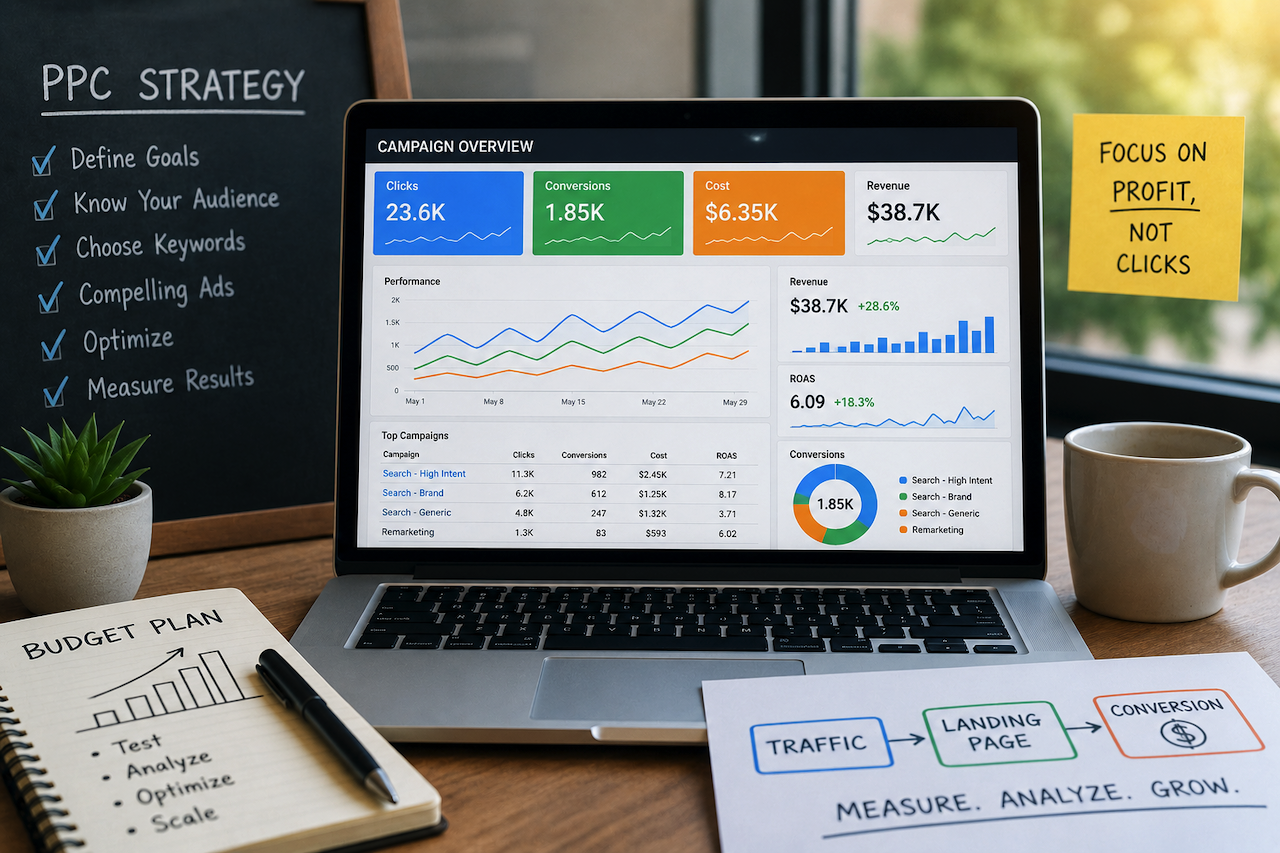
Most PPC accounts don’t fail because “Google Ads is too expensive” or “our industry is too competitive.” They fail because they’re built to chase clicks instead of revenue. The good news: that’s fixable.
If your current campaigns feel like a black hole for ad spend, the goal isn’t just to improve performance. It’s to systematically rebuild the account so every decision is tied back to profit, not vanity metrics. That shift, from cost center to growth engine, starts with how you think about PPC in the first place.
Rather than treating paid traffic as a tap you turn on and off, think of it as an investment. You invest $1 and expect a measurable return over a defined period. That framing changes how campaigns are structured, measured, and optimized. The focus shifts from generating clicks to generating profitable outcomes, which is the foundation of ROI-driven PPC campaigns.
Let’s walk through how to turn underperforming PPC into something that reliably produces revenue instead of headaches.
Diagnose the Real Problem, Not the Symptom
Underperformance is usually a symptom, not a cause. Before touching bids or writing new ads, you need a clear diagnosis.
Start with the Money, Not the Clicks
Look past CPC and CTR. The core questions are:
- How much revenue is the account generating per month?
- What’s the blended ROAS (or cost per acquisition) across all campaigns?
- How does that compare to your allowable CAC or target profit margin?
For e-commerce, you’ll typically look at ROAS and contribution margin. For lead gen or B2B, you’ll need to stitch ad data to your CRM so you can see:
- Lead to opportunity conversion rate
- Close rate by campaign or keyword
- Revenue per closed deal, again by source
Often, “PPC isn’t working” really means “we’re not tracking the right things.” If you can’t see revenue and profit by campaign, you’re flying blind. Fixing conversion tracking, offline imports, and attribution is often the first meaningful optimization.
Only when you understand unit economics—how much you can afford to pay for a click, a lead, and a customer—does optimization become rational instead of reactive.
Rebuild the Account Around Intent
Once the numbers are clear, the next step is structural. Many struggling accounts are a tangle of broad keywords, overlapping campaigns, and generic ads. They’re optimized for volume, not intent.
Segment by Buying Stage
Start by rebuilding your campaigns around user intent and the buying stage:
- High-intent / bottom-of-funnel: Keywords that clearly signal purchase intent (“buy”, “pricing”, “near me”, product names, competitor alternatives). These should usually get the lion’s share of the budget.
- Mid-intent / problem-aware: Searches that show someone is researching options or solutions, but not yet ready to buy. You’ll expect lower immediate ROAS here, but they can work well if your follow-up (email, remarketing, sales) is strong.
- Brand and competitors: Your own brand terms and key competitor terms typically behave very differently from generic search and should be separated so you don’t mask performance.
Each intent bucket warrants its own campaigns, tailored messaging, and, crucially, separate budgets. That lets you protect what’s profitable while experimenting more cautiously in upper-funnel areas.
Keyword and Query Hygiene
Underperforming accounts nearly always have a long tail of waste hiding in the search terms report. Tidying this up can quickly turn red ink into black.
Focus on:
- Cutting queries that never convert or consistently convert at an unprofitable cost.
- Tightening match types where necessary, especially around high-spend themes.
- Building a thoughtful negative keyword strategy to prevent irrelevant traffic from sneaking back in.
Think of this as spring-cleaning for your PPC. You’re not just saving money; you’re allowing the algorithm to focus on the kinds of searches that actually lead to revenue.
Fix the Ad-to-Landing-Page Journey
Even the best-intent targeting fails if the click lands on something that doesn’t sell. Many brands obsess over ad copy while sending traffic to bloated, slow, or generic pages.
The litmus test is simple: if you read the search query, the ad, and the landing page in sequence, does it feel like a coherent conversation or three unrelated messages?
A useful way to think about your landing experience is to align four elements:
- The promise made in the ad (offer, benefit, or outcome)
- The proof that the promise is credible (social proof, data, demonstrations)
- The path to taking action (clear, low-friction next steps)
- The pace of the page (speed, clarity, and cognitive load)
Even modest lifts in conversion rate radically change the economics of PPC. Doubling your conversion rate is equivalent to halving your cost per acquisition, without touching bids or budgets. That’s why high-performing advertisers treat landing pages as a core part of PPC, not an afterthought for “the web team.”
Turn Data Into Daily Decisions
Once the foundation is right—tracking, structure, messaging—the engine is built. Turning it into a revenue machine is about how you operate it day-to-day.
Set Up a Simple Testing Rhythm
Rescue projects often fail because they try to optimize everything at once. You’ll move faster by creating a small, disciplined testing calendar:
- Define a primary metric for each campaign (e.g., qualified leads, revenue, ROAS).
- Test one major variable at a time: ad angle, audience, landing page, or bidding strategy.
- Give tests enough data to be meaningful; ending experiments after a few dozen clicks is just guessing with extra steps.
Carve out a small percentage of spend for controlled experiments while keeping the majority on proven winners. Over time, today’s experiments become tomorrow’s new baseline.
Use Automation, But Don’t Abdicate Control
Smart Bidding, broad match, and automated creative can be powerful, once your account is clean and well-structured. In a messy, underperforming setup, automation scales the chaos.
Switch to automated bidding only when:
- Conversion tracking is accurate and stable.
- You’ve removed the most obvious wasted spend.
- You have clear targets (tCPA, tROAS) grounded in your economics, not hopes.
Think of automation as a high-speed cruise control, not a self-driving car. You’re still responsible for telling it where to go and making sure the road ahead is clear.
Know When PPC Isn’t the Real Problem
Sometimes, the hard truth is that the account is doing its job: it’s revealing underlying business issues. If your product doesn’t resonate, your pricing is out of step with the market, or your sales process is slow and leaky, no amount of PPC finesse will fabricate sustainable ROI.
This is especially common in B2B and high-ticket services, where sales cycles are long and multiple stakeholders are involved. In those cases, success often comes from aligning PPC with broader go-to-market work: sharpening positioning, tightening sales follow-up, and measuring value over the full customer lifetime, not just the first sale.
Bringing It All Together
Turning underperforming PPC into a revenue engine isn’t about a single hack. It’s about stacking several disciplines:
- Clear economics and tracking
- Intent-led structure and keyword hygiene
- Strong ad-to-landing-page alignment
- A deliberate, ongoing testing cadence
- Intelligent use of automation
Do those consistently, and PPC stops being an anxious line item on the budget and starts behaving like what it should have been all along: a controllable, measurable driver of growth.
Featured Image generated by ChatGPT.
Share this post
Leave a comment
All comments are moderated. Spammy and bot submitted comments are deleted. Please submit the comments that are helpful to others, and we'll approve your comments. A comment that includes outbound link will only be approved if the content is relevant to the topic, and has some value to our readers.
Comments (0)
No comment