
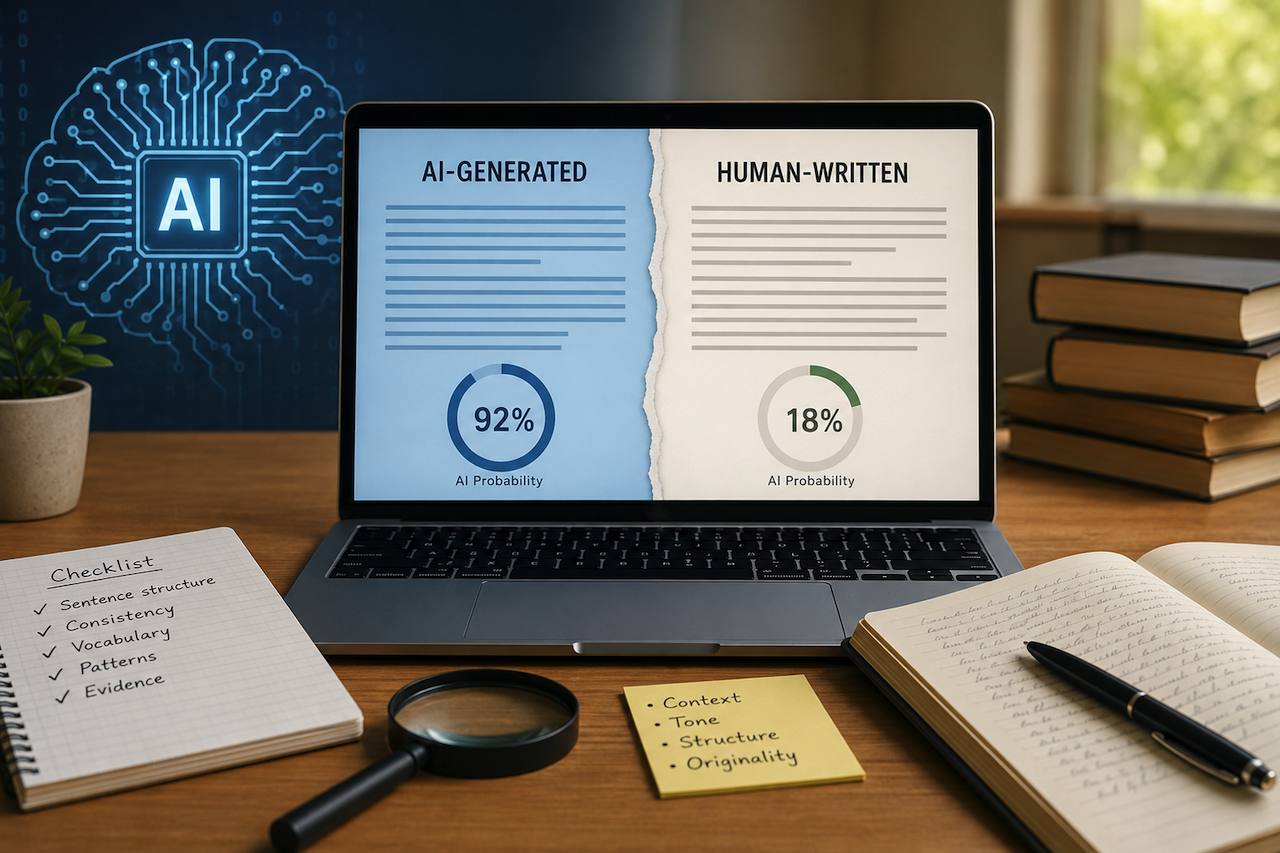
AI writing tools are now widely used by students, professionals, and content creators. As a result, the ability to reliably detect AI-generated text has become genuinely important – for educators reviewing submissions, editors assessing content quality, and researchers studying how AI is changing written communication. The problem is that not all detection methods work equally well, and some commonly recommended approaches are significantly less reliable than they're assumed to be.
This guide covers what actually works when checking whether an essay is AI-generated – the tools, the methods, the limitations, and the technical reasons behind it.
Why AI Detection Is Technically Difficult
Before getting into specific tools and methods, it helps to understand why this problem is hard.
Large language models produce text by predicting the most statistically probable next token given the preceding context. The result is text that is grammatically correct, stylistically consistent, and coherent but statistically different from human writing in measurable ways. Human writers make less predictable word choices, vary their sentence length more dramatically, and produce structural patterns that reflect individual cognitive habits rather than statistical optimization.
AI detection tools look for these statistical patterns. But the difference is getting smaller. Newer AI models write in a more natural and varied way, humanizer tools are built to dodge detection, and AI writing is starting to look more and more like real human writing with every new model.
This means detection is a probabilistic judgment, not a binary determination. A detector that returns a "95% AI" score is not saying with 95% certainty that the text is AI-generated. It's saying the text has statistical properties that are 95% consistent with AI-generated text in its training data. That distinction matters enormously in any context where consequences follow from the determination.
Method 1: Dedicated AI Detection Tools
If in need of the most direct approach, here’s one: you run the text through a purpose-built AI detection platform and get results in 1, 2, 3. Some options are highly popular at the moment. They differ meaningfully in how they work and how reliable they are.
- GPTZero: One of the first widely used AI detectors and still among the most transparent about its methodology. It measures perplexity and burstiness at the sentence and document levels and provides both an overall score and sentence-level highlighting showing which passages triggered detection. Independent testing suggests GPTZero achieves roughly 84% accuracy on clearly AI-generated GPT-4 text, with false positive rates around 9–12% on human-written content.
- Originality.ai: Commonly used by publishers and SEO professionals, though also useful in academic contexts. It combines AI detection with plagiarism analysis and provides sentence-level explanations alongside overall scores. Independent testing by Content at Scale in 2023 reported approximately 94% detection accuracy on AI-generated content with lower false positive rates than GPTZero on the same dataset.
- Turnitin AI Detection: Widely used in educational institutions because it integrates directly into existing academic submission workflows. Turnitin reports internal testing accuracy of 98% with a 1% false-positive rate, though independent studies have suggested higher false-positive rates ranging from 4–9% depending on writing characteristics.
- Copyleaks: Combines AI detection with traditional plagiarism checking and supports multiple languages, making it particularly useful in international academic and publishing environments.
- Winston AI: Designed primarily for educators and publishers. It includes confidence scoring and OCR functionality, allowing users to analyze scanned documents or handwritten-then-typed submissions.
Method 2: Using Multiple Tools and Comparing Results
There are no AI detection instruments that you can trust fully, whatever the result you get. You should run the text through multiple tools and look for agreement across results.
If, for example, several instruments show the same result, chances are you can trust this result. If the results are markedly different (for instance, one tool flags heavily while another returns a low AI probability), the text has mixed statistical properties that warrant closer human review rather than an automated determination.
A practical multi-tool workflow:
- Run the text through GPTZero for sentence-level highlighting
- Run through Originality.ai for a second overall score
- Note which specific passages both tools flag
- Review flagged passages manually for the specific patterns described below
Method 3: Manual Pattern Recognition
Skilled readers know very well how to detect a piece generated by a machine. They do it through pattern recognition that detectors sometimes miss – particularly in shorter texts where statistical analysis is less reliable.
- Uniform sentence complexity: Read through the essay and pay attention to sentence length variation. AI-generated text tends to maintain moderate complexity throughout, rarely very short and rarely very long. Human writing alternates more dramatically. A paragraph where every sentence runs 18–25 words is a signal worth noting.
- Transition phrase patterns: AI models default to specific transition patterns such as "Furthermore," "Moreover," "In addition," "It is worth noting that," and "This highlights the importance of." These phrases are not exclusive to AI writing, but unusually frequent repetition can be a meaningful signal.
- Generic claim construction: AI text tends to make broad, safe, consensus-aligned claims rather than specific, positioned arguments. Sentences like "This is a complex issue with many perspectives" or "Experts generally agree that X is important" are statistically common in AI output because they reflect averaged training data rather than a distinct human viewpoint.
- Absence of specific detail: Human writers often draw on personal experience, named examples, specific readings, and accumulated disciplinary knowledge. AI text frequently gestures toward specificity using phrases like "studies show" or "research suggests" without naming the actual source or finding.
- Hedging in the wrong places: AI models hedge claims at different rates and in different contexts than human writers. Human hedging usually appears where genuine uncertainty exists, while AI hedging often appears uniformly throughout the text as a stylistic default.
Method 4: Comparing Against Known Writing Samples
In academic contexts where a student's previous work is available, direct comparison is one of the most reliable detection methods available and one that no automated tool can replicate.
Look for:
- Vocabulary shift: Does the submitted essay use vocabulary and phrasing that are markedly different from the student's established writing style? A sudden shift toward more sophisticated or more generic vocabulary than previous work can be a meaningful signal.
- Argument structure: Individual writers develop characteristic ways of structuring arguments, including how they introduce counterarguments, use evidence, and construct conclusions. A significant structural departure from established patterns warrants attention.
- Disciplinary knowledge application: Does the essay apply course-specific concepts in the same way the student has demonstrated understanding in previous work? AI-generated essays often apply concepts correctly at a surface level but miss the specific nuances, debates, and applications covered in a particular course.
This method requires more time and human judgment than automated tools, but it is significantly less susceptible to false positives and catches humanized AI text that automated detectors miss.
The Reliability Problem: What the Research Shows
The most important thing to understand about AI detection tools is their false-positive rates – the rate at which they incorrectly flag human-written text as AI-generated.
A 2023 study by researchers at the University of Maryland tested seven leading AI detection tools on a dataset of human-written essays and found false-positive rates ranging from 2% to 17%, depending on the tool and text characteristics. The highest false positive rates occurred with:
- Text written by non-native English speakers
- Formal academic writing in specialized disciplines
- Text that had been heavily edited or revised
- Short texts under 250 words
A Stanford study that same year found that essays written by non-native English speakers were flagged as AI-generated at rates up to four times higher than those for essays written by native speakers, even when both were entirely human-authored. This finding has significant equity implications for any institution using AI detection as an enforcement mechanism.
The practical implication: a high AI detection score is a reason for closer human review, not a determination of AI authorship on its own. The technical limitations of current detection tools are significant enough that consequential decisions, including academic misconduct findings, content rejection, or employment decisions, should not be made based solely on automated detection output.
What to Do With Detection Results
Whether you're an educator, editor, or content reviewer, a structured response to detection results produces better outcomes than treating scores as binary verdicts.
- High detection score (80%+ across multiple tools): Warrants human review of the flagged passages. Look for the manual patterns described above. If available, compare against known writing samples. Consider requesting a conversation with the author about their writing process and the specific content of the work.
- Moderate detection score (40–80%) or conflicting results across tools: The text has mixed statistical properties. This is common in human-edited AI drafts, AI-assisted writing in which significant human revision occurred, or human writing with characteristics that overlap with AI patterns, such as formal register or second-language writing. Human review is warranted; automated determination is not.
- Low detection score (under 40%): The text reads as human by statistical measures. Note that this does not guarantee human authorship. It means the text does not display the statistical patterns current detectors are trained to identify. Heavily humanized AI text, AI text that has been substantially rewritten by hand, or AI text from newer models may still score low.
AI Checker Options
For those needing detection capability without a subscription, several tools offer meaningful free tiers:
- GPTZero: The free tier allows document uploads up to a certain word count with full sentence-level analysis. Sufficient for most individual document checks.
- Copyleaks: Offers a limited number of free scans per month with both AI and plagiarism detection.
- ZeroGPT: Fully free with no account required, useful for quick checks, though accuracy is generally lower than premium tools.
- Writer.com AI Detector: Free with no account required and returns a simple percentage score. Useful as a quick first-pass review tool.
For serious or high-stakes detection work, an AI checker with multi-document analysis, detailed reporting, and regularly updated detection models generally provides more reliable results. Free tools remain useful for quick checks, but they are usually insufficient for systematic review of large volumes of content.
Conclusion
Checking whether an essay is AI-generated is not a solved problem. The best available tools are useful and improving, but they are probabilistic tools operating in a rapidly evolving technical landscape. Their false positive rates are significant enough to warrant caution in any consequential application.
What actually works is a layered approach: multiple detection tools used together, manual pattern recognition applied to flagged passages, and (where possible) comparison against known writing samples. No single method is sufficient on its own. Together, they produce a more reliable picture than any automated tool alone can provide.
The underlying technical reality is that as AI writing models improve and humanization tools become more sophisticated, the statistical gap between AI and human writing will continue to narrow. Detection will remain possible, but it will require more sophisticated methods and more careful human judgment than a single score from a single tool can deliver.
Featured Image generated by ChatGPT.
Share this post
Leave a comment
All comments are moderated. Spammy and bot submitted comments are deleted. Please submit the comments that are helpful to others, and we'll approve your comments. A comment that includes outbound link will only be approved if the content is relevant to the topic, and has some value to our readers.
Comments (0)
No comment