
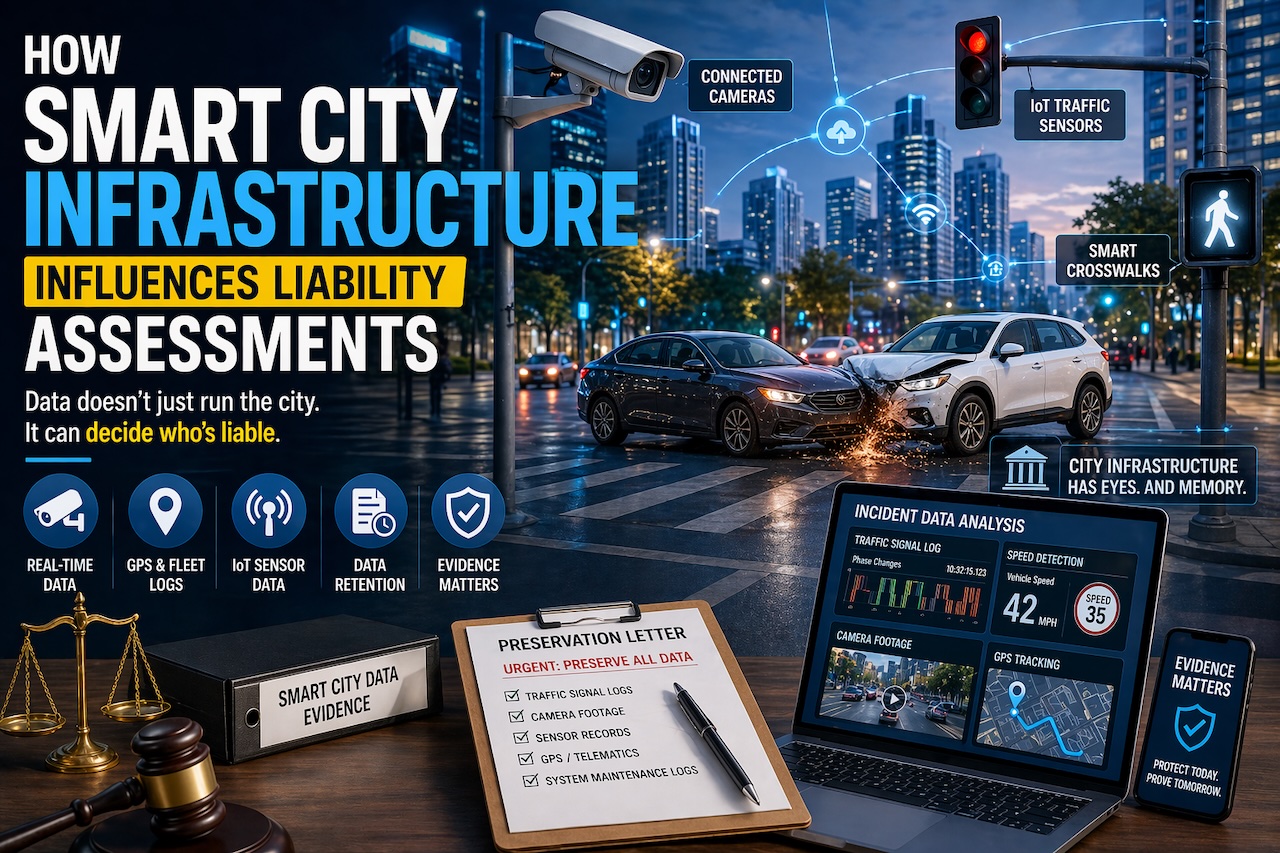
Cities are getting smarter, faster than most people realize. Traffic sensors, connected cameras, IoT crosswalks — all quietly logging data around the clock. When accidents happen inside these environments, that data doesn't just sit there. It gets subpoenaed. And it's changing how liability is established, challenged, and sometimes completely rewritten.
When the City Itself Becomes a Witness
Take a basic intersection accident. That corner might have speed sensors, a municipal camera tied to an AI system, and a traffic signal that logged every phase change to the millisecond.
That data doesn’t disappear on its own, but it can be purged. Most municipalities operate on tight retention windows for raw footage, and once that window closes, critical evidence may be lost permanently. In places like Palm Springs, legal teams handling urban accident claims have adapted to this reality. A local injury lawyer may now send preservation letters to city infrastructure departments within hours of an incident rather than days. This proactive approach is also becoming more common in larger metros such as Los Angeles, Phoenix, and other cities operating networked traffic management systems.
What kind of data are we actually talking about?
GPS Logs, IoT Sensors, and the Data Layer Nobody Talks About Modern smart city infrastructure runs on layers. There's the visible layer — cameras, digital signage, signal poles. Then there's the invisible one: a constant data stream flowing between sensors, city servers, and third-party platforms.
GPS logs from connected fleet vehicles are among the most powerful pieces of evidence in this space. When a rideshare driver, delivery vehicle, or city-operated bus is involved in a collision, the GPS metadata tells a complete story. Not just where the vehicle was, but speed, braking, engine cutoff, route deviation. That's a timestamped record — not conjecture.
IoT devices add another dimension. Smart crosswalks in various cities log pedestrian activation requests, wait times, and signal states. A crosswalk sensor that recorded an active "walk" signal at the exact moment a vehicle ran a red light? That corroborates eyewitness accounts or directly contradicts them. Speed monitoring cameras deployed across school zones capture plate reads, timestamps, speed readings. All of it tied to a specific vehicle at a specific moment.
Tesla, Waymo, and the Autopilot Problem
Tesla's Autopilot has faced multiple federal investigations after fatal crashes. The 2018 Mountain View case, where a Model X on Autopilot struck a highway barrier, was a turning point. The NTSB skipped the witnesses entirely and went straight to the vehicle's onboard logs. It pulled the vehicle's own onboard logs: what the system was doing, second by second, right before impact.
Waymo ran into similar territory in San Francisco. When one of its robotaxis was involved in a collision, investigators had both city traffic camera feeds and Waymo's internal LiDAR data. Two independent sources, same event. That kind of overlap leaves very little room for competing narratives.
Metadata as Evidence: What It Actually Proves
Metadata sounds abstract. It isn't. It's just context, and context is what liability cases are actually fought over.
Two drivers, one intersection, both claiming green. A decade ago, deadlock. Now there's a signal log, camera timestamps, speed readings. The room to maneuver gets very small.
One caveat worth keeping in mind: a GPS log places a vehicle somewhere — it doesn't say who was behind the wheel. A speed reading captures a number, not an intention. Digital evidence has real weight, but courts still need experts who can explain where the data ends and interpretation begins.
When Smart Infrastructure Fails — and Who Pays
Here's the angle that gets overlooked: liability doesn't only flow from the people involved in an accident. Sometimes, it flows from the infrastructure itself.
If a city's smart traffic system malfunctioned (displaying conflicting signals, failing to trigger a pedestrian alert, logging corrupted data that delayed emergency response) the municipality may bear partial or full responsibility. Municipal liability cases are complex. Sovereign immunity doctrines vary significantly by state, and proving negligence in maintaining smart infrastructure requires a very different evidentiary approach than a standard vehicle collision.
The core question is always the same: did someone know the system was broken and do nothing? Maintenance logs and service tickets can answer that. When a private vendor like Cisco or Siemens built the infrastructure, there are suddenly two potential defendants. Sorting out who owns the liability often takes longer than the case itself.
Data Privacy and the Evidentiary Catch
None of this is frictionless. The same data that helps reconstruct an accident can raise serious privacy concerns.
Many smart city sensors collect passively and continuously — not just during an incident, but constantly. Facial recognition systems, license plate readers, and mobility tracking platforms have all faced legal challenges over retention periods, access rights, and disclosure conditions in civil litigation.
Defendants have, in some instances, challenged subpoenas for smart city data by arguing that disclosure would violate the privacy of third parties captured incidentally. Courts are still working through the balance. The general tendency, though, is that when data is directly relevant to a specific incident, courts allow its production with appropriate redactions. The challenge for legal teams is making that argument narrowly and precisely enough to survive a privacy-based objection.
The Infrastructure Is Recording. The Question Is Who Retrieves It.
Smart city technology wasn't designed for litigation. It was built for traffic optimization and public safety management. But the data it generates is extraordinarily precise, and precision is what liability law runs on.
Legal teams that understand the technical architecture of city systems can request the right data from the right departments before it disappears. That includes traffic signal controller logs, municipal camera footage, speed detection records, and vehicle telematics if a connected car was involved. Each comes from a different source, on a different retention schedule, in a different format.
The cities are recording. Whether anyone retrieves the right records is increasingly the variable that decides cases.
Featured Image generated by ChatGPT.
Share this post
Leave a comment
All comments are moderated. Spammy and bot submitted comments are deleted. Please submit the comments that are helpful to others, and we'll approve your comments. A comment that includes outbound link will only be approved if the content is relevant to the topic, and has some value to our readers.
Comments (0)
No comment