
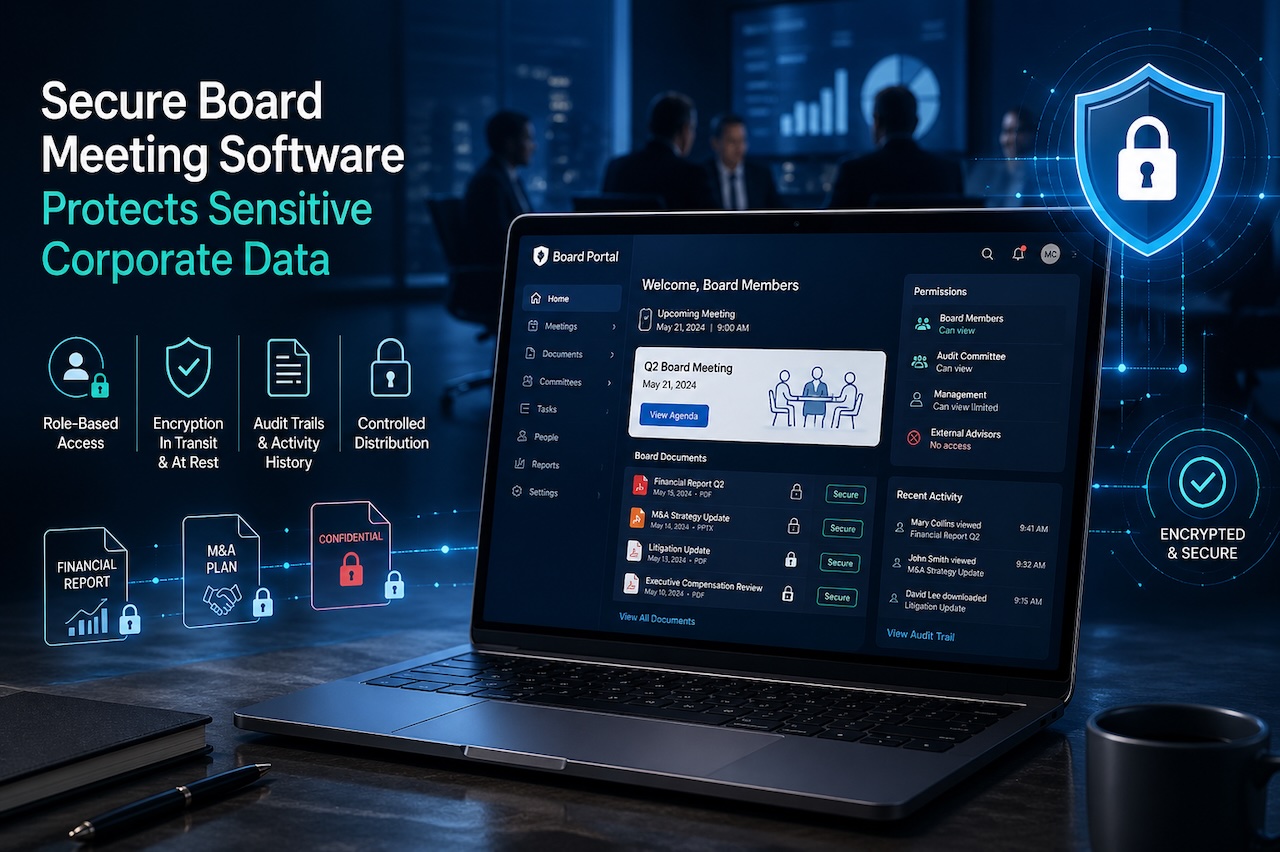
Board materials contain some of the most sensitive information inside a company. Financial reports, acquisition plans, litigation updates, executive evaluations, governance records, and strategic decisions all move through board workflows. When those materials are handled via email attachments, scattered drives, or poor file-sharing practices, the risk is operational.
A stronger system starts when a board portal solution replaces fragmented document handling with controlled access, structured distribution, and secure communication built for governance work. Better software protects confidentiality, supports accountability, and reduces the chance that sensitive board information ends up in the wrong place or stays exposed longer than it should.
Where Board Data Is Most Exposed
Corporate board information usually becomes vulnerable in ordinary moments rather than in dramatic security failures. Risk often appears when documents are forwarded too widely, stored locally, or accessed without enough control over who can view, download, or retain them.
Email Distribution Creates Unnecessary Exposure
Email is often the weakest part of board communication because attachments can be forwarded, downloaded, copied, or stored outside the company’s control. Once the file leaves the original channel, legal and governance teams often lose visibility into how far it travels.
Local Storage Weakens Control
Board members sometimes save materials to laptops, tablets, or desktop folders for convenience. That makes practical sense in the moment, but it weakens document control because the company no longer manages access in one governed environment.
Version Confusion Increases Risk
Board packets often go through late changes, revised decks, updated resolutions, and last-minute legal notes. If multiple versions circulate through email or shared folders, participants may open outdated files or act on the wrong version.
The exposure points below often cause the most avoidable problems:
- Attachments forwarded outside the intended group
- Board files saved on unmanaged devices
- Multiple versions circulating at once
- Access continuing after a user no longer needs it
How Secure Software Improves Protection
A secure platform reduces data exposure because it treats governance materials as controlled records rather than ordinary documents.
Role-Based Access Keeps Information Narrow
Information should be visible only to the people who need it. Secure platforms support that principle through role-based permissions, which allow governance teams to limit access according to director status, committee membership, executive role, or matter type.
Encryption Protects Data in Transit and at Rest
A secure environment protects files while they are being accessed and while they are stored. Encryption helps reduce the chance that confidential material can be read if a transmission is intercepted or a storage layer is compromised.
Security features matter most when they work quietly in the background. A system should strengthen protection without forcing directors into clumsy workarounds that push them back toward unsafe habits.
Audit Trails Improve Accountability
A strong platform should record who accessed documents, when they accessed them, and what actions they took. Audit visibility matters because governance teams often need proof of distribution, access history, and document control during reviews or internal investigations.
The controls below usually make the biggest difference in practice:
- Role-based permissions tied to responsibilities
- Encrypted access to files and communications
- Audit records for viewing and activity history
- Central control over document distribution.
Why Security Matters Beyond the Technology
Board security affects governance quality, legal defensibility, and executive confidence. A weak system creates uncertainty around whether confidential records are actually protected in the way the company assumes.
Governance Teams Need Stronger Control
Legal, compliance, and corporate secretarial teams need to know where board materials live, who received them, and which version is current. A secure system makes those questions easier to answer because distribution and retention happen inside one governed structure. That operational clarity matters as companies become more attentive to digital governance and broader online security advice across leadership functions.
Directors Need a Safer Working Environment
Board members often review materials while traveling, working remotely, or using different devices in different locations. Secure software helps support those realities without forcing directors to depend on less protected channels.
A safer environment also improves usability. Directors can review current documents, communicate inside the platform, and rely on one controlled source instead of juggling attachments across email and local storage.
Sensitive Events Raise the Stakes
Mergers, internal investigations, financing activity, executive transition plans, and major litigation all require stronger control over visibility and retention.
The situations below usually make secure board handling even more important:
- Mergers and acquisition discussions
- Litigation and privileged legal updates
- Executive compensation and succession matters
- Financial reporting before public release.
A More Defensible Way to Handle Information
Secure board meeting software protects sensitive corporate data because it reduces unnecessary exposure at the points where risk appears most often. Access becomes narrower, document control becomes stronger, and governance teams gain a clearer record of who saw what and when.
The real gain is confidence in the process. When materials are distributed, reviewed, and retained inside a controlled system, the company is in a better position to protect confidentiality, support governance standards, and reduce the operational risks that come with informal document handling.
Featured Image generated by ChatGPT.
Share this post
Leave a comment
All comments are moderated. Spammy and bot submitted comments are deleted. Please submit the comments that are helpful to others, and we'll approve your comments. A comment that includes outbound link will only be approved if the content is relevant to the topic, and has some value to our readers.
Comments (0)
No comment