
Red light therapy has moved from niche clinical treatment to mainstream health technology over the past decade. Devices that once existed only in physiotherapy clinics and sports medicine facilities are now available for home use, and the underlying science has attracted serious research attention across multiple fields. Understanding how the technology actually works requires examining the physics of light, the biology of cellular responses, and the relationship among wavelength, frequency of use, and therapeutic outcome.
The Physics of Therapeutic Light
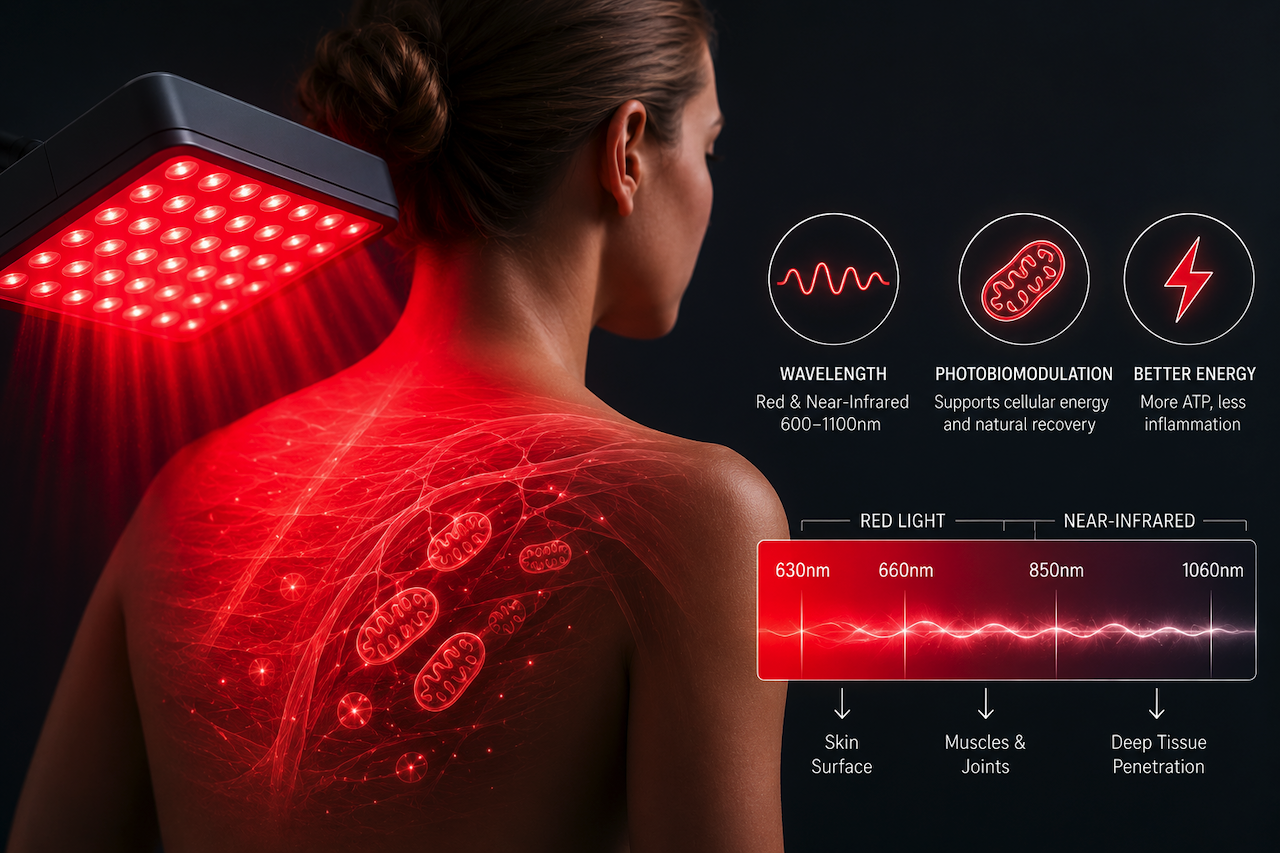
Not all light is therapeutic. The wavelengths used in red light therapy sit within a specific window of the electromagnetic spectrum, broadly referred to as the phototherapeutic window. This window spans from approximately 600nm at the red end of the visible spectrum through to around 1100nm in the near-infrared range.
Within this window, light can penetrate biological tissue without causing the damage associated with ultraviolet radiation. Instead of breaking down cellular structures, light in this range interacts with specific photoreceptors within cells, triggering biological responses that support repair, recovery, and regeneration.
The depth to which light penetrates tissue is directly related to its wavelength. Shorter wavelengths in the red range from 630nm to 660nm are absorbed more readily at the skin surface, making them most effective for applications involving the epidermis and upper dermis. Longer wavelengths in the near-infrared range from 800nm to 850nm pass through the skin surface more readily and are absorbed deeper in muscle tissue and joints. Devices operating at 1060nm near-infrared wavelengths achieve greater tissue penetration, reaching structures that standard near-infrared devices cannot effectively treat.
The Biology of Photobiomodulation
The cellular mechanism behind red light therapy is known as photobiomodulation. The primary target within cells is cytochrome c oxidase, a photoreceptor located within the mitochondrial respiratory chain. When light at therapeutic wavelengths is absorbed by cytochrome c oxidase, it triggers a series of downstream biological responses.
The most significant of these is increased production of adenosine triphosphate, the molecule that powers cellular activity. More ATP means cells have more energy available for their primary functions, including repair, protein synthesis, and regulation of inflammation. Additional effects include reduced oxidative stress, modulation of reactive oxygen species, improved nitric oxide signaling, and enhanced cellular communication.
The net result across these mechanisms is a biological environment more conducive to healing, recovery, and regeneration. This is why the research literature on photobiomodulation spans such a wide range of applications, from wound healing and skin rejuvenation to pain management, joint conditions, and neurological function. The mechanism operates at the cellular level and is therefore relevant wherever cellular function is impaired or under stress.
Wavelength and Its Clinical Implications
The choice of wavelength in a red light therapy device is not cosmetic. Different wavelengths activate different biological responses and reach different tissue depths, which determines what conditions and goals the device is suited to address.
Red wavelengths at 630nm to 660nm are primarily absorbed at the skin surface and in the upper layers of the dermis. They are effective for collagen stimulation, skin repair, wound healing, and surface-level inflammation. Devices focused on these wavelengths are well-suited to cosmetic and dermatological applications.
Near-infrared wavelengths from 800nm to 850nm penetrate the skin surface and are absorbed in muscle tissue, tendons, and superficial joints. They are used for muscle recovery, inflammation reduction, and pain management in areas accessible within this penetration depth.
At 1060nm, the penetration depth increases significantly beyond the standard near-infrared range. Light at this wavelength reaches deeper joint structures, connective tissue, and bone, making it relevant for conditions that require treatment at depths standard devices cannot effectively reach. Understanding the specific properties of 1060nm red light therapy provides useful context for evaluating devices designed for deeper tissue applications.
The Role of Frequency in Red Light Therapy Devices
Wavelength and frequency are related but distinct properties of light. Wavelength refers to the physical distance between wave peaks, measured in nanometres. Frequency refers to the number of wave cycles per second, measured in hertz. As wavelength increases, frequency decreases in proportion, following the fundamental relationship among the speed of light, wavelength, and frequency.
In red light therapy devices, the frequency of the emitted light is determined by its wavelength. Red light at 660nm oscillates at approximately 454 terahertz. Near-infrared light at 850nm oscillates at approximately 353 terahertz. At 1060nm, the frequency drops further to around 283 terahertz. These differences in oscillation frequency influence how tightly it interacts with biological tissue at the molecular level, affecting absorption characteristics and the depth at which photobiomodulation occurs.
Some devices also incorporate pulsed-frequency modes, in which the light is switched on and off at a set rate, measured in hertz, rather than emitting continuously. Pulsed frequencies in therapeutic devices typically range from single-digit hertz to several hundred hertz. Different pulsed frequencies have been studied for their effects on specific biological targets, with some research suggesting that certain pulsed rates may enhance particular therapeutic outcomes. Understanding how red light therapy frequency influences tissue interaction and cellular response provides useful technical background for evaluating device specifications beyond wavelength alone.
Irradiance and Its Importance
Irradiance is the power output delivered to the treatment area, measured in milliwatts per square centimeter. It is arguably the most important technical specification for evaluating a red light therapy device, yet it is frequently absent or misleading in product marketing.
A device with low irradiance requires significantly longer sessions to deliver an equivalent therapeutic dose to one with higher irradiance. At very low irradiance levels, achieving a clinically relevant dose within a practical session time may not be possible.
When evaluating devices, irradiance should always be assessed at the recommended treatment distance rather than at zero distance from the device surface. Peak surface irradiance is not a meaningful clinical metric. The delivered dose at the distance the user will actually occupy during treatment is the relevant figure.
LED vs Laser Technology
Most consumer red light therapy devices use LED technology. LEDs emit non-coherent, broad-spectrum light across a range of wavelengths. They are effective across standard therapeutic wavelength ranges and are well supported by the research literature for most common applications.
Low-level laser devices emit coherent, monochromatic light at a precise wavelength. The coherence of laser light and its precise wavelength specificity result in different tissue-interaction characteristics compared to LED devices at the same nominal wavelength. At higher wavelengths such as 1064nm, low-level laser technology delivers penetration depth and dose characteristics that LED technology at equivalent wavelengths cannot match.
The choice between LED and laser technology is not about one being superior across all applications. It is about matching device characteristics to the specific therapeutic goals and tissue depths of a given application.
Conclusion
Red light therapy technology is grounded in well-established physics and cellular biology. The therapeutic effects are not the result of heat or a placebo. They arise from specific interactions between light at defined wavelengths and photoreceptors within biological cells. Understanding wavelength, irradiance, and frequency of use as distinct yet interrelated variables is the foundation for using this technology effectively and for evaluating devices by their actual therapeutic merits rather than by marketing claims alone.
Disclaimer
This article is provided for informational and educational purposes only and should not be considered medical advice, diagnosis, or treatment guidance. Readers should consult qualified healthcare professionals before using red light therapy or any other wellness technology for medical or therapeutic purposes. Information regarding wavelengths, frequencies, irradiance, and device performance is general in nature and may not apply to every individual, condition, or product. iplocation.net is not affiliated with, responsible for, or liable for the effectiveness, safety, claims, or outcomes associated with any third-party products, services, or external websites mentioned in this article.
Featured Image generated by ChatGPT.
Share this post
Leave a comment
All comments are moderated. Spammy and bot submitted comments are deleted. Please submit the comments that are helpful to others, and we'll approve your comments. A comment that includes outbound link will only be approved if the content is relevant to the topic, and has some value to our readers.
Comments (0)
No comment