
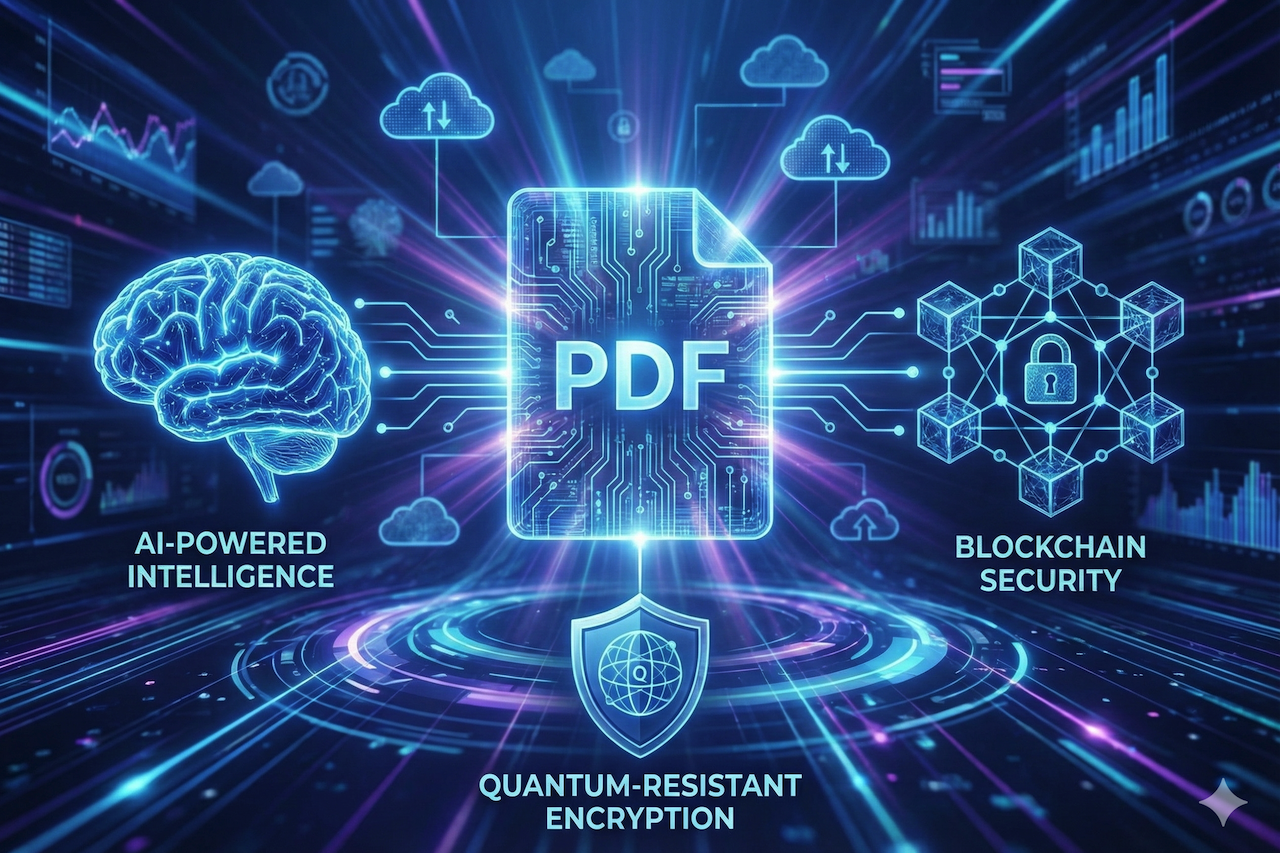
The PDF format has remained remarkably stable since Adobe introduced it in 1993, but recent technological advances are transforming how these documents function. What began as a simple solution for cross-platform document viewing has evolved into an interactive, secure, and intelligent file format.
The next generation of PDFs will incorporate artificial intelligence, enhanced security protocols, and seamless integration with cloud services.
Businesses relying on PDFs for contracts, reports, and presentations need to understand upcoming capabilities that will change workflow efficiency. Individuals who insert signatures in PDF documents for personal transactions will benefit from stronger authentication methods and improved accessibility.
The PDF specification continues to expand through updates managed by the International Organization for Standardization (ISO). PDF 2.0, released in 2017, introduced new compression algorithms, enhanced encryption, and better support for rich media. Current development focuses on integrating artificial intelligence, implementing advanced accessibility features, and developing blockchain verification methods.
AI-Powered Document Intelligence
Artificial intelligence is transforming PDFs from static documents into intelligent information systems. Machine learning algorithms can now analyze document content, automatically extract data, and provide contextual insights without human intervention.
Automated Content Extraction and Analysis
Modern AI tools scan PDF documents to identify specific data types, such as names, addresses, dates, financial figures, and contract terms. This capability eliminates manual data entry when processing invoices, legal agreements, or research papers. The technology recognizes patterns across multiple document types and learns to extract information with increasing accuracy.
Natural language processing allows PDFs to answer questions about their own content. Users can query a 500-page technical manual with questions like "What is the maintenance schedule for Component X?" and receive direct answers with page references. This search capability goes beyond simple keyword matching to understand context and intent.
Document summarization automatically generates executive summaries from lengthy reports. AI analyzes text structure, identifies key points, and produces coherent summaries that capture essential information. This function saves hours when reviewing contracts, research papers, or regulatory filings. Understanding the legal aspects of e-signatures becomes easier when AI automatically highlights signature requirements and compliance clauses.
Predictive Document Management
AI algorithms will predict which documents users need based on their work patterns and calendar events. Before a scheduled meeting, the system might automatically retrieve relevant contracts, presentations, and previous meeting notes. This predictive assistance reduces the time spent searching through file systems.
Machine learning will identify potential errors in documents before they are distributed. The technology can flag missing signatures, detect unusual contract terms, or notice inconsistencies between related documents. These checks prevent costly mistakes and ensure compliance with organizational standards.
Enhanced Security and Verification
Security concerns drive significant innovation in PDF technology. Emerging verification methods will make document tampering virtually impossible while simplifying authentication for legitimate users.
Blockchain-Based Document Verification
Blockchain technology offers immutable proof of document authenticity and modification history. When someone creates or modifies a PDF, the system generates a unique cryptographic hash and records it on a blockchain. Anyone can verify the document against this blockchain record to confirm it has not been altered.
This approach provides several advantages over traditional digital signatures:
- Permanent verification that survives beyond certificate expiration dates
- Transparent modification history showing who changed what and when
- Decentralized verification that does not depend on a single certificate authority
- Lower costs compared to recurring certificate fees
- Universal verification without proprietary software or special access.
Government agencies and financial institutions are piloting blockchain verification for critical documents like property deeds, academic credentials, and corporate filings. This technology will likely become standard for high-value documents within the next five years.
Quantum-Resistant Encryption
Current PDF encryption relies on mathematical problems that quantum computers could eventually solve. The PDF specification will adopt post-quantum cryptographic algorithms designed to resist attacks from quantum computing. This transition must happen before quantum computers become powerful enough to break existing encryption methods.
The National Institute of Standards and Technology (NIST) has selected several quantum-resistant algorithms for standardization. PDF developers are already testing these algorithms to ensure compatibility and performance. Documents encrypted with quantum-resistant methods will remain secure for decades regardless of computational advances.
Preparing for What Comes Next

Image by Freepik.
Organizations should audit their current PDF workflows to identify processes that will benefit from these emerging capabilities. Document repositories need proper metadata and organization to maximize the benefits of AI-powered search and analysis. Security policies must evolve to incorporate biometric authentication and blockchain verification methods.
Individual users can prepare through simple steps that improve document quality now while ensuring future compatibility:
- Tag documents properly with titles, authors, and keywords for better AI indexing
- Use consistent naming conventions across files and folders
- Enable accessibility features in PDF creation software
- Store documents in cloud services that will integrate new PDF capabilities
- Review and update signature methods to comply with evolving standards.
The PDF format continues adapting to technological change while maintaining backward compatibility. Documents created today will remain readable for decades, but taking advantage of new features requires active engagement with evolving standards and tools.
Conclusion
The PDF format is no longer just a static document standard. With the integration of artificial intelligence, advanced security models, and future-ready encryption, PDFs are evolving into intelligent, secure, and highly adaptable tools.
Organizations and individuals who understand these changes early will be better positioned to improve efficiency, strengthen document security, and maintain long-term compatibility as standards continue to evolve.
Disclaimer
This article is provided for informational and educational purposes only and does not constitute legal, technical, or professional advice. While reasonable efforts are made to ensure the accuracy and timeliness of the information, iplocation.net makes no representations or warranties regarding the completeness, reliability, or suitability of the content.
Any references to third-party websites, tools, or services are provided for informational context only. iplocation.net does not control, endorse, or assume responsibility for the content, accuracy, availability, or practices of external websites. Accessing third-party links is done at the reader’s own discretion and risk.
Readers should independently evaluate any tools, services, or technologies mentioned and consult qualified professionals where appropriate. iplocation.net shall not be held liable for any loss, damage, or consequences arising from the use of, or reliance on, the information provided in this article or any linked external resources.
Featured Image generated by Google Gemini.
Share this post
Leave a comment
All comments are moderated. Spammy and bot submitted comments are deleted. Please submit the comments that are helpful to others, and we'll approve your comments. A comment that includes outbound link will only be approved if the content is relevant to the topic, and has some value to our readers.
Comments (0)
No comment