

How Much Does It Cost to Build a SaaS Product in 2026?
Key Takeaways
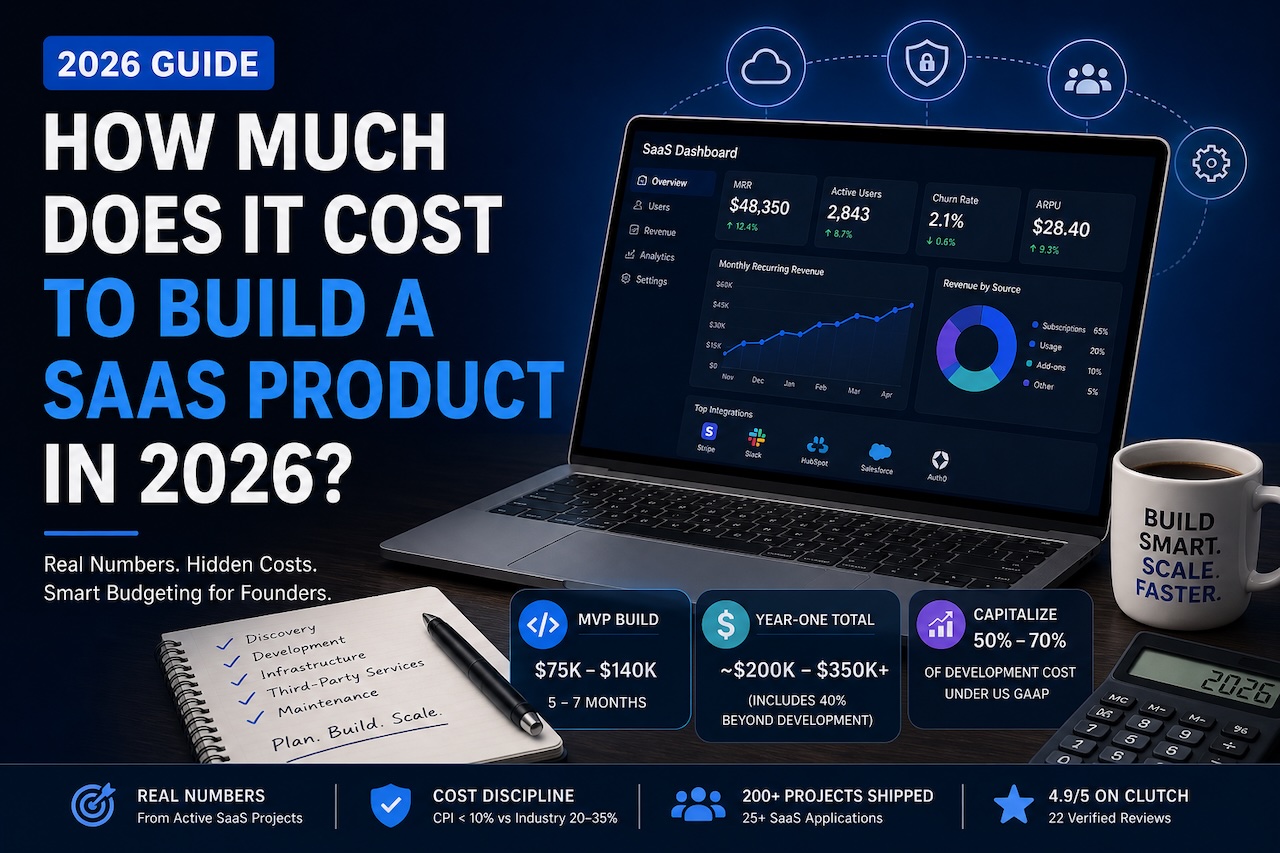
- A real production SaaS MVP costs between $75,000 and $140,000 in 2026. Most clients land in the $95,000 to $115,000 range for the build itself, plus another $4,000 to $8,000 per month for the first three months of post-launch work. The numbers reflect what experienced saas software development services teams charge today.
- Founders consistently underestimate non-development cost by about 35 percent. Infrastructure, third-party services, and ongoing maintenance compound silently in year one.
- Roughly 50 to 70 percent of SaaS development cost can be capitalized under US GAAP, depending on the project phase and auditor interpretation.
- Clockwise Software’s Cost Performance Index stays under 10 percent across hundreds of projects, compared with an industry average overrun of 20 to 35 percent.
Why I’m Writing About SaaS Cost in 2026
Almost every founder who calls me opens the conversation with a version of the same question: how much does it cost to build a SaaS product? The honest answer is annoying because it depends on a dozen variables. The dishonest answer is a single number that satisfies the founder’s immediate need and then explodes into a budget surprise four months into the build.
I have run more than a dozen SaaS engagements as a Project Manager at Clockwise Software since I joined. The cost questions get more sophisticated each year. In 2022, founders asked how much the build cost. In 2024, they started asking about total cost of ownership. By 2026, the smart founders are asking about capitalization treatment, infrastructure scaling, and how AI tooling changes the labor cost curve.
This article covers what a SaaS build actually costs, what it costs beyond development, how to think about the accounting, and where founders most often miscalculate. It draws on real numbers from SaaS client work and from a four-year marketplace partnership that has been one of the cleanest cost stories I have managed.
Disclaimer: I am not an accountant. The capitalization guidance in this article reflects what my finance team and I have learned over the years about working with auditors. Your specific situation depends on your auditor and your jurisdiction.
Part 1: What a SaaS Build Actually Costs in 2026
Let me start with concrete numbers. These are the price ranges I quote on real client calls in April 2026.
| Build Scope | Price Range | Timeline | Best Fit |
|---|---|---|---|
| Validation prototype | $15,000 to $35,000 | 4 to 8 weeks | Pre-product founders testing demand before committing |
| Discovery, small | $12,000 | 3 weeks | Clear scope, single user type, sharp vision |
| Discovery, medium | $16,000 | 5 weeks | Most projects |
| Discovery, large | $25,000 | 8 weeks | Complex platforms, multiple roles, AI components |
| Lean SaaS MVP | $75,000 to $140,000 | 5 to 7 months | Pre-seed and seed teams shipping to first paying users |
| Market-ready SaaS v1 | $140,000 to $280,000 | 7 to 11 months | Series A teams with validated ICP, ready to scale |
| Enterprise-ready SaaS | $280,000 to $600,000+ | 11 to 18 months | SOC 2, SSO, audit trails, complex permissions |
| AI-native premium | +15 to 20 percent | +1 to 2 months | Real AI features with evaluation infrastructure |
| Marketplace premium | +25 percent | +1 to 2 months | Two-sided UX, matching logic, dual-funnel onboarding |
| Mobile companion app | +$50,000 to $120,000 | +3 to 5 months | Native or React Native paired with web product |
| Dedicated team monthly | $28,000 to $65,000 | Ongoing | Post-MVP scale, capability gaps |
| Hourly specialist rate | $50 to $99 | Flexible | Specific skill gaps in client teams |
Three observations from these numbers matter. First, the discovery investment is the single best dollar spent on the project. Discovery costs 8 to 12 percent of a typical MVP budget and prevents most of the rebuild work that destroys budgets later.
Second, the AI-native premium is a real line item now, not a marketing add-on. It covers prompt versioning infrastructure, evaluation harnesses, model abstraction layers, and design exploration for AI surfaces.
Third, the SaaS MVP development cost band is wider than founders expect. The $65,000 difference between the low and high end of the lean MVP range reflects real scope decisions made during discovery.
Part 2: What Drives the Price Up
The price ranges above hide a lot of variation. The biggest drivers are user roles, billing complexity, integration count, AI feature depth, compliance requirements, and performance expectations.
Number of User Roles
Each user role roughly adds 8 to 12 percent to total build cost. Five roles is not five times more than one role; it is closer to three times more because the back-end logic compounds while the front-end work scales more linearly.
Billing Complexity
Seat-based subscription is the cheapest billing model to build. Usage-based billing with tiered metering is more expensive, and hybrid plans with grandfathered customers are the most expensive. Billing complexity alone can add $20,000 to $40,000 to a SaaS app development cost.
Integration Count
Each integration past the second adds disproportionate complexity. Common integrations like Stripe, Salesforce, HubSpot, and Slack are inexpensive because the patterns are well understood. Custom ERPs, niche tools, and SOAP APIs add real cost.
AI Feature Depth
A single AI assistive feature adds 5 to 8 percent to baseline cost. An ambient copilot across multiple screens adds 15 to 22 percent. A full evaluation harness adds another 8 to 12 percent.
Compliance Requirements
SOC 2 adds six to eight weeks to the calendar. HIPAA adds eight to twelve. The EU AI Act adds four weeks at minimum for documentation alone. Stacking multiple regimes compounds the documentation and audit trail work.
Performance and Scale Requirements
A SaaS targeting 10,000 users in year one costs about the same to build as one targeting 1,000. A SaaS that needs to handle 100,000 concurrent users at launch costs measurably more because the architecture decisions diverge.
| Feature Dimension | Cost Adjustment | Schedule Adjustment |
|---|---|---|
| Each additional user role beyond the first | +8 to 12 percent | +1 to 2 weeks |
| Usage-based billing instead of seat-based | +$15,000 to $25,000 | +2 to 3 weeks |
| Each integration past the second | +$8,000 to $20,000 | +1 to 2 weeks |
| Single AI assistive feature | +5 to 8 percent | +1 to 2 weeks |
| Ambient AI copilot across multiple screens | +15 to 22 percent | +3 to 5 weeks |
| SOC 2 Type II preparation | +$25,000 to $45,000 | +6 to 8 weeks |
| HIPAA-compliant architecture | +$40,000 to $80,000 | +8 to 12 weeks |
| Mobile companion app | +$50,000 to $120,000 | +3 to 5 months |
| Multi-region data residency | +$30,000 to $60,000 | +4 to 6 weeks |
| Real-time collaboration features | +$25,000 to $55,000 | +4 to 7 weeks |
These adjustments are not purely additive. A product with usage-based billing, multiple AI features, SOC 2, and a mobile companion will cost more than the sum of its line items because the integration points multiply.
Part 3: Total Cost of Ownership Beyond Development
Development cost is roughly 60 percent of year-one total spend on a typical SaaS. Founders who budget only for development face a substantial surprise around month four when the other costs start showing up.
Infrastructure
Cloud infrastructure for a typical SaaS in 2026 runs $500 to $4,000 per month at MVP stage, scaling to $5,000 to $20,000 per month as the user base grows past 5,000 customers. Products with heavy AI usage can spend more on inference than on the rest of their infrastructure combined.
Third-Party Services
A typical SaaS in 2026 uses 15 to 25 third-party services. Stripe, authentication, transactional email, observability, analytics, and support tooling can easily create $1,500 to $6,000 per month in service fees once the product has real users.
Ongoing Maintenance
Annual maintenance for a SaaS product runs 12 to 18 percent of build cost. The work covers bug fixes, security patches, dependency updates, integration changes, and small feature adjustments.
Team Retention
Once a SaaS is in production, the team that built it is usually the cheapest team to maintain it. Replacing the team mid-flight typically costs 15 to 25 percent more in the first year because of context loss.
Customer Support Tooling
A SaaS with paying customers needs a help desk, a status page, a knowledge base, and basic in-product support tooling. These add $200 to $1,500 per month in tooling costs and roughly 0.5 to 1 full-time-equivalent of staff time once volume picks up.
| Cost Category | Year-One Total | Percent of Total |
|---|---|---|
| Initial build | $120,000 | 60 percent |
| Discovery phase | $16,000 | 8 percent |
| Cloud infrastructure | $18,000 | 9 percent |
| Third-party services | $24,000 | 12 percent |
| Post-launch maintenance | $15,000 | 7 percent |
| Customer support tooling | $8,000 | 4 percent |
| Year-one total | $201,000 | 100 percent |
Founder budgeting note: if a founder has $200,000 of available capital for year one, the SaaS development cost they should plan for is roughly $120,000. Spending the full $200,000 on development leaves no headroom for the other 40 percent of year-one spend.
Part 4: Capitalization and the Accounting Treatment
Under US GAAP, specifically ASC 350-40 for internal-use software and ASC 985-20 for software intended for sale, SaaS development costs split into three phases with different treatment.
The preliminary project stage covers research, evaluation, and high-level planning. These costs are expensed as incurred. The application development stage covers actual build work, including coding, design, testing, and configuration. These costs are capitalized as an intangible asset and amortized over the useful life of the software, typically three to five years. The post-implementation stage covers ongoing maintenance, support, and minor enhancements. These costs are expensed as incurred.
The split matters because it changes how investors and lenders perceive runway. Capitalization is not a cash-flow benefit; it is a presentation benefit.
| Project Phase | Treatment Under ASC 350-40 | Typical Share of Total Spend |
|---|---|---|
| Discovery and research | Expensed | 8 to 12 percent |
| Architecture and high-level design | Mixed | 5 to 8 percent |
| UX and UI design | Capitalized | 10 to 15 percent |
| Frontend and backend coding | Capitalized | 40 to 50 percent |
| Quality assurance and testing | Capitalized | 10 to 15 percent |
| Data migration | Expensed | 0 to 8 percent |
| Training and documentation | Expensed | 3 to 6 percent |
| Post-launch maintenance | Expensed | Ongoing |
| Post-launch new feature work | Capitalized | Ongoing |
Auditor reminder: talk to your auditor early in the project, not at year end. Clients can lose 10 to 20 percent of potential capitalization when phase-split documentation is not collected during the project.
Part 5: How to Manage SaaS Cost Effectively
SaaS cost management is mostly about avoiding predictable surprises. The saas product development services that help most are fixed-price discovery, two-week sprints, monthly cost reviews, formal change request management, weekly demos, and shipping test coverage and observability from sprint one.
Fixed-Price Discovery Before Any Build Commitment
Discovery is fixed-price, fixed-scope, and produces a real plan. The client commits to the build budget after seeing the discovery output, not before.
Two-Week Sprints With a Strict Scope Envelope
Every sprint commits to a specific set of work. Mid-sprint scope changes go into the next sprint, not the current one.
Monthly Cost Reviews Against the Original Estimate
Once per month, actual spend is compared to the original estimate, broken down by sprint and category. If there is variance, it is discussed openly before it compounds.
Change Request Management as a Formal Process
Every scope change should go through a written request that includes cost and schedule impact. Informal scope changes are how budgets explode.
Weekly Demos That Surface Progress Honestly
The Friday demo is a load-bearing meeting. Real product, running on real infrastructure, in front of the real client, makes progress visible and problems harder to hide.
Test Coverage and Observability Shipped From Sprint One
Testing infrastructure and observability should ship early. The cost of building them from day one is roughly the same as building them at the end, but the cost of finding production bugs later is far higher.
Part 6: Case Study: Workerbee and the Cost of Doing It Right
Workerbee is an online marketplace for IT consulting built for Agilea Solutions. The platform connects corporations with software consultants through project matching, contract management, and payment workflows.
Discovery ran five weeks and produced a marketplace architecture, two-sided UX flow, integration plan, and phased delivery backlog. The team chose Nest.js for the backend and React for the frontend. Four years later, the stack has not been rewritten.
The MVP build came in within budget and shipped on the originally scoped timeline. Year two and three showed the long-term value of cost discipline: no surprise rebuilds, no major architectural rewrites, and maintenance that stayed within the typical annual range.
One important cost decision came during discovery. The client originally requested fifteen integrations at MVP. The team pushed back and shipped with three. The remaining twelve went into a roadmap based on real user demand. About half were never built because customer feedback showed they were unnecessary.
Part 7: How Cost Varies by Company Stage and Funding Model
The cost of SaaS is not one number. It depends on the company stage, funding model, and target user base.
| Founder Type | Year-One Product Cost Range | Common Scope | Typical First Paying Users |
|---|---|---|---|
| Bootstrapped solo or duo | $130,000 to $200,000 | Lean MVP, single role, two integrations | 20 to 100 |
| Bootstrapped with savings or revenue | $180,000 to $300,000 | Market-ready, multi-role | 50 to 300 |
| Pre-seed funded | $200,000 to $400,000 | Market-ready, AI features, billing depth | 100 to 500 |
| Seed funded | $280,000 to $600,000 | Market-ready with compliance, mobile | 250 to 1,500 |
| Series A scaling | $400,000 to $1,200,000 | Enterprise features, multi-region | 1,000 to 10,000 |
| Internal enterprise SaaS | $400,000 to $1,500,000 | Heavy compliance, deep customization | 500 to 25,000 internal users |
How AI Changed the Cost-Per-User Math
Traditional SaaS economics assumed near-zero marginal cost per user once the product was built. AI changed that assumption. A SaaS product that uses AI inference on every user action has real marginal cost per user.
For AI-heavy SaaS, model two cost lines separately: the build cost and the per-user monthly unit cost. Across projects managed since early 2024, AI-heavy SaaS has spent roughly $3 to $11 per active user per month on inference and AI-related infrastructure.
The Hidden Cost of Vendor Switching
Switching vendors mid-project is expensive. Across inherited SaaS products since 2022, the average cost to bring an inherited project up to quality standards has been roughly 35 to 45 percent of the original build cost, on top of what was already spent.
Part 8: Outsourced Development vs In-House Cost
A senior US-based software engineer in 2026 costs roughly $180,000 to $260,000 in fully loaded annual cost. A five-engineer team costs $900,000 to $1.3 million per year, not including recruiting, hiring time, retention risk, and management overhead.
An outsourced equivalent team at Clockwise Software costs $336,000 to $780,000 per year. The team is productive within two weeks because they already know each other and have shipped together before.
| Cost Component | Outsourced | In-House |
|---|---|---|
| Direct team cost | $420,000 average | $1,100,000 average loaded |
| Recruiting cost | None | $50,000 to $100,000 |
| Time-to-productivity | 2 weeks | 4 to 7 months |
| Productivity lost during hiring | None | $300,000 to $500,000 opportunity cost |
| Retention risk | Low | Significant |
| PM and design overhead | Included | Additional $250,000 to $400,000 |
| Office and tools | None for client | $30,000 to $80,000 |
| True 12-month comparable cost | $420,000 to $500,000 | $1,750,000 to $2,200,000 |
The outsourced model is not always the right choice. Founders who already have a senior CTO and a partial team may benefit more from staff augmentation. Founders planning a permanent engineering function may prefer to hire because long-run economics can favor in-house once the team is established.
Part 9: How to Calculate the True Cost of Your SaaS
Start with the MVP base. For a single-role, three-integration, no-AI SaaS, the base is $90,000. Add 10 percent for each role beyond the first. Add $14,000 for each integration beyond the first three. Multiply by 1.18 if the product has substantial AI features. Add compliance costs such as $35,000 for SOC 2, $60,000 for HIPAA, or $20,000 for GDPR-heavy work. Add discovery and the first three months of post-launch support.
For a typical mid-complexity SaaS with three roles, six integrations, AI features, and SOC 2 compliance, the formula produces around $245,000 in development spend. Add 40 percent for infrastructure, services, maintenance, and tooling, and the year-one total lands around $343,000.
Part 10: Where Founders Most Often Miscalculate
Confusing Freelancer Rates With Real Team Cost
Freelancer hourly rates do not map cleanly to real SaaS team output. A real SaaS team includes design, project management, QA, infrastructure, and delivery discipline.
Underestimating Post-Launch Support
The first three months after launch are when product-market fit is being tested. Founders should plan for $4,000 to $8,000 per month of post-launch support for at least three months.
Ignoring the AI Inference Bill
Products with heavy AI usage can spend $2,000 to $15,000 per month on inference at modest scale and significantly more as the user base grows.
Assuming Vendor Pricing Scales Linearly
Auth0, Stripe, Datadog, SendGrid, and other vendors price aggressively at small scale and then jump at break points. Plan for the curve, not the current point.
Part 11: What I Would Tell a Founder Asking About SaaS Cost in 2026
Start with discovery. Pay $12,000 to $25,000 for a real discovery phase before committing to any build budget. The output should include written architecture, a backlog with estimates, and a phase plan you can review with your auditor.
Budget honestly. Use the formula above and add 40 percent for non-development cost. Plan capitalization conversations early. Pick an experienced vendor over a cheap vendor. Stay engaged through demos and reviews. Plan for year two because the build is not the end.
A Final Note on Reading Cost Articles Critically
There are many articles online about SaaS cost, and many are misleading in subtle ways. Vendors quote suspiciously low numbers to win clicks. Generalist publications repeat figures from older years. AI-generated content lifts numbers from older articles without checking whether they still hold.
Ask when the article was written, whether the author runs engagements at the prices quoted, whether the numbers include full lifecycle cost, and whether AI inference costs are accounted for. Cost transparency is one of the marks of a vendor worth working with.
 FAQs
FAQs
A lean SaaS MVP costs $75,000 to $140,000 and takes 5 to 7 months. A market-ready v1 runs $140,000 to $280,000 over 7 to 11 months. Enterprise-grade SaaS with compliance and SSO runs $280,000 to $600,000+.
A production-grade SaaS MVP at Clockwise Software costs between $75,000 and $140,000. Discovery is separate at $12,000 to $25,000, and post-launch support typically costs $4,000 to $8,000 per month for the first three months.
Under US GAAP, SaaS development costs split into preliminary, application development, and post-implementation phases. Preliminary and post-implementation costs are expensed, while application development costs can be capitalized and amortized.
Yes, the application development stage portion can be capitalized under ASC 350-40 in the US and similar standards elsewhere. Eligible costs may include direct labor, contractor fees, and software licenses purchased specifically for the build.
Total SaaS cost includes development, infrastructure, third-party services, ongoing maintenance, and team retention. Development is roughly 60 percent of year-one total cost.
Total year-one cost for a bootstrapped SaaS company building a real product typically runs $130,000 to $350,000. Funded SaaS companies may spend more than $1 million in year one once team and marketing are included.
Outsourcing SaaS development typically costs 30 to 50 percent less than equivalent US-based in-house development for the same scope, but savings only materialize when the outsourced team is coherent and experienced.
Use fixed-price discovery, two-week sprints with strict scope envelopes, monthly cost reviews, formal change request management, and regular demos to prevent budget drift.
A digital product development agency builds custom software products end-to-end. Pricing models include fixed-price work, time-and-materials, and dedicated team retainers. The right model depends on scope stability.
Featured Image generated by ChatGPT.
Related Articles
May 20, 2026
Most Reliable End-to-End Product Development Agencies in 2026 [Reviewed]
We evaluated dozens of agencies claiming end-to-end capability. We found that most fall short at the handoff points: the gap between design and engineering, or between launch and l...
Read More
May 18, 2026
AI Application Development: How Much Does It Cost to Build an AI App?
Looking to develop an AI-powered solution for your business? One of the first questions founders and technology leaders ask is how much the project will cost. Intelligent software...
Read More
October 28, 2025
How to Build a High-Performing Offshore Development Team from Scratch
Offshore dedicated developers are full-time remote software experts who work exclusively on your project from another country, usually through a trusted offshore partner. This appr...
Read More
Comments
Comments are available to signed-in users and are moderated to keep the discussion useful and respectful. Spam, automated submissions, and low-value promotional comments are removed. Outbound links may be approved when they are relevant and genuinely helpful to readers, but they are displayed as plain text rather than clickable hyperlinks.
No comments have been published yet.
Please sign in to submit a comment.