
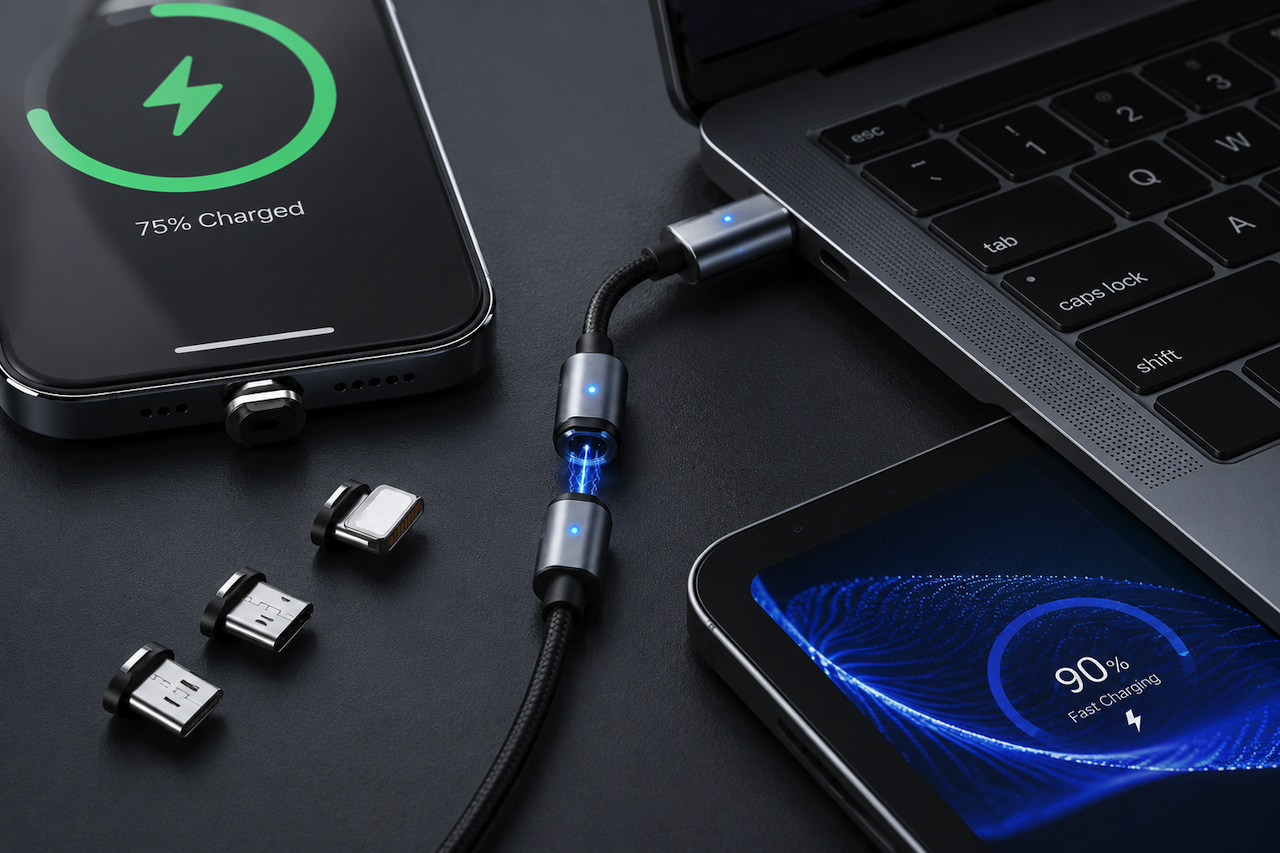
Magnetic cables have become a popular accessory for people who want convenience without the wear and tear of traditional connectors. But a common question remains: how much charging power can these cables actually deliver? It's a fair concern, especially if you rely on fast charging to keep your devices ready throughout the day. The answer depends on several technical factors, and understanding them helps clarify what to expect from different cable designs and specifications. This article breaks down everything you need to know, from wattage limits to protocol support and beyond.
What Determines the Charging Power of a Magnetic Cable
Not all magnetic cables are built the same. The amount of power a magnetic cable can deliver to your device depends on a handful of specific design choices made during manufacturing. Two of the most important factors are the connector pin architecture and the precision of the magnetic connection itself.
Connector Pin Architecture and Contact Quality
The pins inside a magnetic connector serve as pathways for electrical current to flow. A cable with only one or two pins typically supports basic charging at lower wattages, usually capped at around 5W to 18W. However, fast charge magnetic cables typically feature a higher pin count, sometimes four or more, allowing more current and voltage to flow simultaneously, which results in faster charging speeds.
Contact quality is just as crucial as the number of pins. Poor-quality metal contacts can introduce resistance, which generates heat instead of efficiently transferring power. High-quality connectors, on the other hand, use materials with low electrical resistance, ensuring that more of the power from your charger reaches your device’s battery rather than being wasted as heat.
Magnet Strength and Alignment Precision
The strength of the magnet determines how firmly the connector seats against the tip attached to your device. A weak magnet allows micro-movement, which interrupts the electrical contact and reduces the consistency of the power flow. This is one reason some users notice their device charges intermittently or at lower speeds than expected.
Alignment precision is equally important. If the magnetic tip and connector do not align perfectly, the pins may only make partial contact. Even a slight misalignment can significantly reduce effective wattage. Premium magnetic cables use tighter tolerances and stronger magnets to keep the connection stable, which translates directly into more consistent, higher charging power delivered to your device.
Wattage Limits: How Magnetic Cables Compare to Standard Cables
Standard USB-C cables with full Power Delivery support can handle up to 100W or even 240W under the latest USB PD 3.1 specification. Magnetic cables, by contrast, have traditionally occupied a lower-performance range, with many earlier models topping out at 5W or 18W.
But the landscape has shifted. Modern magnetic cables now support 60W, 100W, and, in some cases,140W, depending on the connector design and the quality of the internal wiring. The key distinction is whether the cable uses a USB-C magnetic tip or an older proprietary tip format. USB-C magnetic connectors are better positioned to support higher wattage because the underlying standard was designed with high-power transfer in mind.
For everyday smartphone charging, the difference in wattage between a magnetic cable and a standard cable may feel minimal. For laptops or tablets that demand sustained higher wattage, the gap becomes more noticeable. If your device requires 65W or more to charge at full speed, verify that the specific magnetic cable is rated to support that output.
Fast Charging and Power Delivery Protocol Support
Fast charging is not just about wattage. It also depends on whether your cable and charger speak the same protocol language as your device. Common fast charging protocols include USB Power Delivery (USB PD), Qualcomm Quick Charge, and proprietary standards from various device manufacturers.
Magnetic cables that support USB PD can automatically negotiate the correct voltage and current levels with your charger and device. This negotiation allows a charger to safely deliver higher wattage without damaging your battery. Without protocol support, your device defaults to standard 5W charging regardless of your charger's power rating.
When using a magnetic cable for fast charging, it is important to verify the product specifications carefully. Look for explicit mention of USB PD compatibility, Quick Charge support, or whichever protocol your device uses. A magnetic cable that lacks protocol support may still charge your device, but it will do so more slowly and will not fully utilize your charger’s capabilities. Matching the protocol is just as important as matching the wattage rating.
Do Magnetic Cables Affect Data Transfer Speeds?
This is a question that often comes up alongside charging power, and the answer is nuanced. Many budget magnetic cables are designed solely for charging. They include only the pins necessary to carry power, which means they cannot transfer data at all. If you plug in such a cable and expect to sync files between your phone and computer, nothing will happen on the data side.
Magnetic cables built for both charging and data transfer include additional pins and more complex internal wiring. These cables can support data transfer, though the speed depends on the standard they use. Cables based on USB 2.0 are limited to around 480 Mbps, while cables built on USB 3.2 or USB4 can reach several gigabits per second.
If data transfer matters to you, read the product description carefully and look for a clear mention of data-transfer support and the specific USB standard. Do not assume that a magnetic cable handles data just because it handles charging. The two functions require different internal architectures, and many manufacturers build charging-only versions to keep costs lower.
Common Reasons Your Magnetic Cable Is Charging Slowly
If your magnetic cable is not delivering the power you expected, a few common culprits are worth checking. The most frequent cause is a dirty or oxidized magnetic tip. Dust, lint, and moisture can build up on both the tip and the connector over time. Even a thin layer of debris increases resistance and reduces the effective wattage reaching your device.
Another reason is a mismatch between the cable's rated wattage and your charger's output. If your charger delivers 65W but your magnetic cable is only rated for 18W, the cable becomes the bottleneck. Your device will charge at the lower limit, not the higher one. Always verify that your cable, charger, and device all support compatible wattage levels.
A third factor is cable length. Longer cables have higher resistance over the run, which can slightly reduce the power delivered to the device. For high-wattage use cases, shorter cables are preferable. Plus, a weak magnetic connection from a low-strength magnet or a worn tip can cause the cable to lose contact intermittently, making charging feel unreliable or slower than expected. Replacing a worn tip often resolves the issue immediately.
Conclusion
Magnetic cables can deliver impressive charging power, but only if the right variables line up: pin architecture, magnet quality, protocol support, and component compatibility. For most smartphone users, a well-built magnetic cable will meet everyday needs without compromise. For higher-demand devices, pay close attention to wattage ratings and protocol support before you commit. The technology has come a long way, and choosing the right cable means you get both the convenience and the performance you need.
Featured Image generated by ChatGPT.
Share this post
Leave a comment
All comments are moderated. Spammy and bot submitted comments are deleted. Please submit the comments that are helpful to others, and we'll approve your comments. A comment that includes outbound link will only be approved if the content is relevant to the topic, and has some value to our readers.
Comments (0)
No comment