
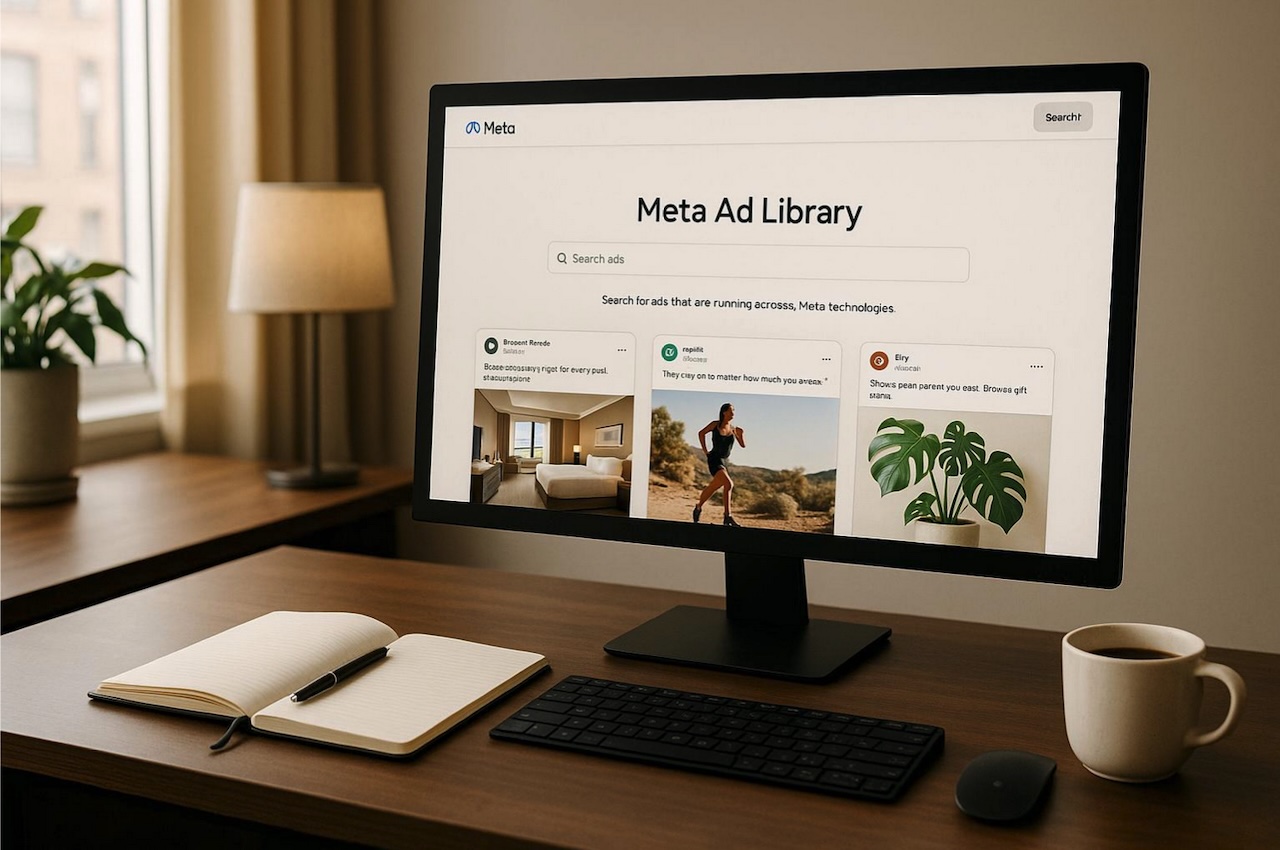
Competitor research on Meta used to mean scrolling through someone's Facebook page and hoping an ad showed up. Now there's an actual tool for it. Meta's Ads Library made competitor ad data publicly accessible, and for a lot of marketers, it changed how they approach campaign prep.
Meta's Ads Library is one of the tools that makes this research possible. Understanding what it offers, where it falls short, and how to get the most out of meta ads spy research in general can make a meaningful difference in how campaigns are built.
What the Library Gets Right
Type in a brand name, and the library shows what's currently active. Video or static, short copy or long, promotional offer or brand awareness push. It's all there, and it's free. For a marketer who just wants a quick look before a briefing, that's enough. It loads fast, requires no account setup, and covers both Facebook and Instagram in the same search. When a competitor drops something new, whether that's a product launch or a fresh angle on their core offer, it tends to show up in the library within a reasonable timeframe.
The library also shows when an ad started running, which gives a rough sense of how long certain creatives have been live. Ads running for several months are worth paying close attention to. That longevity usually means the creative is profitable rather than still in testing.
Where Things Get Frustrating
Here's the problem. The Meta Ads Library was not built with competitive intelligence in mind. It was built because regulators pushed for advertising transparency. Those are different goals, and the product reflects that difference in ways that matter for anyone doing real meta ads spy research.
There are no engagement numbers. None. An ad sitting in the library could have 200,000 reactions or two. There's no way to tell from inside the tool. This is probably the single biggest limitation because engagement data is what separates ads worth studying from ads that went nowhere. Without it, a marketer is left guessing which creatives are actually performing and which are just running.
Historical depth is another issue. The library is mostly a current snapshot. Trying to understand how a competitor's creative strategy has evolved over the past six months, which hooks they've cycled through, which offers they've tested and retired, is extremely difficult. The data simply isn't there in any reliable form.
And searching by concept or keyword across multiple competitors at once? Not really possible. The library is brand-centric. If a marketer wants to understand how an entire category is advertising around a specific topic, they'd have to search brand by brand and compile the results manually. That takes hours for results that are still missing the engagement dimension.
What Serious Meta Ads Spy Research Actually Requires
The gap between what the Meta Ads Library provides and what effective meta ads spy research requires is substantial. Filling that gap changes the quality of intelligence available before a campaign is built.
The first thing that matters is engagement filtering. Being able to sort ads by actual reaction and comment counts immediately separates the ads audiences responded to from the ones they ignored. That's the starting filter for anything worth analyzing further.
Run time data matters too. An ad that has been live and paid for across 90 or 120 days is carrying its own weight. The brand running it looked at the numbers and decided to keep spending. That decision is itself a data point. Filtering for those longer-running ads removes tests and seasonal campaigns from the picture, leaving behind what's genuinely working.
Then there's the cross-competitor dimension. Effective meta ads spy research isn't just about one brand. It's about spotting what multiple competitors in the same space are consistently doing. When several brands in a category all keep coming back to the same type of hook or the same offer framing, that's a market signal, not a coincidence. The Meta Ads Library can't surface that pattern efficiently.
Connecting Meta Research to What's Happening on Google
Social advertising and search advertising are different environments, but the competitive intelligence from each one feeds into the other.
Google ads spy research shows what's working when buyers are actively looking for something. The value propositions winning on search tend to reflect real purchase intent. When a particular angle keeps appearing in long-running Google search ads, testing that same angle as a Meta hook is a reasonable next step. The intent signal from search adds a layer of validation that social engagement data alone doesn't provide.
Running a combined ads spy approach across both platforms gives a clearer picture of how a category communicates with its buyers from awareness all the way through to conversion. Each channel's data makes the other more useful.
Where Third-Party Ad Intelligence Tools Fill the Gap
While native ad libraries provide a baseline level of transparency, they often fall short when it comes to deeper competitive analysis and actionable insights. This is where third-party ad intelligence platforms can be useful. They typically offer features like engagement-based filtering, run-time sorting, keyword-driven discovery, and the ability to analyze ads across multiple competitors—capabilities that go beyond what standard libraries provide.
For example, tools such as PowerAdSpy illustrate how these platforms can aggregate large volumes of ad data across regions and categories. Many of these tools maintain extensive databases spanning hundreds of millions of ads and continuously update their collections, making it easier to observe what campaigns are currently active rather than relying on outdated snapshots.
Another advantage of these platforms is multi-channel visibility. Instead of reviewing each advertising ecosystem separately, some tools bring together data from platforms like Google, YouTube, Reddit, Pinterest, Quora, and display networks into a single interface. This kind of consolidation can help streamline research workflows and make it more practical for teams to conduct consistent, cross-platform competitive analysis.
Conclusion
The Meta Ads Library is worth knowing about and worth checking. But serious meta ads spy research needs engagement data, run time filtering, historical depth, and cross-competitor pattern analysis. None of that is available in the native library. Tools like PowerAdSpy exist precisely because the gap between basic transparency and real competitive intelligence is large enough to matter in campaign performance.
Share this post
Author

Read the latest articles from Rakibul Hasan Razu
How to Rewrite AI-Generated Text Without Sounding Robotic

August 12, 2025
In 2025, many people write with the help of AI. Students use it for homework. Bloggers use it for posts. Even businesses use it for ads. But there's a problem. The text often sounds like a robot wrote it. It feels too flat, too perfect, or just unnatural. That's where an AI rewriter or a humanize AI tool becomes [...]
Learn moreLeave a comment
All comments are moderated. Spammy and bot submitted comments are deleted. Please submit the comments that are helpful to others, and we'll approve your comments. A comment that includes outbound link will only be approved if the content is relevant to the topic, and has some value to our readers.
Comments (0)
No comment