
Fleet operators have always faced a fundamental tension: every hour a vehicle sits out of service is an hour it is not generating revenue. For the organizations responsible for maintaining those fleets, that same constraint shapes how they must operate. Traditional maintenance models that require a vehicle to arrive only after something breaks are increasingly being replaced by data-driven approaches built around vehicle location signals, telematics, and real-time operational visibility.
From Break-Fix to Predictive: The Telematics Shift
On most commercial fleets, onboard hardware and cellular connections that gather and relay vehicle data in real time are now standard equipment. A standard telematics unit records engine diagnostics, GPS positioning, odometer readings, fuel usage, idle time, hard braking, and fault codes. This data is fed constantly to cloud-based systems where it can be queried, analyzed, and channeled to third-party systems.
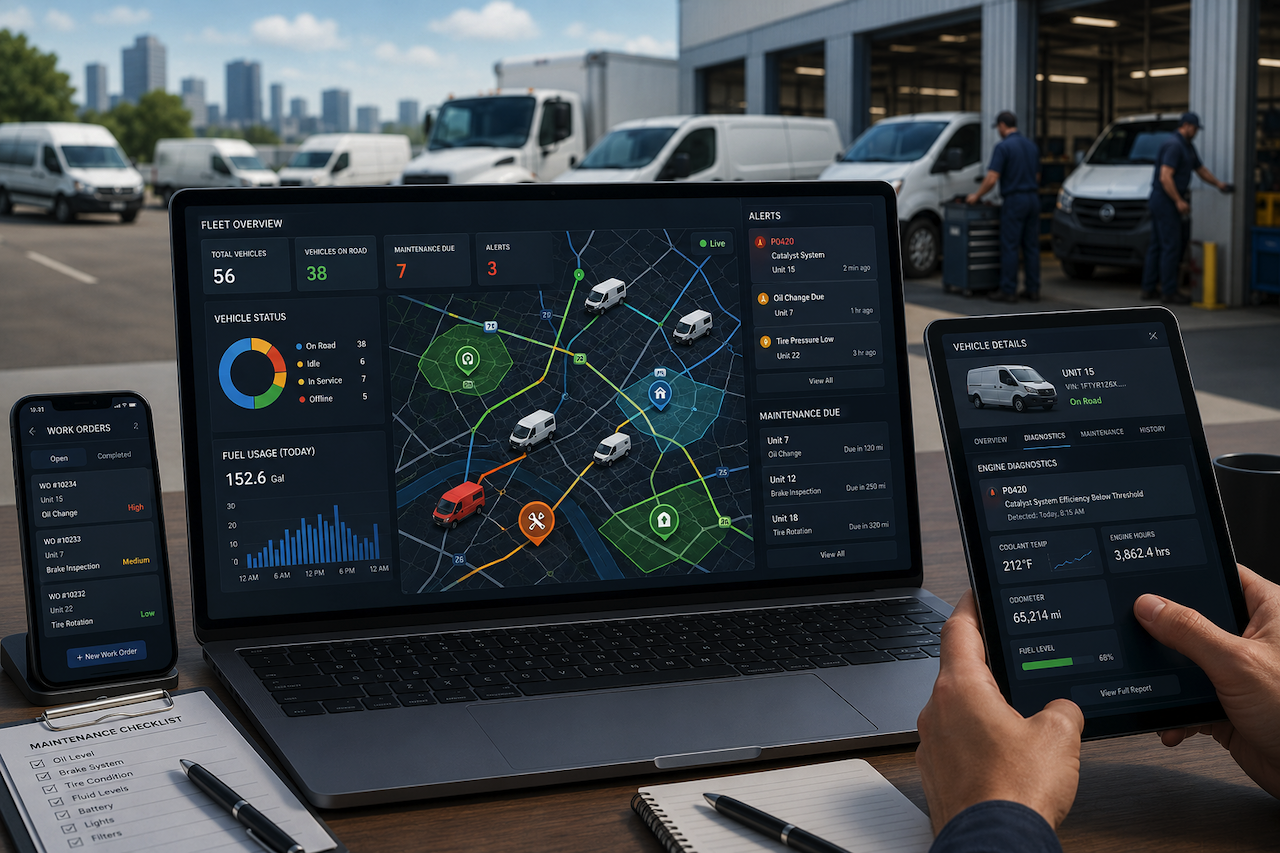
For a fleet service provider managing commercial accounts, that stream is operationally significant. Instead of waiting for a driver to report that a vehicle has a P0420 code, a service advisor can see almost immediately that a unit has recorded a catalyst fault code, exceeded its oil change threshold, or shown elevated coolant temperatures over the last few days. That service requirement is not yet a breakdown, and that window is where proactive maintenance can make a meaningful difference.
Location Data as a Scheduling Layer
GPS data adds a spatial dimension to fleet service that organizations are increasingly using. Knowing where vehicles are and where they move allows service teams to coordinate maintenance windows more intelligently. A delivery van that routes through a commercial corridor near a service location three mornings per week creates a different scheduling opportunity than one based 40 miles away. Location history reveals patterns, and patterns become scheduling anchors.
Fleet managers appreciate this because it lets service happen without pulling vehicles from routes unnecessarily. A provider that can say, "We see Unit 7 passes your depot at 6:45 AM on Tuesdays. Can we have a technician ready for a 20-minute brake inspection before dispatch?" is delivering a fundamentally different service than one that asks a fleet manager to find a full day to bring the vehicle in. The net effect on vehicle uptime can be significant.
Geofencing adds another layer. As a vehicle comes in to pre-staged parts, a fueling depot, or a service location, automated alerts can initiate check-in workflows, mark parts orders for the vehicle, or notify technicians to prepare a bay. This type of automated coordination is not a luxury for fleets with dozens of vehicles rotating through different service intervals. It is how organizations avoid backlogs and missed appointments.
Translating Telematics Into Technician Workflow
Telematics data and location signals are only operationally useful when they connect to everyday maintenance operations. In many service environments, including those that use auto repair shop management software, telematics data can be connected directly to scheduling, work order, and maintenance workflows. The goal is not the software itself, but ensuring that vehicle data reaches the people responsible for keeping fleets running.
Telematics feeds can be integrated into maintenance operations through APIs, connected fleet systems, or other workflow tools. If a maintenance threshold is reached or a fault code is received, service teams can be alerted automatically, allowing them to prioritize inspections and repairs before problems escalate.
This matters operationally because fleet accounts involve volume. A service operation managing a 30-vehicle delivery fleet is not tracking each unit's maintenance state manually. Accurate visibility into service intervals, fault codes, and parts availability helps technicians prioritize work based on actual vehicle needs rather than memory or callbacks.
Coordinating Multi-Vehicle Service Events
A more technically challenging scenario for fleet service providers is the coordinated service event, where a fleet operator needs several vehicles serviced within a short time frame. Seasonal tire changeovers, DOT inspection cycles, brake campaigns, and similar events occur regularly. For a fleet of 20 vehicles, scheduling these individually is a scheduling problem; handled in aggregate, it becomes a logistics challenge that requires visibility across vehicle location, technician capacity, parts availability, and bay utilization at the same time.
Telematics-enabled maintenance workflows can support this by helping teams identify vehicles approaching service intervals or recurring fault conditions. A service manager can identify every fleet vehicle within a 50-mile radius that is within 1,000 miles of a tire rotation and schedule them in a rolling sequence across two days without calling each driver or hunting through individual records.
Reducing Downtime Through Data Continuity
A consistent benefit among organizations that formalize telematics-based fleet maintenance is improved visibility into downtime risks. The mechanism is straightforward: earlier detection allows earlier parts planning, and parts delays are one of the main drivers of extended repair cycles. When a fault code surfaces three days before a vehicle is scheduled for service, that gives the service team more time to source a specific injector, sensor, or other component instead of discovering the need during teardown.
Location data contributes in a subtler way. Service teams can track whether a vehicle has been diverted or is running behind schedule for an appointment and adjust technician assignments accordingly, rather than having a technician idle while waiting on a delayed drop-off. Across many service events, this type of micro-optimization can compound into meaningful throughput gains.
The Operational Case
For organizations supporting commercial fleets, integrating telematics and location data into service workflows is becoming a baseline capability rather than a differentiator. Fleet operators are accustomed to data-driven operations in their own logistics. They increasingly expect service partners and maintenance teams to operate the same way. Providers that can demonstrate active monitoring of vehicle health, predictive scheduling, and rapid response to fault alerts are better positioned to support fleet reliability.
The technology infrastructure required for this approach already exists through telematics devices, GPS monitoring, connected fleet systems, and automated maintenance workflows. Organizations that successfully connect vehicle data to service operations are often able to deliver maintenance that is faster, more accurate, and less disruptive to fleet operators.
Conclusion
Telematics and location data are changing how fleet service operations approach maintenance, scheduling, and vehicle uptime. Rather than waiting for breakdowns to occur, organizations can use real-time diagnostics, GPS insights, and predictive maintenance signals to identify issues earlier and coordinate service more efficiently.
As fleets become increasingly connected, the value of operational visibility continues to grow. Organizations that combine telematics data with effective maintenance workflows are better positioned to reduce downtime, improve resource utilization, and keep vehicles on the road where they generate value.
Featured Image generated by ChatGPT.
Share this post
Leave a comment
All comments are moderated. Spammy and bot submitted comments are deleted. Please submit the comments that are helpful to others, and we'll approve your comments. A comment that includes outbound link will only be approved if the content is relevant to the topic, and has some value to our readers.
Comments (0)
No comment