
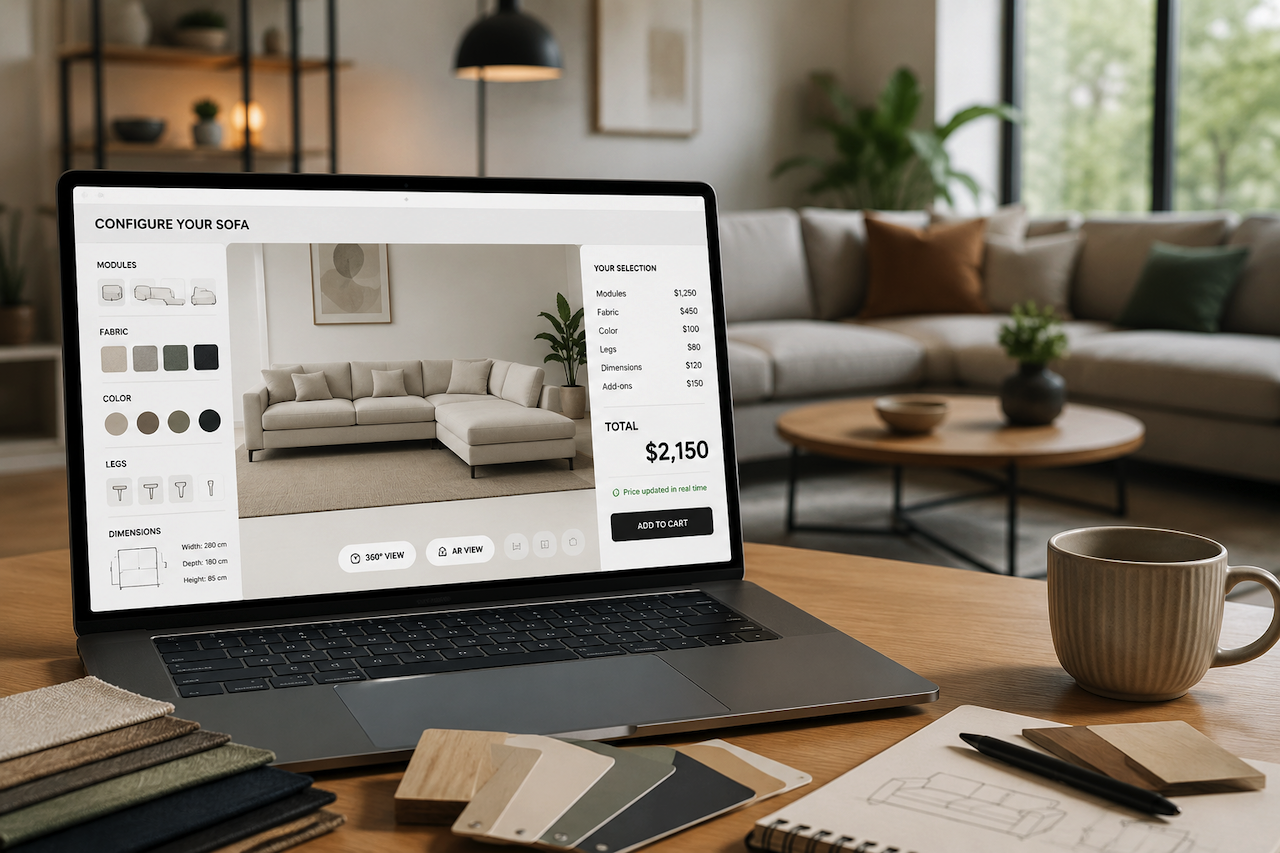
When shopping online today, customers expect personalized products, transparent pricing, and seamless experiences. With high consideration, costly items like furniture, balancing all of these can be challenging, especially when brands still follow traditional fixed pricing models. Static pricing often fails to adapt to customers’ changing demands, inventory levels, and market competition, resulting in missed sales.
Dynamic pricing can also be integrated into custom 3D product configuration tools to reflect pricing changes in real time based on customer selections, particularly for bespoke or made-to-order products. Customers can review different configurations, materials, and dimensions alongside updated pricing information during the purchasing process.
What Is Dynamic Pricing?
Dynamic pricing is a pricing strategy in which prices change based on customer selections and market conditions, including seasonality, competitor pricing, and inventory levels. While service industries like airlines and hotels have adopted this approach for decades, furniture companies are increasingly using it in response to growing demand for configurable and personalized purchasing experiences.
This pricing approach is particularly relevant for configurable products, where prices can update instantly based on selections for materials, finishes, dimensions, modules, and add-ons. As a result, it is commonly used across a wide range of furniture categories, including sofas, storage systems, office furniture, and luxury pieces.
Why Dynamic Pricing Matters in Furniture Commerce
Better Profit Margins
Flexible pricing strategies can help furniture companies improve profit margins, particularly for seasonal collections or products experiencing stronger demand. Real-time pricing adjustments also allow businesses to respond more efficiently to changing market conditions and customer behavior.
Rather than relying on fixed pricing alone, businesses can use real-time insights to support more informed pricing decisions and improve margin forecasting over time.
Improved Inventory Management
Many furniture retailers are struggling to manage inventory for large, high-cost products. Undoubtedly, while overstocking can tie up warehouse space and incur high costs over time, understocking leads to lost sales and longer delivery times.
Flexible pricing systems can also help companies respond to inventory challenges by adjusting prices based on real-time stock levels. For example, prices may be reduced for slower-moving collections, while limited-stock products may maintain higher pricing to support margin stability.
So, you manage inventory strategically rather than relying on constant manual updates. This further improves business operations, reduces effort, and minimizes human error.
Staying Competitive in a Crowded Market
Because furniture is high-value, customers rarely purchase on their first visit to your website. Most of them compare brands with similar products and make a decision later.
On the other hand, focusing only on pricing strategies without offering configurable purchasing experiences can also make conversion more difficult. This is where Visual Configure, Price, and Quote tools can support furniture companies by allowing customers to customize products and review pricing and visual updates simultaneously.
As a result, they have everything they need for the final order, and they feel more confident closing their deals. All of these are completed independently, without the sales team’s support, thereby creating a more competitive, customer-centered experience.
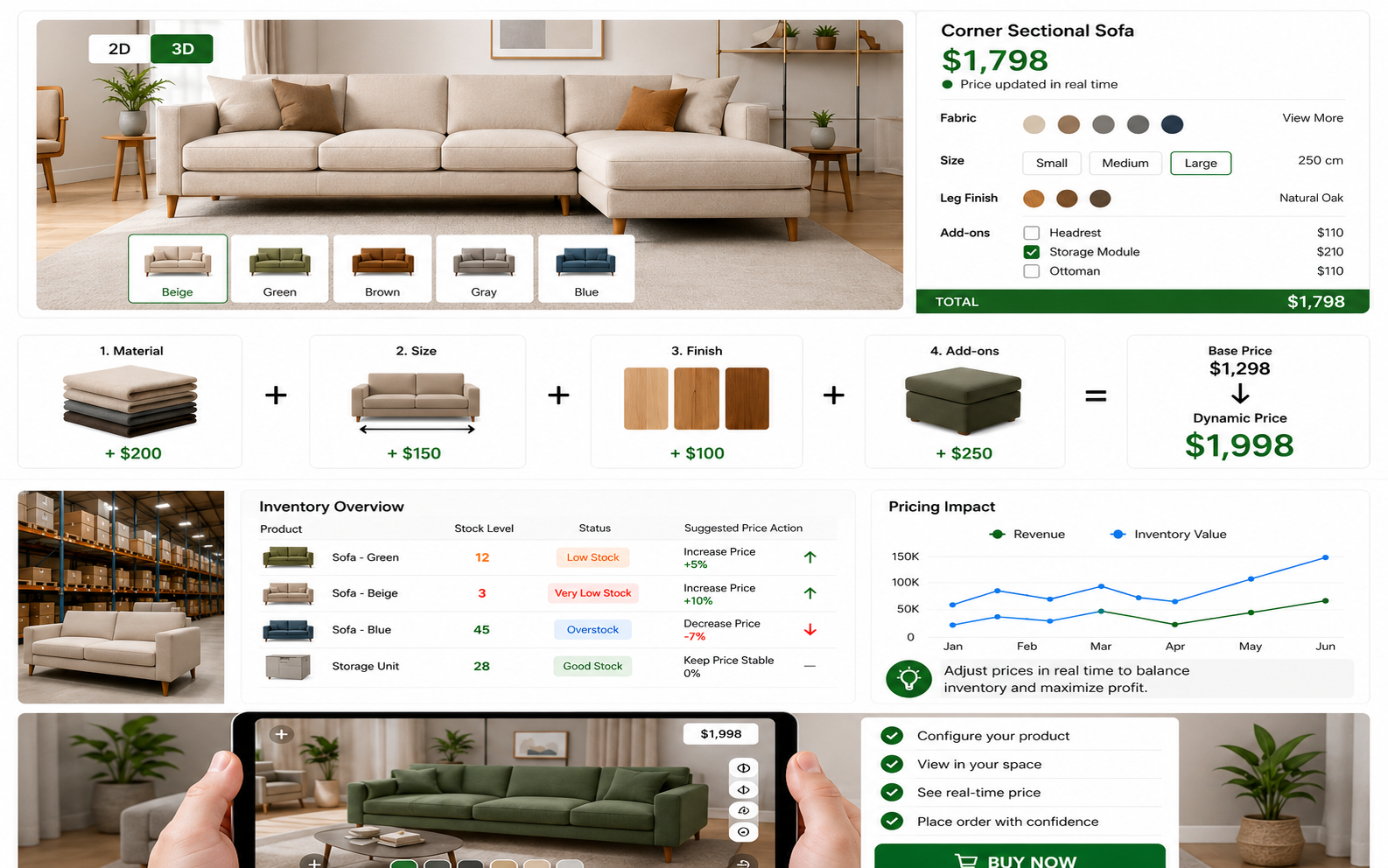
Image generated by ChatGPT.
Higher Conversion Rates
Customers are generally more likely to complete purchases when pricing information and product customization options are presented clearly throughout the purchasing process. Combining flexible pricing with 3D visualization and configuration tools can also support a more transparent and informed buying experience, which may contribute to higher conversion rates.
The Role of Data in Pricing Strategies
Successful pricing strategies depend heavily on data accuracy and update frequency. Furniture companies need a clear understanding of customer behavior, product demand, and broader market trends before making pricing decisions. Some of the most valuable data sources include:
- Website traffic and customer engagement
- Seasonal shopping behavior
- Competitor pricing
- Product popularity
- Inventory levels
- Customer demographics
- Cart abandonment trends
Recently, many marketers and developers have utilized AI-powered pricing tools to analyze this data and generate helpful, real-time insights to support smarter pricing strategies. Today, everything should be based on data rather than guesswork, which is especially essential to ensuring long-term profitability and delivering better customer experiences.
Challenges of Real-Time Pricing Strategies
Although real-time pricing strategies offer many benefits, they need to be implemented carefully.
Building customer trust is particularly important for high-value purchases such as furniture. As a result, pricing adjustments need to be implemented consistently and communicated clearly. If pricing fluctuations appear unpredictable or unclear, some customers may become hesitant during the purchasing process, which can contribute to cart abandonment and reduced confidence in the brand.
Another consideration is ensuring that pricing strategies align with overall brand positioning and business goals. While discounts may help move excess inventory, excessive price reductions can also affect the perceived value of premium furniture products.
Technology integration is another important factor. Pricing systems need to work reliably with existing e-commerce platforms, ERP systems, CRM software, and third-party applications to support consistent operations and data accuracy.
The Future of Furniture Commerce
The furniture industry continues to focus on transparency, personalization, and digital purchasing experiences. Shoppers are increasingly looking for configurable products, flexible pricing, and interactive buying tools.
While AI has had more impact on the market, commonly found in furniture discovery, suggestions, and personalization, its real value comes when it is applied strategically.
Looking ahead, product configuration and visualization tools, such as 3D configurators, Visual CPQ, and augmented reality (AR), will play a central role in enabling more confident, informed purchasing decisions for expensive products, such as furniture.
Conclusion
For furniture companies seeking to improve profitability and strengthen their competitive position, flexible pricing strategies have become increasingly important. Real-time pricing updates based on customer selections, inventory levels, demand patterns, and shopping behavior can support greater pricing transparency and operational flexibility.
These systems are often combined with technologies such as product configuration tools, AI-driven analytics, and 3D visualization to create more personalized purchasing experiences.
Featured Image generated by ChatGPT.
Share this post
Leave a comment
All comments are moderated. Spammy and bot submitted comments are deleted. Please submit the comments that are helpful to others, and we'll approve your comments. A comment that includes outbound link will only be approved if the content is relevant to the topic, and has some value to our readers.
Comments (0)
No comment