
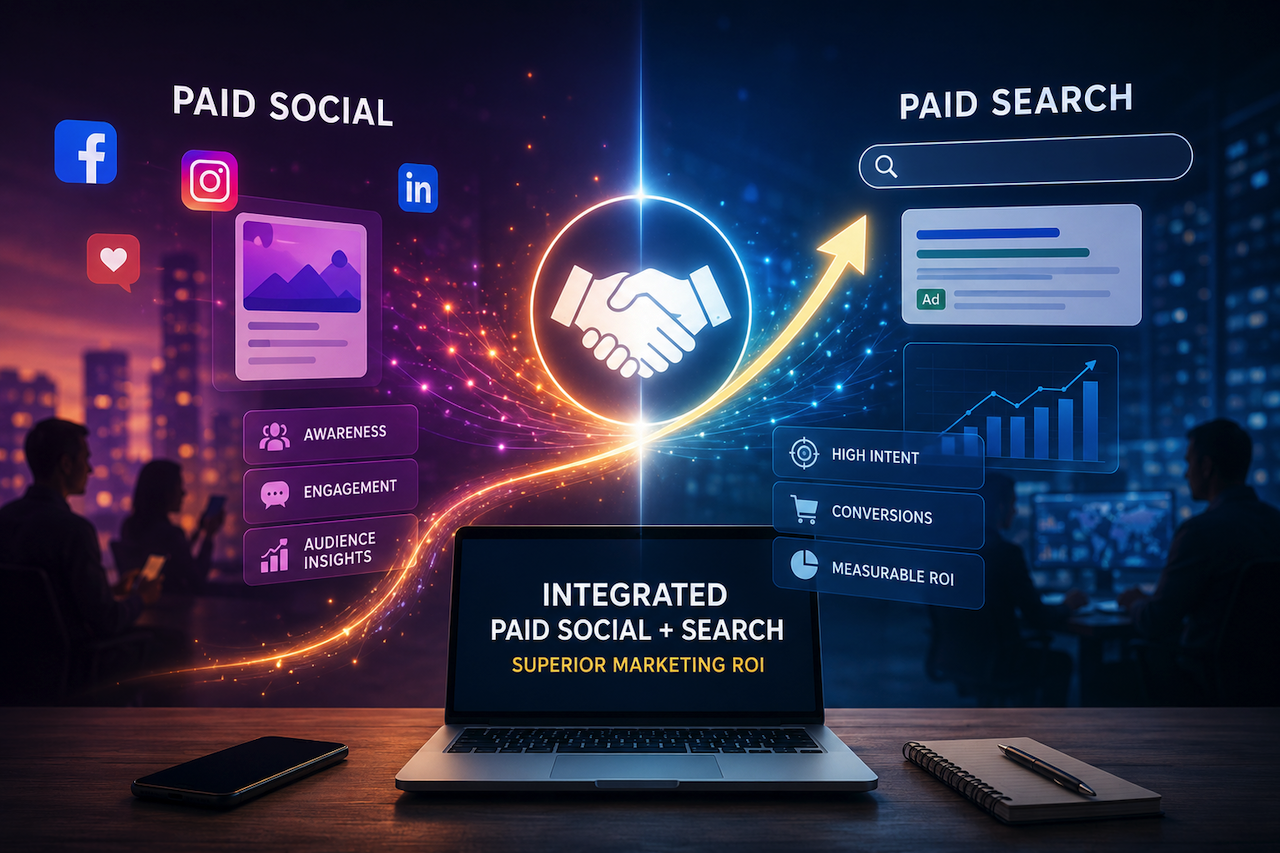
In 2026, digital marketers face an efficiency crisis. Customer acquisition costs have skyrocketed across multiple sectors, particularly for B2B organizations where companies regularly spend two dollars to acquire every single dollar of new annual recurring revenue. To combat this intense financial pressure, modern marketing professionals are moving away from isolated campaigns and adopting unified strategies. Search and social media advertising are increasingly being managed as a joint budget, projected to capture approximately 54% of the massive global digital advertising spend this year. Instead of debating whether search or social media is better, brands are scaling both simultaneously, creating a compounding effect that significantly boosts overall Return on Investment.
The Foundation of Cross-Channel Visibility
Relying strictly on organic social media to drive brand awareness for search campaigns is no longer viable. With average organic reach on platforms like Facebook dropping to just over 1%, brands must actively invest in paid placements to be seen. A cohesive paid approach ensures that a brand remains visible in buyers' social feeds while they are casually browsing, planting the seed for the moment they are finally ready to search and buy. Establishing this foundational presence is essential, as multi-channel marketing is non-negotiable for online retailers and service providers seeking to engage consumers seamlessly throughout their entire purchasing journey. Without this initial visibility, subsequent search campaigns often struggle to gain traction against competitors with stronger brand recall.
Aligning Social Demand with Search Intent
The synergy between channels lies in their core functions. Paid social excels at generating top-of-funnel demand and gathering precise audience demographic data. Paid search, conversely, captures high-intent prospects who are actively looking for a specific solution. Coordinating these two disciplines requires careful audience segmentation, keyword planning, and performance measurement. Some organizations manage these activities internally, while others work with a PPC management agency to help coordinate campaigns across multiple advertising platforms. When search and social data are aligned effectively, audience insights can be mapped to relevant search queries, helping reduce inefficiencies and create a continuous feedback loop between channels. This level of synchronization allows keyword data from search campaigns to inform social media messaging, while high-performing social audiences can be used to refine targeting strategies for search campaigns.
Key Benefits of an Integrated Approach
The statistical evidence supporting a unified cross-channel strategy is compelling. Recent industry tracking from HubSpot notes that a majority of marketing professionals now rank paid social as their top channel for cost-per-lead efficiency, making it the perfect tool to fill the top of the search funnel. However, the true financial return happens when these channels interact—according to an extensive dataset analysis by Omnisend, marketers executing campaigns across three or more integrated channels earned a staggering 494% higher order rate than those relying on isolated, single-channel efforts.
This multi-channel integration drives superior marketing ROI through several specific mechanisms:
- Higher Retargeting Conversions: Customers are 70% more likely to convert when they are served a targeted ad on social media after initially visiting a website via a paid search advertisement.
- Lower Acquisition Costs: By adapting social ad creatives based on a user's initial search query intent, companies can reduce overall customer acquisition costs by up to 50%, according to McKinsey research.
- Superior Lead Quality: Platforms like LinkedIn offer highly qualified professional data. LinkedIn advertising generates 277% more B2B leads than Facebook and Twitter combined, providing targeting signals that align perfectly with enterprise search campaigns.
- Dramatic Performance Lifts: Combining paid search intent capture with paid social demand generation yields incredible results, such as a 132% increase in conversion rate documented in recent B2B real estate campaigns.
Unifying Your Ad Spend Strategy
To achieve these superior returns, businesses need to rethink how they allocate their advertising dollars. Viewing search and social as competing departments severely limits growth. Integrating paid search and paid social helps organizations navigate the famous 95-5 rule championed by LinkedIn's B2B Institute, which states that 95% of buyers are currently out of market. By focusing solely on capturing immediate demand, brands leave significant revenue on the table and miss the opportunity to build affinity with future buyers.
A unified budget ensures your brand remains visible on social feeds for the vast majority, then captures them via search when they transition into the 5% who are ready to buy. Marketing mix modeling has shown that top-of-funnel paid social campaigns can significantly increase search volume for branded keywords, directly improving incremental return on ad spend (ROAS). When cross-channel personalization is implemented correctly, customers experience a cohesive journey from their first scroll through a social feed to their final click on a search engine results page, helping support long-term profitability.
Conclusion
As customer acquisition costs continue to rise, businesses can no longer afford to treat paid search and paid social as separate marketing functions. Search captures existing demand, while social media helps create it, making the two channels most effective when they work together. By aligning audience insights, messaging, and budget allocation across platforms, organizations can improve lead quality, increase conversion rates, and achieve stronger long-term returns. In an increasingly competitive digital landscape, an integrated search and social strategy is becoming a key driver of sustainable marketing performance.
Featured Image generated by ChatGPT.
Share this post
Leave a comment
All comments are moderated. Spammy and bot submitted comments are deleted. Please submit the comments that are helpful to others, and we'll approve your comments. A comment that includes outbound link will only be approved if the content is relevant to the topic, and has some value to our readers.
Comments (0)
No comment