
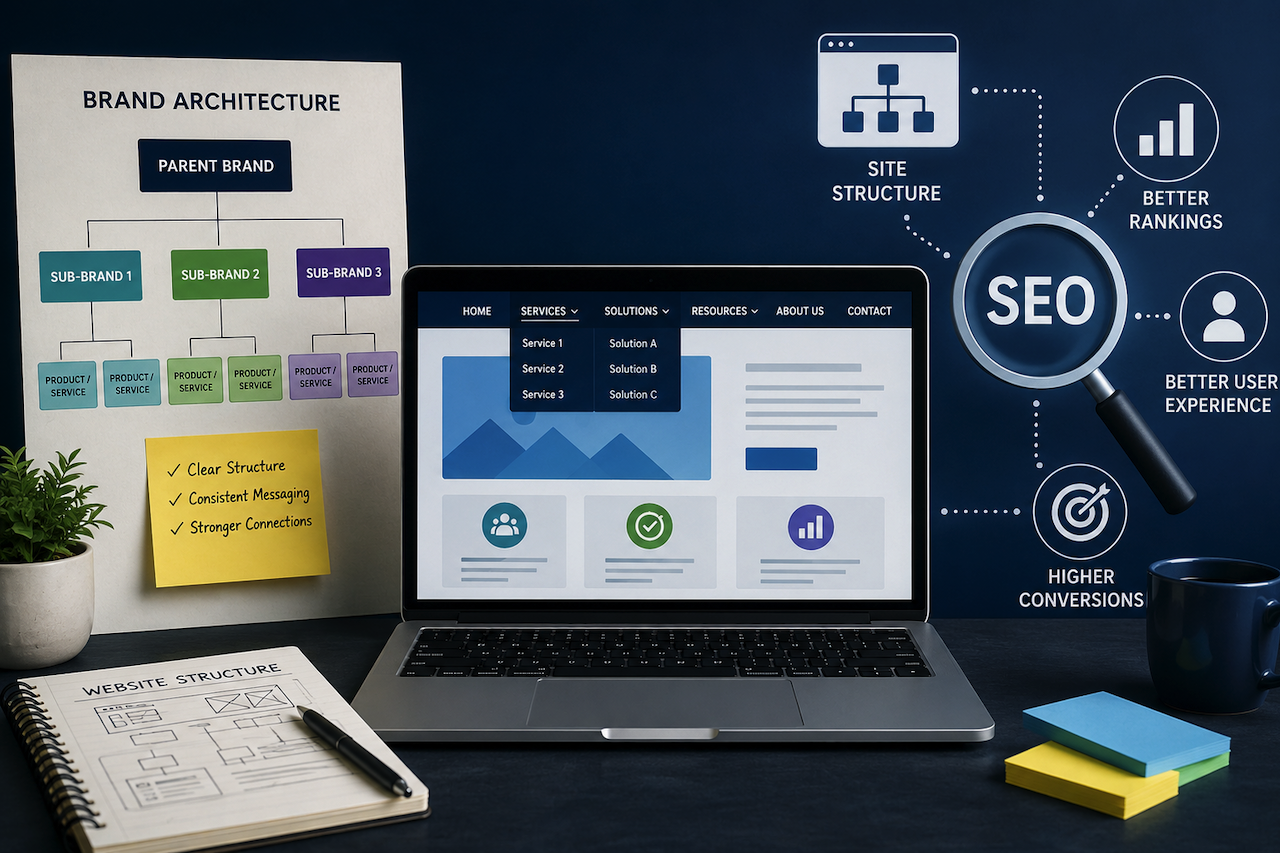
When businesses plan a website overhaul, the conversation usually jumps straight to wireframes, keyword mapping, and server response times. While these technical elements are undeniably vital, they often fail to deliver meaningful results if the core foundation is weak. That foundation is not a sophisticated codebase or a complex search algorithm. It is the brand architecture. The way a company organizes its products, services, and corporate identity in the real world must directly and logically translate into the digital realm. If the overarching brand story is disorganized or contradictory, the website navigation will inevitably be confusing, too. Without a solid brand blueprint, even the most visually appealing websites end up forcing visitors to dig through cluttered menus to find basic information.
Establishing the Strategic Blueprint
Brand architecture dictates the fundamental relationship between a parent company and its various sub-brands, products, or service lines. Before a web admin can create a logical digital taxonomy or an intuitive dropdown menu, this corporate hierarchy must be clear to everyone involved. Often, leadership teams struggle to define these boundaries internally, leading to a disjointed online presence. When internal teams cannot agree on how to categorize their own services, the end user suffers the consequences.
This is why establishing a clear brand strategy is a crucial first step before executing a major web redesign. Whether developed internally or with guidance from a brand strategy agency, defining core messaging, target audience, and market positioning helps ensure that a company's offerings are grouped in a way that makes sense to consumers. By taking an objective look at how the market perceives the business, companies can create clearer conceptual groupings that give web developers a definitive blueprint for the site's primary navigation.
Translating Identity into Crawlability
Search engines like Google rely heavily on clear site structures to understand the contextual relationship between different pages. A well-defined brand architecture naturally leads to a tightly siloed website structure. This means broad, overarching categories sit at the top of the site hierarchy, with highly specific product or service pages nested neatly underneath. When a digital property accurately mirrors a logical brand structure, web crawlers can easily index the content and assign accurate topical relevance to the correct URLs.
Once your conceptual brand structure is defined, the next step is applying advanced technical SEO strategies to ensure this new architecture performs flawlessly in search results. Proper URL structuring, robust XML sitemaps, and strategic internal linking protocols are significantly easier to implement when the underlying brand map already makes logical sense. Instead of retroactively trying to force keywords into poorly planned pages, SEO specialists can naturally optimize a structure built correctly from day one.
User Experience and the Bottom Line
Crawlability is only half of the digital equation. The structural layout of your website also dictates the entire user journey. If a prospective customer arrives on your homepage and cannot immediately understand how your core services are categorized, they will leave and visit a competitor. An intuitive layout, driven by clear, concise brand positioning, dramatically reduces the end user's cognitive load. This is particularly crucial for mobile visitors, who have limited screen space and even less patience for confusing navigation menus.
According to industry experts, optimizing your website architecture improves how users navigate your pages and interact with your digital storefront. Simplified navigation and clear calls to action strongly influence whether a visitor completes a purchase or submits an inquiry form. When a website's navigation reflects a coherent, well-planned brand architecture, users spend less time hunting for basic information and far more time engaging meaningfully with the content.
Best Practices for Aligning Brand and Web Structure
Bridging the gap between conceptual branding and technical web execution requires a collaborative, strategic approach. Marketing teams, content creators, and web admins must work together to ensure the digital footprint accurately represents the business model.
Here are several actionable steps to successfully align your corporate branding with your website taxonomy:
- Audit your current assets: Carefully map out every product, service, and sub-brand your company currently offers. Look closely for overlapping categories or confusing industry jargon that might frustrate everyday users.
- Adopt a flat site architecture: Aim for an efficient structure where users can reach any page within three to four clicks from the homepage. This streamlined approach satisfies both demanding search engine crawlers and human visitors.
- Standardize your URL slugs: Ensure your website URLs follow a consistent pattern that directly reflects your brand hierarchy (for example, domain.com/category/product-name).
- Use breadcrumb navigation: Implement visible breadcrumbs to help users instantly understand where they are located within your brand's wider ecosystem. This also provides search engines with valuable additional context about your internal site structure.
- Test your menus: Conduct rigorous usability testing on your main navigation menus. Ask impartial participants to find specific products to see if your internal branding terminology actually aligns with how external customers search for solutions.
Conclusion
Ultimately, web marketing and search engine optimization do not exist in a vacuum. The most technically sound website in the world will still struggle to convert incoming visitors if its core messaging and structural logic are deeply flawed. By viewing your brand architecture as the ultimate structural blueprint for your digital presence, you can bridge the gap between creative marketing and technical execution. This holistic approach ensures that search engines can crawl your site efficiently, users can navigate your pages intuitively, and your business can grow sustainably in an increasingly competitive digital landscape.
Featured Image generated by ChatGPT.
Share this post
Leave a comment
All comments are moderated. Spammy and bot submitted comments are deleted. Please submit the comments that are helpful to others, and we'll approve your comments. A comment that includes outbound link will only be approved if the content is relevant to the topic, and has some value to our readers.
Comments (0)
No comment