
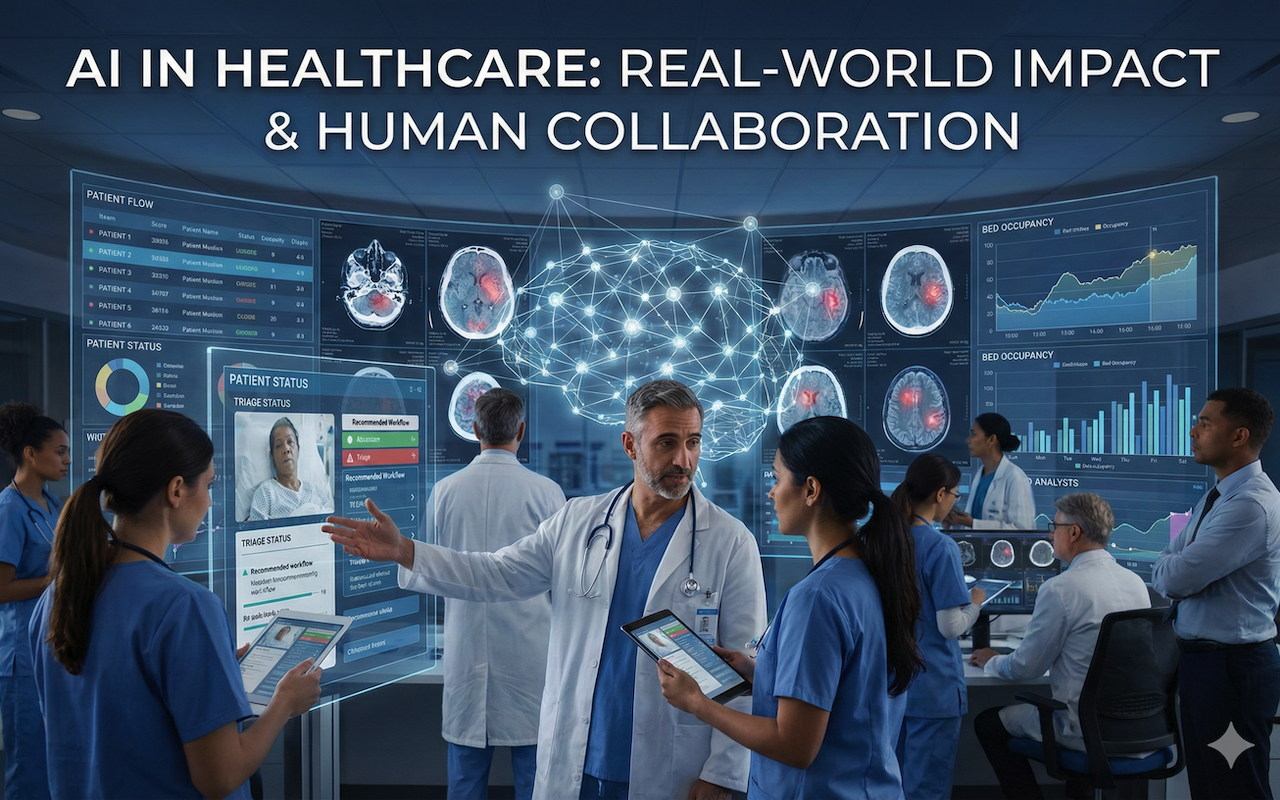
Right now, emergency rooms across many healthcare systems continue to face pressure. Long waiting times remain common, and staff shortages add to the problem. As a result, hospitals are increasingly turning to artificial intelligence to better manage patient flow and daily operations.
AI is no longer limited to research or small trials. As of recent years, hospitals and care providers are using data-driven systems to support diagnosis, manage demand, and reduce delays in treatment. Some healthcare facilities are piloting AI systems to predict patient arrivals and coordinate imaging, laboratory work, and discharge activities during busy periods. Others are introducing AI-supported triage in emergency departments to help staff prioritize care more effectively.
That is why it is the right time to discuss AI in healthcare from a real-world impact perspective. Growing patient volumes, workforce gaps, and access challenges continue to stretch healthcare systems. Medical institutions and hospitals can collaborate with an experienced AI development company to build end-to-end systems that improve coordination and support more accurate clinical outcomes.
How AI Is Used in Healthcare
AI adoption in healthcare spans both clinical and operational areas. These systems often work quietly in the background to support healthcare workers as they manage high volumes of patients and data. The main focus remains on assistance, while clinicians retain full oversight.
Currently, how AI is used in healthcare becomes clear through applications that are already active in hospital environments:
- Patient triage systems: AI can review reported symptoms and vital signs to assess urgency, helping flag patients at risk of rapid deterioration.
- Medical imaging analysis: AI assists with reviewing X-rays, CT scans, and MRIs more quickly, highlighting areas that may require closer attention and helping radiologists manage growing workloads.
- Hospital operations planning: Predictive models analyse historical admission data to forecast bed demand during peak periods, allowing hospitals to prepare staffing and resources in advance.
- Digital health platforms: AI helps patients access the appropriate level of care by analysing symptom inputs and guiding them toward telehealth, primary care, or emergency services when needed.
Doctors are increasingly using AI in healthcare to reduce repetitive tasks and manage information overload. These tools flag abnormal results, summarize patient histories, and support follow-up planning. As a result, AI use cases in healthcare continue to expand, focusing on practical needs rather than experimentation.
AI in Healthcare Diagnostics and Clinical Decision Support
One of the most discussed areas is AI-driven diagnosis in healthcare. Diagnostic systems trained on medical datasets can analyze images, pathology reports, and patient records with speed and consistency. In clinical settings, this supports earlier identification of conditions that benefit from timely intervention.
AI in healthcare diagnostics contributes to workflows in several ways:
- Imaging review support that identifies potential abnormalities for clinician assessment
- Pathology data analysis that detects markers linked to disease progression
- Risk-scoring tools that help prioritize patients with complex conditions
- Decision-support systems that compare outcomes from similar treatment cases
People often ask how accurate AI in healthcare really is. This is an important question, as clinical outcomes are at stake. Accuracy depends on data quality, model training, and strong clinical oversight. AI-assisted decision-making works best when clinicians validate outputs and apply medical context. These systems are designed to support decisions, not replace them.
Benefits of AI for Healthcare Providers and Patients
One of the biggest benefits of AI in healthcare is its impact across the entire ecosystem. For providers, AI supports efficiency and consistency. For patients, it improves access and responsiveness, creating benefits on both sides.
AI in healthcare delivers value in several areas:
- Reduced administrative burden, allowing clinicians to focus on patient care
- Faster diagnostic turnaround, supporting earlier treatment planning
- Improved access to services, including remote or underserved populations
- More consistent clinical decisions, guided by data rather than intuition
When hospitals implement AI, questions often arise about whether the investment could be better used elsewhere. However, these outcomes explain why adoption continues. AI tools can also help connect healthcare systems, enabling more informed decisions based on collective data.
Challenges, Risks, and Ethical Concerns in AI-Driven Healthcare
AI brings both benefits and risks, and the risks must be managed carefully. Discussions around the pros and cons of AI in healthcare often focus on trust, safety, and responsibility.
Key challenges include:
- AI bias in healthcare, where training data may not represent diverse populations
- Patient data privacy, particularly when handling sensitive medical records
- Clinical accountability, ensuring responsibility for AI-supported decisions
- Standards and oversight, maintaining safe and consistent AI use
Some people question whether AI in healthcare is ultimately beneficial or harmful. The answer depends on how it is implemented. Trust increases when systems are transparent, well-tested, and used with clear clinical supervision. Strong governance is essential for safety and public confidence.
Generative AI, AI Agents, and Emerging Healthcare Trends
New developments such as generative AI and AI agents are expanding how AI supports healthcare workflows. These tools focus mainly on administrative and communication tasks rather than direct clinical diagnosis.
Current trends shaping healthcare include:
- Generative AI applications that support clinical documentation and summaries
- AI agents that assist with appointment scheduling and patient follow-ups
- Integrated care platforms combining clinical and operational data
- Governance frameworks guiding responsible and compliant use
These developments reflect gradual evolution rather than sudden disruption. Adoption continues at a measured pace, aligned with regulatory requirements and clinical needs.
The Role of AI in Healthcare Systems
Healthcare systems typically include public services, private providers, and research-driven institutions. AI needs to operate across all of these environments. Interoperability, compliance, and data accuracy remain critical considerations.
AI supports system-wide goals such as better patient outcomes, shorter waiting times, and more effective use of limited resources. Predictive analytics helps organizations plan staffing needs, while data analysis supports population health insights. These applications strengthen long-term planning while keeping humans in control.
As more healthcare providers adopt AI, collaboration between technology teams and clinical professionals becomes increasingly important. Training, governance, and realistic expectations are key to successful implementation.
Conclusion: What AI Means for the Future of Healthcare
AI is already supporting many aspects of healthcare delivery. The next phase of healthcare technology is AI with humans firmly in the loop. The future of AI in healthcare depends on responsible deployment, clear governance, and continued clinical involvement.
When implemented thoughtfully, AI can reduce workload pressures on healthcare professionals while supporting safer, more efficient, and higher-quality patient care. In practice, healthcare organizations often work with experienced technology partners, such as a mobile app development company like Vrinsoft Pty LTD, to design and implement AI-enabled platforms that align with clinical workflows, compliance requirements, and patient needs.
Disclaimer
The information provided in this article is for general informational purposes only and does not constitute medical, legal, or professional advice. While efforts are made to ensure accuracy, healthcare technologies and regulations may change over time.
References to third-party websites are provided for informational purposes only. iplocation.net does not control, endorse, or assume responsibility for the content, accuracy, or availability of external links and is not liable for any loss or damage arising from their use.
Featured Image generated by Google Gemini.
Share this post
Leave a comment
All comments are moderated. Spammy and bot submitted comments are deleted. Please submit the comments that are helpful to others, and we'll approve your comments. A comment that includes outbound link will only be approved if the content is relevant to the topic, and has some value to our readers.
Comments (0)
No comment