
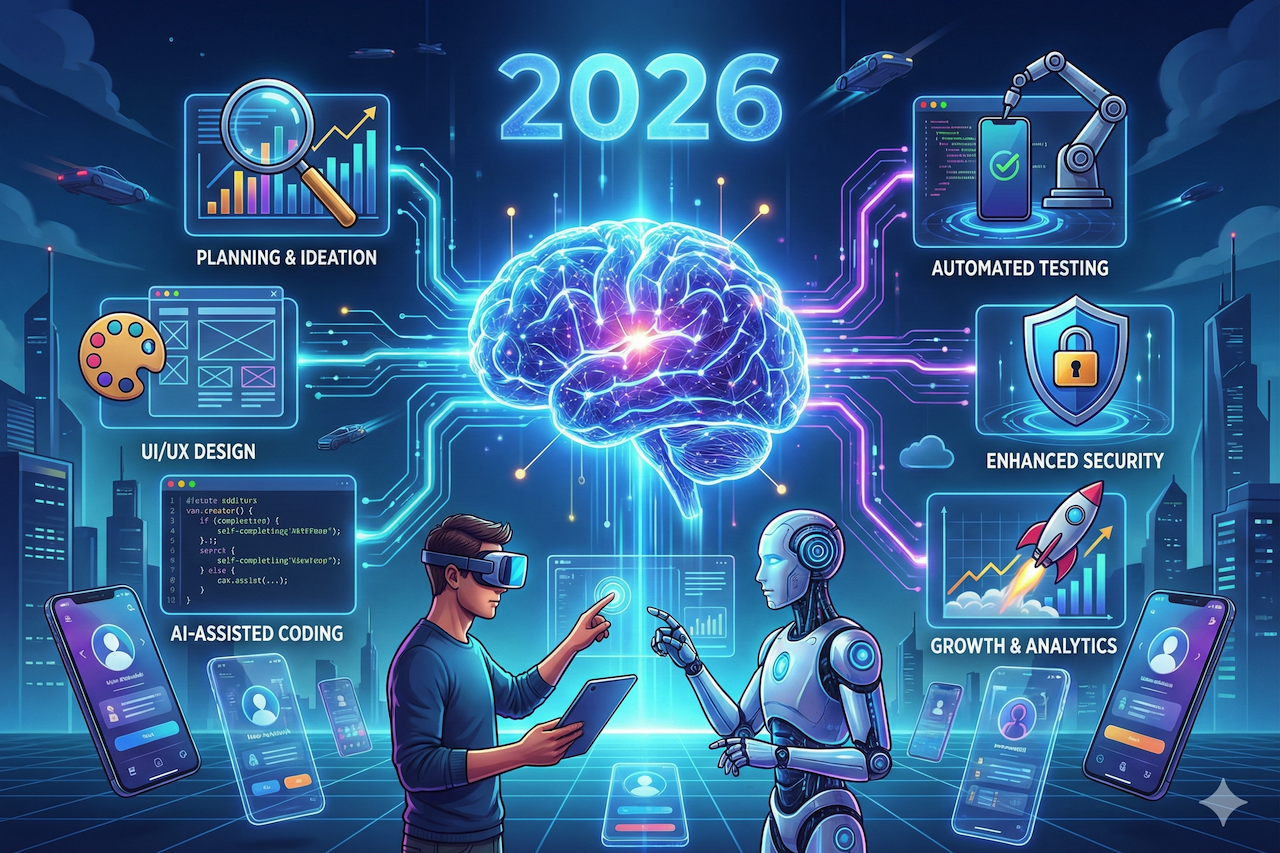
The concept of the future is no longer Artificial Intelligence (AI); it is already driving digital transformation in industries everywhere. In 2026, AI is transforming how applications are conceived, designed, developed, tested, and scaled. Businesses are accelerating decision-making, saving money, and providing many individualized digital experiences through the power of intelligent automation and data-informed decision-making.
Now, more and more companies are turning to AI-based solutions to help them stay competitive, from start-ups to companies of all sizes. This transition is even more pronounced in the mobile app industry today, where the success of an app is measured by how quickly it performs, user experience, and innovation. Let’s take a look at how AI is changing the game in app development in 2026 and why companies need to stay ahead of the curve.
The Growth of AI in App Creation
In the last decade, AI has transitioned from simple rule-based systems to more sophisticated models that can learn, reason, and make decisions. In the past, AI was used primarily for chatbots and analytics. It has evolved into a central part of the application lifecycle today.
In 2026, AI aids developers from concept to delivery. They analyze user behavior, predict feature success, write code snippets, identify bugs, and even recommend UI improvements. This transformation has reduced reliance on manual labor and improved overall development productivity.
AI-driven development is not a people replacement; it’s a people augmentation that frees developers to be creative, inventive, and solve problems.
AI-Powered App Planning and Ideation
One of its most essential implications arises very early in the planning process. AI tools study market trends, competitor apps, and user preferences before a single line of code is written.
How AI helps in planning:
- Based on real-time user demands
- Finds a lack of features in other solutions
- Recommends monetization strategies
- Examines user comments of other apps like this
With predictive analytics, firms can quickly validate app ideas and mitigate the risk of failure. This data-informed approach ensures apps are created with a defined purpose and optimal market fit.
Smarter UI/UX Design With AI
UX is the difference between an app that fails and one that succeeds. It’s 2026, and AI-driven design tools are now commonplace in the way interfaces are constructed and refined.
AI can:
- Analyze user interaction patterns
- Suggest layout improvements
- Optimize UI based on user demands.
- Conduct automated A/B testing.
Rather than guesswork, designers are now informed by AI, leading to more intuitive and engaging interactions. The result is apps that feel more human, responsive, and user-focused.
AI-generated design also accelerates prototyping, enabling teams to see a concept quickly and iterate efficiently.
AI-Assisted Coding and Development
AI-enhanced development tools are making coding faster and more accurate. These tools help developers by writing code, identifying errors, and advising on best practices in real time.
Key benefits of AI-assisted coding:
- Faster development cycles
- Reduced human error
- Cleaner and optimized code
- Better collaboration among teams
AI tools for mobile app development enable faster architectural scaling, easier API integration, and consistent code across platforms, resulting in more robust applications in less time.
Automated Testing and Quality Assurance
Until now, testing has been one of the most time-consuming parts of app development. In 2026, testing will no longer be the bottleneck, thanks to AI automating many processes.
AI can:
- Detect bugs early in development
- Perform regression testing automatically
- Simulate real-user behavior
- Identify performance bottlenecks
Machine learning models continuously learn from previous test cases, ensuring apps are more stable, crash less, and keep users happy after launch.
Personalized User Experiences With AI
Personalization is no longer a luxury; it’s what users expect. AI enables apps to use real-time information to deliver personalized experiences to customers.
Examples include:
- Content recommendations
- Customized notifications
- Adaptive interfaces
- Behavior-based features
Apps are more engaging and relevant when they can predict user preferences. This results in greater retention, better conversions, and long-term loyalty.
AI and Predictive Analytics for App Growth
AI doesn’t stop working after an app launches. It helps businesses understand how users interact and what to do next.
AI-driven insights can:
- Predict churn rates
- Identify high-value users
- Optimize marketing campaigns
- Suggest feature enhancements
With these insights, organizations can make proactive rather than reactive decisions, helping them scale faster and improve ROI.
Enhanced App Security With AI
As apps handle more sensitive data, security has become a top priority. AI is essential for identifying and preventing cyber threats.
In 2026, AI-powered security systems:
- Detect suspicious behavior in real time
- Prevent fraud and data breaches
- Strengthen authentication methods
- Monitor vulnerabilities continuously
AI security ensures compliance with data protection laws while maintaining user trust.
Efficiency in Costs and Time Via AI
One of the key benefits of AI in app development is cost reduction. Automation reduces manual work, speeds up development, and minimizes errors.
Businesses benefit from:
- Faster time-to-market
- Reduced development costs
- Efficient resource utilization
- Scalable development processes
Using AI, businesses can create premium apps without overspending or sacrificing innovation.
AI in Cross-Platform Development
AI enhances cross-platform app development, ensuring consistency across devices and operating systems. Innovative tools automatically adapt layouts, performance, and features for each platform.
This enables companies to reach a broader audience with a consistent brand experience. AI also simplifies maintenance and updates, making cross-platform apps more scalable and reliable.
AI in 2026: Why Businesses Must Embrace It
The competition is more challenging than ever. Users expect fast, intelligent, and personalized digital experiences. Companies that fail to embrace AI risk being left behind.
By working with modern development teams, businesses can build future-proof applications powered by AI. Artificial intelligence is no longer a bonus; it’s a necessity for growth.
The organizations that adopt AI now will be tomorrow’s digital leaders.
Outlook: Where Is AI Going With App Development?
As AI continues to advance, we’ll see:
- Fully autonomous development workflows
- Emotion-aware applications
- Deeper integration with IoT and AR/VR
- Smarter voice and gesture-based interfaces
The future will merge human creativity and machine intelligence, unlocking new opportunities in mobile app development.
Businesses that invest early in AI innovation will lead the digital transformation.
Conclusion
In 2026, AI has made app development faster, smarter, and more user-focused. From planning and design to testing, security, and growth, AI touches every part of the app lifecycle.
For businesses, adopting AI-driven development isn’t optional; it’s essential. Those that do will stand out, deliver better user experiences, and succeed long term in the digital world.
Featured Image generated by Google Gemini.
Share this post
Author

Leave a comment
All comments are moderated. Spammy and bot submitted comments are deleted. Please submit the comments that are helpful to others, and we'll approve your comments. A comment that includes outbound link will only be approved if the content is relevant to the topic, and has some value to our readers.
Comments (0)
No comment