
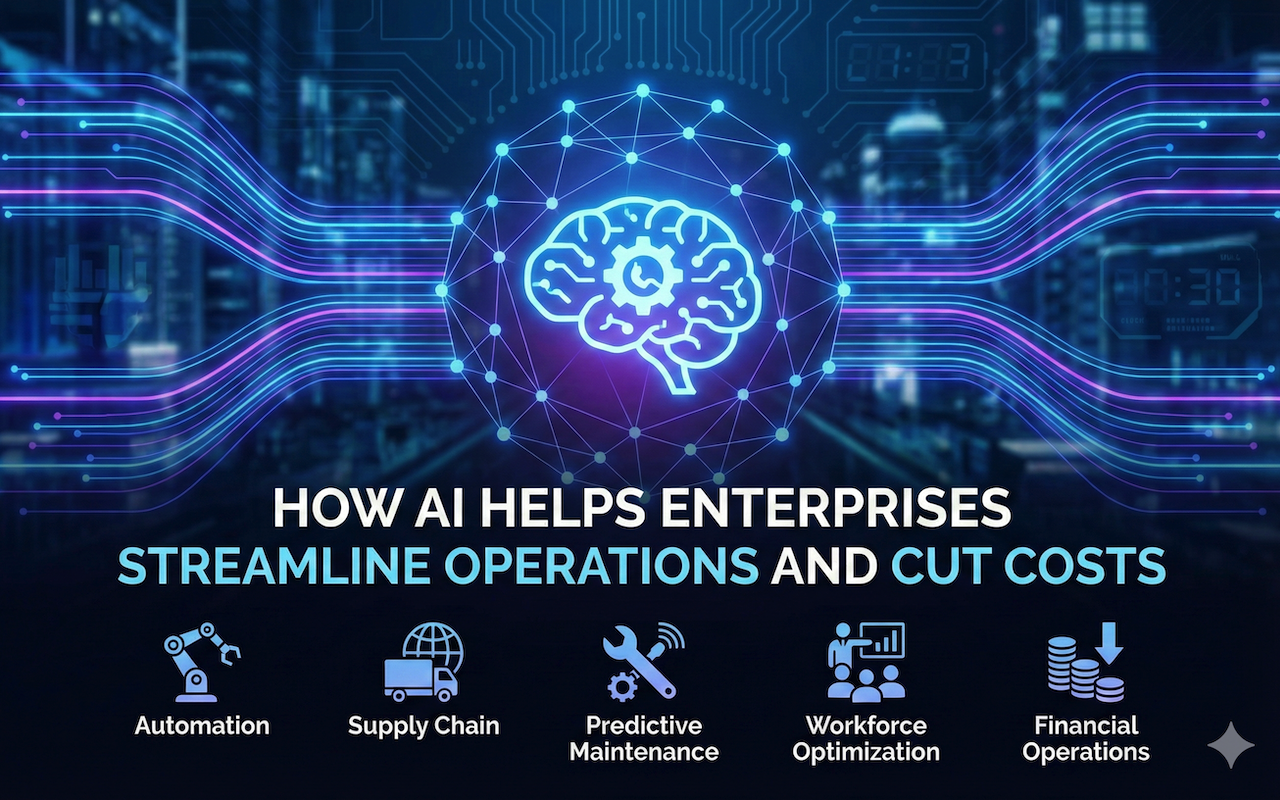
Enterprise operations are under steady pressure to do more with less. Rising costs, complex supply chains, workforce challenges, and growing customer expectations have made efficiency a top priority. This is where AI in operations is proving to be a game changer. No longer limited to experimentation or innovation labs, AI is now embedded in day-to-day enterprise operations, streamlining workflows, reducing waste, and unlocking measurable cost savings.
From predictive maintenance and intelligent automation to AI-driven supply chain optimization, organizations are using artificial intelligence to make operations faster, smarter, and more resilient. This article explores how AI is helping enterprises streamline operations and reduce costs, using practical examples, real-world use cases, and strategic insights. It also examines how internal teams and AI development companies support the design, integration, and scaling of these solutions. By the end, you’ll understand where AI can deliver the highest operational ROI and how businesses can adopt it without disrupting existing systems.
AI-Powered Process Automation for Operational Efficiency
One of the most impactful uses of AI in operations is process automation. While traditional automation follows fixed rules, AI-powered automation learns from data, adapts to change, and improves over time. This makes it well suited for complex enterprise environments.
In large organizations, operational processes such as order processing, invoice management, payroll validation, and compliance reporting often involve thousands of repetitive steps. When AI is combined with robotic process automation (RPA), these workflows can be automated end-to-end. Machine learning models can read documents, classify data, detect anomalies, and trigger actions with minimal human intervention.
For example, enterprises using intelligent automation in financial operations have reduced invoice processing times from days to minutes while significantly lowering error rates. In HR operations, AI supports resume screening, onboarding workflows, and employee data updates—reducing administrative effort and accelerating hiring cycles.
The greatest cost savings emerge when AI is applied across entire workflows rather than isolated tasks. Connecting finance, HR, procurement, and compliance into a unified automation layer delivers compounding efficiency gains.
AI in Supply Chain and Logistics Optimization
Supply chains are among the most cost-intensive components of enterprise operations. AI in operations is transforming supply chains by improving visibility, forecasting demand, and reducing inefficiencies across procurement, inventory, and logistics.
AI-driven demand forecasting analyzes historical data, seasonality, market trends, and external signals to predict demand more accurately. This enables organizations to reduce excess inventory, prevent stockouts, and optimize warehouse utilization. In logistics, AI-based route optimization lowers fuel costs and delivery times by dynamically adjusting routes based on traffic, weather, and demand patterns.
Predictive analytics also helps organizations identify supply chain risks early, such as supplier delays or geopolitical disruptions, allowing corrective action before costs escalate.
Predictive Maintenance and Asset Optimization
For asset-intensive industries such as manufacturing, energy, transportation, and utilities, maintenance represents a significant operational expense. AI in operations enables predictive maintenance, one of the most direct ways enterprises reduce costs.
By analyzing sensor data, machine logs, and historical performance, AI models predict when equipment is likely to fail. Maintenance teams can intervene before breakdowns occur, avoiding costly downtime and emergency repairs. Compared to scheduled maintenance, predictive maintenance reduces unnecessary servicing while extending asset lifespan.
Organizations implementing AI-driven maintenance strategies consistently report lower maintenance costs and improved equipment uptime, directly supporting productivity and operational continuity.
Workforce Optimization and Intelligent Resource Planning
Labor is one of the highest operational costs for enterprises. AI in operations helps optimize workforce planning, scheduling, and productivity without compromising quality.
AI-powered workforce analytics examines workload patterns, skill availability, and demand fluctuations to create more accurate staffing plans. In customer operations, AI forecasts call volumes and adjusts staffing levels accordingly. In manufacturing and logistics, it aligns labor allocation with production and delivery requirements.
AI also supports employee productivity by acting as a digital assistant—automating reporting, answering internal questions, and guiding staff through complex processes. This reduces time spent on non-core tasks and improves overall efficiency.
AI-Driven Cost Control and Financial Operations
Cost leakage is often hidden within financial operations through duplicate payments, unapproved expenses, inefficient procurement, and inaccurate forecasting. AI in operations brings intelligence to financial workflows, enabling real-time cost control.
AI models analyze spending patterns to detect anomalies, identify savings opportunities, and enforce compliance automatically. In procurement, AI evaluates supplier performance, pricing trends, and contract terms to support more cost-effective purchasing decisions.
Enterprises also use AI for cash flow forecasting, scenario planning, and budgeting. By modeling multiple operational scenarios, decision-makers can balance growth objectives with cost efficiency.
The advantage of AI-driven financial operations lies in proactive cost management. Instead of reacting to overruns after they occur, organizations can prevent them in advance.
Operational Decision-Making with AI and Advanced Analytics
Beyond automation, AI strengthens decision-making across enterprise operations. Advanced analytics platforms transform large volumes of operational data into actionable insights faster and more accurately than traditional reporting methods.
AI-powered dashboards provide real-time visibility into key performance indicators such as operating costs, throughput, efficiency, and risk. Machine learning models identify patterns that may be difficult for humans to detect, enabling leaders to address issues before they escalate.
For example, AI can highlight which operational bottlenecks are driving cost overruns or which process changes are likely to deliver the highest ROI. This data-driven approach replaces intuition with evidence.
AI shifts organizations from reactive operations to predictive and prescriptive models, where decisions are guided by expected future outcomes rather than past performance.
Conclusion
AI is no longer an experimental technology; it is a proven operational advantage. As enterprises face rising cost pressures and increasing complexity, AI in operations provides a practical path to efficiency, resilience, and scalability. From intelligent automation and predictive maintenance to supply chain optimization and financial cost control, AI delivers measurable savings while improving overall performance.
The key to success lies in strategic adoption. Organizations that focus on high-impact use cases, integrate AI into existing workflows, and prioritize long-term value consistently outperform those that treat AI as a standalone tool. By combining human expertise with machine intelligence, enterprises can operate more effectively and achieve sustainable cost reductions.
If you are evaluating how to streamline operations and reduce costs, now is the right time to identify where AI can make the greatest impact. Start with targeted initiatives, measure results, and scale with confidence.
Featured Image generated by Google Gemini.
Share this post
Leave a comment
All comments are moderated. Spammy and bot submitted comments are deleted. Please submit the comments that are helpful to others, and we'll approve your comments. A comment that includes outbound link will only be approved if the content is relevant to the topic, and has some value to our readers.
Comments (0)
No comment