
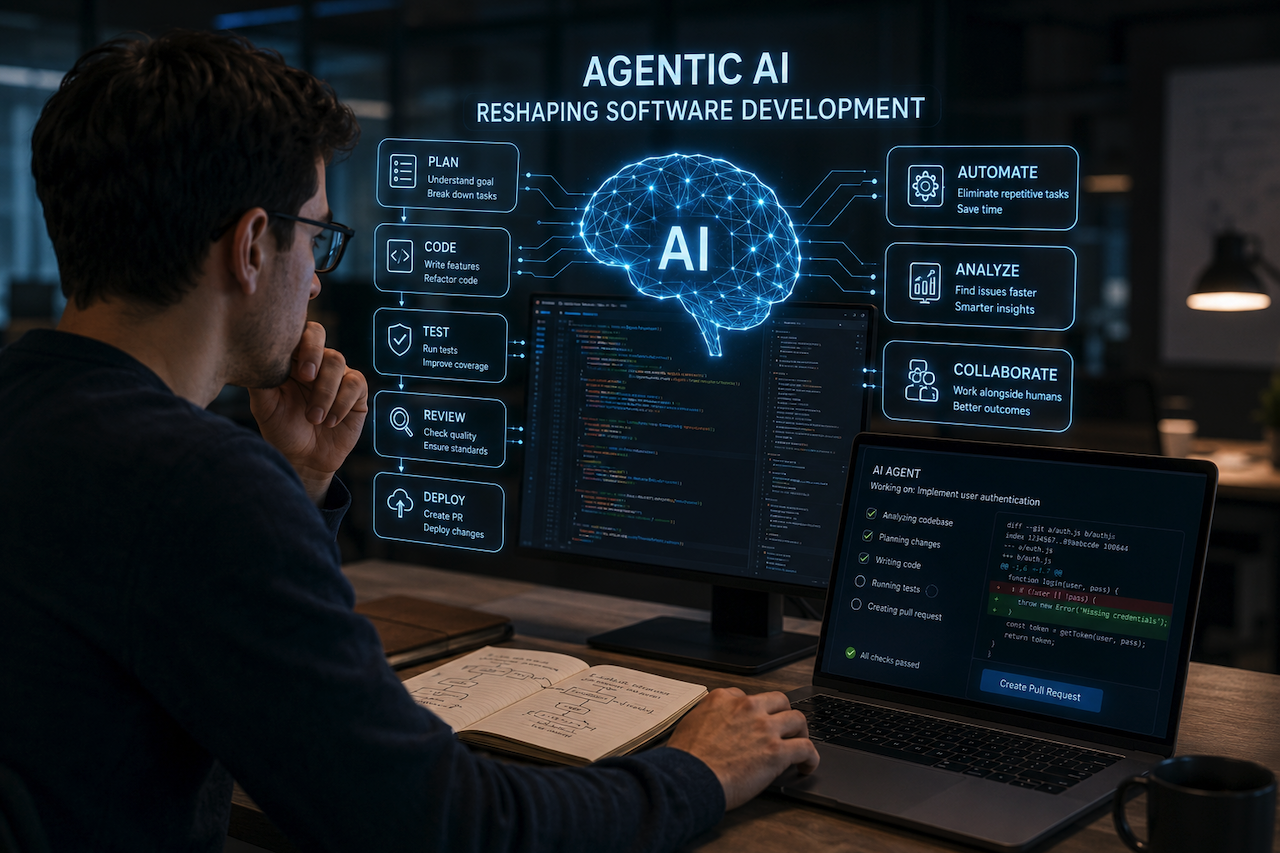
A few years ago, if you asked a developer what AI did for them, they might have shrugged and mentioned autocomplete. Maybe a code suggestion here and there. Useful, sure, but nothing earth-shattering. Fast forward to today, and the conversation sounds completely different. Developers are talking about AI agents that don't just suggest code. They go off and write entire features, fix bugs across multiple files, and even open pull requests while the team grabs coffee.
This shift has a name: agentic AI. And if you build software for a living, it is worth understanding what is actually changing on the ground. Development teams are quietly rebuilding the way software gets designed, tested, and delivered around these systems, and many people still have no idea how quickly the workflow is evolving.
What Makes AI "Agentic" Anyway
The simplest way to think about it is this. Traditional AI tools wait for you to ask a question. Agentic AI takes a goal and figures out the steps on its own.
Give an old-school code assistant a prompt like "fix this function," and it will offer a suggestion. Give an agent the same task, and it might read the function, look at how it is used elsewhere, run the tests, notice a related issue two files over, and patch that too. It plans, executes, checks its work, and keeps going until the job is done.
The clearest way to see it: a copilot helps you type. An agent helps you ship.
That difference sounds small on paper. In practice, it changes who does what on a software team, how long projects take, and what clients should expect when they sign a contract.
A Quick Look at How We Got Here
Software development has gone through a few quiet revolutions. Manual coding gave way to frameworks. Frameworks gave way to agile workflows. DevOps brought automation to the deployment and testing pipeline. Then came AI copilots that could finish a line of code or suggest a function.
Each of those changes made developers faster. None of them changed the basic shape of the work. A human still made every decision and pushed every keystroke that mattered.
Agentic AI is the first wave actually to change the shape of work. The human is still in charge, but the human is reviewing and directing rather than typing every line. That sounds subtle. It is not.
Where It Is Showing Up in Real Projects
Faster Prototyping and Same-Day Demos
Custom software used to start with weeks of discovery, mockups, and back-and-forth. Agents are compressing that timeline. A product manager can describe a feature in plain English and, within hours, have a working prototype to click through. Not production-ready, but real enough to show stakeholders and gather feedback. Teams that used to spend a month on the first demo are now showing something tangible by Friday.
This shift is also changing expectations around timelines and delivery speed in custom software development services. A project that may have taken eight weeks to produce a working MVP a year ago can now often reach the prototype stage much faster with the help of agentic AI tools and automation.
Code That Actually Fits Your Codebase
Earlier code suggestions were generic. They didn't know your naming conventions, your folder structure, or that one weird utility function everyone uses for date formatting. Agents do better here because they can read the whole repository before writing anything. The output starts to look more like what your senior engineer would write, not a Stack Overflow snippet pasted in cold.
This matters most for projects where consistency counts, such as enterprise platforms with five years of history. Agents can absorb that history and write code that respects it.
Testing Without the Yawning
Let's be honest. Writing tests is rarely anyone's favorite part of the job. Agents handle this surprisingly well. They can scan a function, generate edge cases a tired human might miss, run the tests, and adjust until coverage looks healthy. Some teams report cutting test writing time in half, freeing developers to focus on harder design problems.
Bug Hunts That Don't Eat the Afternoon
Tracking down a bug that only shows up in production used to mean hours of digging through logs and tracing issues manually. An agent can now ingest logs, reproduce the issue locally, identify the likely root cause across multiple parts of the application, and propose a fix. Human review is still essential, but much of the repetitive troubleshooting work can be significantly reduced.
Documentation That Stays Current
Documentation rots. Everyone knows it, nobody wants to fix it. Agents can keep docs synced with code as it changes, write changelogs, and generate onboarding guides for new hires. Boring work, finally getting automated.
Legacy System Modernization
This one is quietly huge. Enterprises sitting on twenty-year-old codebases have spent decades dreading rewrites. Agents can analyze legacy systems, document what they actually do (often a surprise to everyone involved), and incxrementally rewrite components without breaking what already works. Modernization projects that once felt impossible now feel achievable, even if they are still not easy.
What This Means for the People Building Software
Here is where things get interesting. The fear that AI will replace developers misses what is actually happening. Software developers are still very much in the picture, but the job is shifting.
Less time is being spent typing out boilerplate. More time goes into reviewing what the agent produced, deciding whether the approach is right, and making the architectural calls that matter. Junior developers are being pushed to think more like seniors earlier in their careers because machines are handling routine work. Seniors are spending more energy on system design, security, and the messy human parts of software, like figuring out what the customer actually needs.
The economics of software development are shifting as well. Projects that once required five engineers working for six months may now be completed by smaller teams in significantly less time. That changes how teams estimate timelines, allocate resources, and approach project delivery overall.
What Teams Should Actually Watch For
If you are evaluating software development teams in this new landscape, there are a few questions worth asking that did not matter nearly as much a year ago.
- How are agents being used in their workflow? A vague answer is a yellow flag. Teams that have figured this out can describe specific places where agents save time and specific places where they keep humans firmly in control.
- Who reviews agent output before it ships? "Nobody, the AI handles it" is the wrong answer. So is "We don't use AI." The right answer sounds like a thoughtful process where senior engineers vet anything risky before it goes anywhere near production.
- How is your code and data protected? Agents need access to repositories and, sometimes, to production systems. Development teams should be able to explain their guardrails without breaking a sweat. If they get cagey, take that as data.
- Are project timelines and prices reflecting the new reality? If a vendor is quoting traditional timelines and traditional prices while quietly using agents to deliver in half the time, that is worth a conversation.
The Parts Nobody Is Talking About Loudly Enough
Agentic AI is not magic. A few things deserve honest attention before any team goes all in.
Agents make mistakes confidently. They will write code that looks great and quietly does the wrong thing. Without a human who knows what they are looking at, those mistakes ship. Code review has never mattered more than it does right now.
Security is a moving target. An agent with access to your repository, cloud account, and production database is a powerful tool and a serious risk. Permissions, audit logs, and guardrails are no longer optional.
Then there is the quiet problem of skill atrophy. If junior developers never struggle through writing their first authentication flow from scratch, do they actually learn how it works? Teams are starting to think hard about how to balance speed with the kind of deep learning that builds real engineers over time.
There is also a governance question that deserves more airtime. Who owns the code an agent writes? How do you handle bugs in AI-generated code that nobody fully understands? These are not abstract concerns. Smart teams are working through them now, rather than waiting for a problem to force the issue.
How to Start Without Getting Burned
For organizations exploring agentic AI, the right path is rarely "go all in immediately." A more useful pattern looks like this.
Start with internal tools or low-risk projects where mistakes won't sink the company. Use agents for the work nobody wants to do anyway, like documentation, test generation, and refactoring. Build human review into every workflow, especially for anything customer-facing or security-sensitive. Track what actually gets faster and what doesn't, because the wins are real but uneven.
Then expand from there. Teams that learn the tools on small projects develop the judgment to use them on bigger ones. Teams that skip that step tend to make expensive mistakes in public.
Where This Is Heading
Custom software development is becoming less about typing and more about judgment. The teams winning right now are the ones treating agents as collaborators, not replacements. They are rethinking their workflows, retraining their developers, and being honest about what agents do well and where humans still need to drive.
The next few years will probably bring agents that handle even larger pieces of work: full features, entire microservices, maybe whole applications for simpler use cases. The best builders will be the ones who learn to direct that capability with taste and clear thinking, rather than getting steamrolled by it.
If you are evaluating a software development team today, the question is no longer whether they use agentic AI. The more important questions are whether they use it effectively, whether they are transparent about it, and whether their pricing reflects the speed and efficiency these tools can provide. Asking the right questions can reveal a great deal about how a team actually works.
Conclusion
Agentic AI is changing software development faster than many teams expected. Tasks that once consumed days of manual effort can now be accelerated through AI-assisted workflows, allowing developers to focus more on architecture, problem-solving, and oversight rather than repetitive implementation work.
At the same time, the technology introduces new questions around security, governance, code quality, and long-term developer growth. The teams adapting most successfully are not the ones replacing humans entirely, but the ones learning how to combine human judgment with AI-driven execution in a practical and controlled way.
As agentic AI continues to evolve, software development will likely become less about writing every line manually and more about directing, reviewing, and refining increasingly capable systems. Understanding how these tools work, and where their limits still exist, will become an important part of building modern software responsibly.
Featured Image generated by ChatGPT.
Share this post
Leave a comment
All comments are moderated. Spammy and bot submitted comments are deleted. Please submit the comments that are helpful to others, and we'll approve your comments. A comment that includes outbound link will only be approved if the content is relevant to the topic, and has some value to our readers.
Comments (0)
No comment