
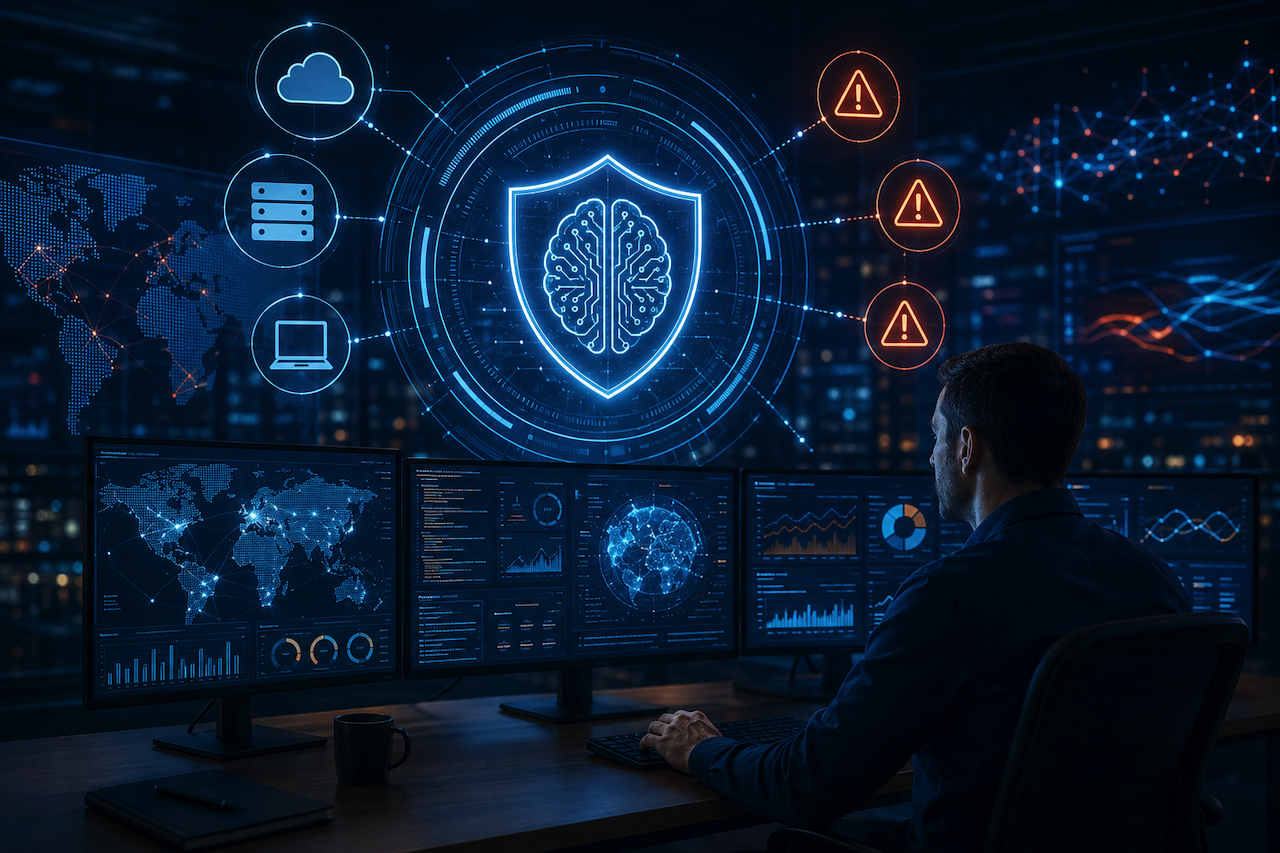
Business processes increasingly rely on digital systems, cloud-based platforms, connected devices, and remote work environments, prompting threat actors to develop increasingly sophisticated attacks. This escalating risk profile is supported by macroeconomic data indicating that global cybercrime costs are projected to drive annual economic losses exceeding $10.5 trillion, outpacing traditional defensive scalability. However, while traditional security technologies will remain necessary, many will be unable to keep pace with advancing threats.
This emerging approach is beginning to reshape cybersecurity operations. Unlike traditional AI systems that primarily analyze information and provide recommendations, these systems can monitor environments, evaluate conditions, and take action with greater autonomy. Their ability to learn from experience and adapt to changing circumstances allows them to respond more effectively to evolving threats.
Rather than waiting for human operators to review alerts and implement preventive measures, these systems can act independently based on available data, risk assessments, and predefined objectives. This enables organizations to identify and address potential security issues before they escalate into larger incidents.
As cyberattacks become faster, more automated, and increasingly sophisticated, many organizations are exploring autonomous AI-driven security capabilities to strengthen their defenses, support compliance efforts, and improve incident response efficiency.
Understanding Agentic AI in Cybersecurity
Agentic artificial intelligence (AI) refers to intelligent systems capable of acting autonomously. Unlike traditional AI tools that primarily analyze information and provide recommendations, these systems can monitor environments, assess conditions, identify potential threats, and take action with minimal human intervention.
In security operations, their primary role is protecting digital assets, including networks, applications, devices, and sensitive information. This is accomplished through the continuous analysis of large volumes of security data, identifying abnormal behavior, investigating suspicious activity, and responding to risks before they escalate into larger incidents.
Organizations generate enormous amounts of security-related data every day, making it difficult for analysts to manually review every alert. As a result, important threats can be overlooked. These autonomous systems help address that challenge by working alongside security teams, continuously monitoring environments, prioritizing risks, and supporting faster response efforts around the clock.
Why Traditional Security Systems Are Struggling
Cybercrime has changed massively in the last year. Cybercriminals are now using advanced techniques to commit their crimes, such as using artificial intelligence for phishing scams, ransomware, credential theft, intelligence-based assaults, and zero-day exploits.
Standard security measures usually rely on preset rules and recognized signatures to protect against problems. When fighting familiar attacks, these techniques can be highly effective; however, they may not detect newly developed or previously unidentified risks. Also, security personnel experience alert fatigue when their systems produce an excessive number of alerts.
As a result, some critical risks can go undetected for long periods.
These systems address many of the limitations of traditional security tools by continuously learning from network activity, user behavior, threat intelligence, and historical incident data. Rather than relying solely on known attack signatures or predefined rules, they can identify anomalies that may indicate an emerging threat.
Detecting Threats Through Behavioral Analysis
Every organization has a unique digital environment. Employees log in at different times, applications communicate in distinct ways, and systems develop recognizable usage patterns. Over time, these autonomous systems learn what normal activity looks like and use that baseline to identify unusual behavior.
When a behavior is unusual relative to the company's history, AI can quickly recognize and identify the pattern.
For example, if an employee's account is compromised and suddenly starts accessing sensitive files (this is now the new normal for that employee), but they are now accessing the files from an unfamiliar location, or they begin to download large amounts of data outside of normal working hours, AI would flag this type of behavior as suspicious.
Behavioral analysis is unlike traditional tools that identify malware by looking for known malware signatures. Behavioral analysis can help to identify potential threats before discovery/recognition. This is particularly useful in identifying internal threats, compromised accounts, or advanced attacks.
Faster Detection of Zero-Day Attacks
A zero-day vulnerability is a type of cybersecurity threat that poses a significant challenge because it is not known to either the vendors who develop the software or the security teams responsible for protecting it. As a result, when attackers learn about a new zero-day vulnerability, they can exploit it before a patch to fix it becomes available.
Traditional security systems typically struggle to detect zero-day attacks because they rely on signatures or rules that exist to identify known attacks. However, agentic AI works differently; instead of looking for attack signatures, it looks for abnormal behaviors in the system.
For example, if an application suddenly starts operating differently from how it normally does, the AI will detect the behavioral anomaly and investigate further.
By detecting anomalous behavior at an early stage, organizations can respond more quickly and reduce the impact of zero-day attacks on their networks.
Automating Incident Response
The detection of risks is only the beginning. It is just as important to act quickly to thwart the risk.
For most organizations, security analysts have to manually investigate each alert, assess the risk, and decide what actions to take to respond. This takes time, and it becomes an even bigger problem when dealing with many risks during a mass attack.
Organizations can use autonomous security systems to automate much of the incident response process. Once a potential threat is identified, the system can immediately initiate predefined actions such as:
- Isolating any devices that are compromised
- Blocking any IP addresses that are suspected of being malicious
- Deactivating any suspicious accounts
- Restricting any unauthorized access
- Initiating additional Investigation steps.
All of these actions would occur in seconds rather than hours, giving the attacker less time to move throughout the network and cause damage.
Strengthening Phishing and Social Engineering Defense
Cybercriminals still use phishing as an easy way to gain access to a target's computer system by creating fake emails, text messages, or websites that mislead consumers into giving away their confidential data. Because of advanced technology such as artificial intelligence (AI), cybercriminals now have a much better chance of camouflaging their phishing attempts and evading detection than they did in years past.
Phishing attacks can be detected in real time by analyzing email content, sender behavior, communication patterns, and any embedded links or attachments. These systems can identify subtle indicators of malicious activity even when traditional detection methods fail. They also continuously learn from newly identified phishing campaigns, improving their ability to recognize emerging tactics and techniques.
Enhancing Threat Hunting Capabilities
Threat hunting is the proactive effort to discover hidden threats in the organizational environment before they trigger security alerts. Threat hunting has traditionally required highly skilled analysts to perform manual analysis of log files, network activity, and system events; this typically takes considerable time and resources.
With AI supporting threat hunting, security analysts can continuously scan vast amounts of security data while identifying relationships that might otherwise go undetected. These systems can correlate events across multiple environments to uncover hidden attack paths and help determine which risks require the most immediate attention.
By taking a proactive approach, organizations can detect threats earlier than they otherwise would and improve their overall security posture.
Protecting Cloud and Hybrid Environments
The majority of today’s businesses use a combination of on-premises, hybrid, and cloud-based systems; therefore, managing security across all these systems is very challenging.
These systems provide a broad view of the organization's environment and can monitor activity across multiple platforms simultaneously. They can identify unusual behavior, detect potential misconfigurations that may expose sensitive information, and recommend or apply appropriate security controls to reduce risk.
Because cloud environments change rapidly, the ability to learn and adapt in real time is especially valuable. As infrastructure evolves, security measures can evolve alongside it, helping organizations maintain visibility and protection across dynamic environments.
Reducing Security Team Workloads
As threats become more numerous and complex, security professionals are continually pressed to do more with less. Many organizations have limited resources and struggle to manage the volume of alerts generated each day.
These systems help automate routine alert monitoring and prioritize the most critical risks. This allows security teams to focus on high-risk incidents and strategic initiatives rather than reviewing large volumes of routine alerts.
The reduction in operational costs and improvements in overall security effectiveness will enhance security teams' ability to provide adequate protection against cyberattacks.
Challenges and Considerations
While these systems offer significant advantages, they do not replace human expertise, judgment, and experience.
To responsibly utilize AI systems, organizations must ensure that they are properly trained, continuously validated, and monitored for compliance with security policies and industry regulations. Human oversight remains essential for handling complex situations, making strategic decisions, and ensuring that AI technologies are used ethically and responsibly. As organizations increasingly rely on automated decision-making, understanding why AI matters for transparency, trust, and better decisions becomes increasingly important. Organizations must understand how AI-driven decisions are made, maintain appropriate oversight, and build trust in automated security processes.
There are additional challenges posed by adversarial attacks, in which cybercriminals exploit vulnerabilities in AI systems to manipulate or deceive them. Therefore, organizations need strong governance frameworks, continuous validation processes, and robust security measures to maximize the benefits of agentic AI while minimizing potential risks.
The Future of Digital Defense
As digital defense moves into a new age of speed, flexibility, and smartness, the way defense technologies evolve to keep pace with the rise of automation and artificial intelligence used by attackers is critical.
Agentic AI represents an important step forward in the evolution of modern security operations. Its ability to identify threats, analyze complex patterns, respond to incidents, and continuously learn from new data makes it a valuable addition to modern security operations.
Organizations that adopt this technology may benefit from improved threat visibility, faster response times, reduced operational burdens, and greater resilience against evolving cyber threats.
Conclusion
The increasing sophistication, frequency, and difficulty in detecting advanced threats with traditional security approaches mean businesses will need an intelligent, machine-speed operating system that can quickly adjust to constant changes in the threat landscape.
Agentic AI combines autonomous decision-making, continuous learning, behavioral analysis, and automated response capabilities. Together, these functions help organizations identify risks earlier and reduce the likelihood that security events escalate into major incidents.
While human expertise remains essential, the partnership between security professionals and intelligent automation is helping shape the future of digital defense. As threats continue to evolve, these technologies are expected to play an increasingly important role in protecting organizations, critical infrastructure, and sensitive information.
Featured Image generated by ChatGPT.
Share this post
Author

Leave a comment
All comments are moderated. Spammy and bot submitted comments are deleted. Please submit the comments that are helpful to others, and we'll approve your comments. A comment that includes outbound link will only be approved if the content is relevant to the topic, and has some value to our readers.
Comments (0)
No comment