
When it comes to cybersecurity planning, software supply chain risk has been receiving more attention in recent years, especially as attackers look for ways into trusted development and delivery workflows. In the EU’s 2025 threat landscape report, supply chain threats accounted for 10.6% of assessed threats. More attacks now move through dependencies, vendors, and trusted delivery workflows, rather than targeting production systems directly.
Deployment pipelines are where code, credentials, approvals, and infrastructure access come together, which makes them a high-value target. A weak dependency policy, a poorly scoped credential, or a build process that accepts too much without verification can turn a minor engineering lapse into a production problem very quickly. That shift also shows up in NIST’s secure development guidance, which places software security inside the development lifecycle instead of treating it as a final gate before release.
For fast-moving teams, the bigger concern is whether automated delivery can still be trusted when the surrounding ecosystem is complex, dependency-heavy, and increasingly shaped by AI-assisted development.
Where Pipeline Risk Builds
In a continuous deployment model, the pipeline itself becomes part of the attack surface because approved code can move into production with very little human delay.
Most problems here do not begin with a dramatic breach. They start with routine decisions, such as a token with broader access than it needs, a package pulled from the wrong source, a build runner that can still reach too many systems, or an artifact repository that treats anything inside the environment as trustworthy by default.
Pipelines are built to move code quickly and consistently, which can leave little room for deeper verification unless those checks are designed in from the start. Attackers only need to find one step where access is too broad, validation is too weak, or trust is assumed without evidence.
Narrow What the Pipeline Is Allowed to Trust
One practical way to harden a deployment pipeline is to reduce implicit trust at the earliest stages of the workflow.
Repository access is part of that. Multi-factor authentication, branch protection, and tighter merge permissions still do a lot of work in fast-moving environments. These are established controls, but repository access remains one of the first places attackers look for leverage.
Dependencies deserve the same level of scrutiny. Public ecosystems are essential, but they also introduce ambiguity. Automated systems resolve packages quickly, often without much context. That is exactly what makes dependency confusion, typosquatting, and package poisoning so effective.
That is why guidance continues to emphasize private registries, version pinning, and software bills of materials as basic supply chain controls. They do not remove risk, but they do reduce the blind trust built into the release path.
Treat the Build Environment as a Security Boundary
A lot of teams still consider the build stage as if it were neutral infrastructure. In reality, it is one of the most privileged points in the delivery chain.
If an attacker can influence the build system, they may not need to alter the source repository at all. They can change the output instead. That makes this kind of compromise harder to catch because the review trail still looks clean, and the source may appear untouched.
The fixes here are practical. Use ephemeral runners where possible. Restrict outbound network access during builds. Stop storing long-lived secrets in pipeline settings. Move toward short-lived credentials and centralized secrets management. In many cases, pipeline hardening comes from stripping away assumptions that built up over time, especially around long-lived secrets, persistent runners, and overly broad permissions.
Reconsider the Implications of AI-assisted Development
AI-assisted development now affects pipeline security, whether or not teams treat it as part of their software supply chain risk model. Code assistants and linters can speed up routine work, generate tests, and reduce friction for developers, which is especially promising in teams that favor continuous deployment. But these tools can also accelerate the introduction of insecure coding patterns, weak validation logic, and unvetted package suggestions.
Threat reporting has started to connect that shift more directly to supply chain exposure. Recent incidents involve poisoned hosted machine learning models, trojanized Python packages, and a “Rules File Backdoor” vector aimed at configuration files used by AI coding assistants. There is also “slopsquatting,” where hallucinated package names create openings for attackers to register and weaponize them.
There isn’t necessarily an issue with teams using AI tools. However, faster generation raises the standard for code review, dependency validation, and approval workflows. Otherwise, generated code and suggested packages can move into trusted branches before anyone confirms they belong there, are secure, or even exist for legitimate reasons.
Do Not Let Artifact Trust Remain Implicit
In continuous deployment pipelines, once a given software component reaches the artifact repository, teams often shift attention elsewhere, even though it remains a critical trust boundary.
Artifact signing, attestations, and provenance records help teams verify exactly where a release came from, which build process produced it, and whether anything in that chain has been altered. That helps during incident response, but it also makes unauthorized uploads and tampered packages easier to catch before release.
This is also where pipeline security starts to overlap more clearly with broader infrastructure security. Artifact storage, orchestration access, and deployment permissions often intersect. If those controls are loose, a pipeline can still move compromised software very efficiently even when earlier stages look fine on paper.
Monitor for Drift, Not Just Noise
Monitoring only helps when teams know what normal looks like across build frequency, dependency changes, secrets usage, deployment timing, and permission drift.
These events become useful once teams understand normal release behavior across repositories, runners, credentials, and deployment timing.
Pipeline monitoring works best when tied to an understanding of how release activity usually behaves, not when logs are collected mainly for compliance or retention. Teams often gather more telemetry and alerts yet still miss what matters because the gap is context, not data.
Undo Old Habits and Build Better Ones
Much of the risk in pipeline security comes from everyday shortcuts, such as shared credentials, broad trust between tools, and direct pulls from public ecosystems.
Hardening a deployment pipeline usually means undoing some of those habits. Teams should focus on reducing token scope, isolating build environments, signing artifacts, and verifying provenance before deployment.
Pipelines now need to be treated as security-critical infrastructure, with the same discipline applied to access control, verification, and monitoring.
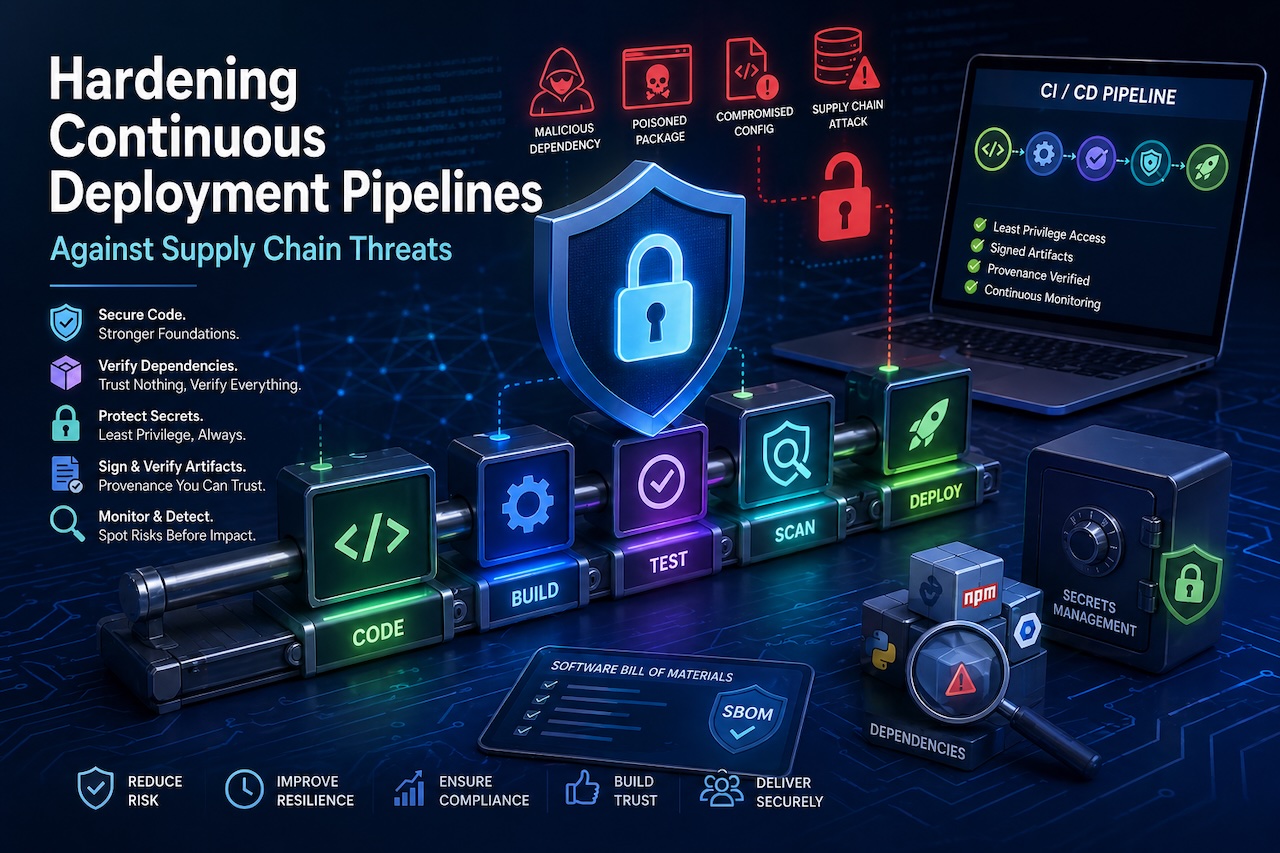
Featured Image generated by ChatGPT.
Share this post
Leave a comment
All comments are moderated. Spammy and bot submitted comments are deleted. Please submit the comments that are helpful to others, and we'll approve your comments. A comment that includes outbound link will only be approved if the content is relevant to the topic, and has some value to our readers.
Comments (0)
No comment