
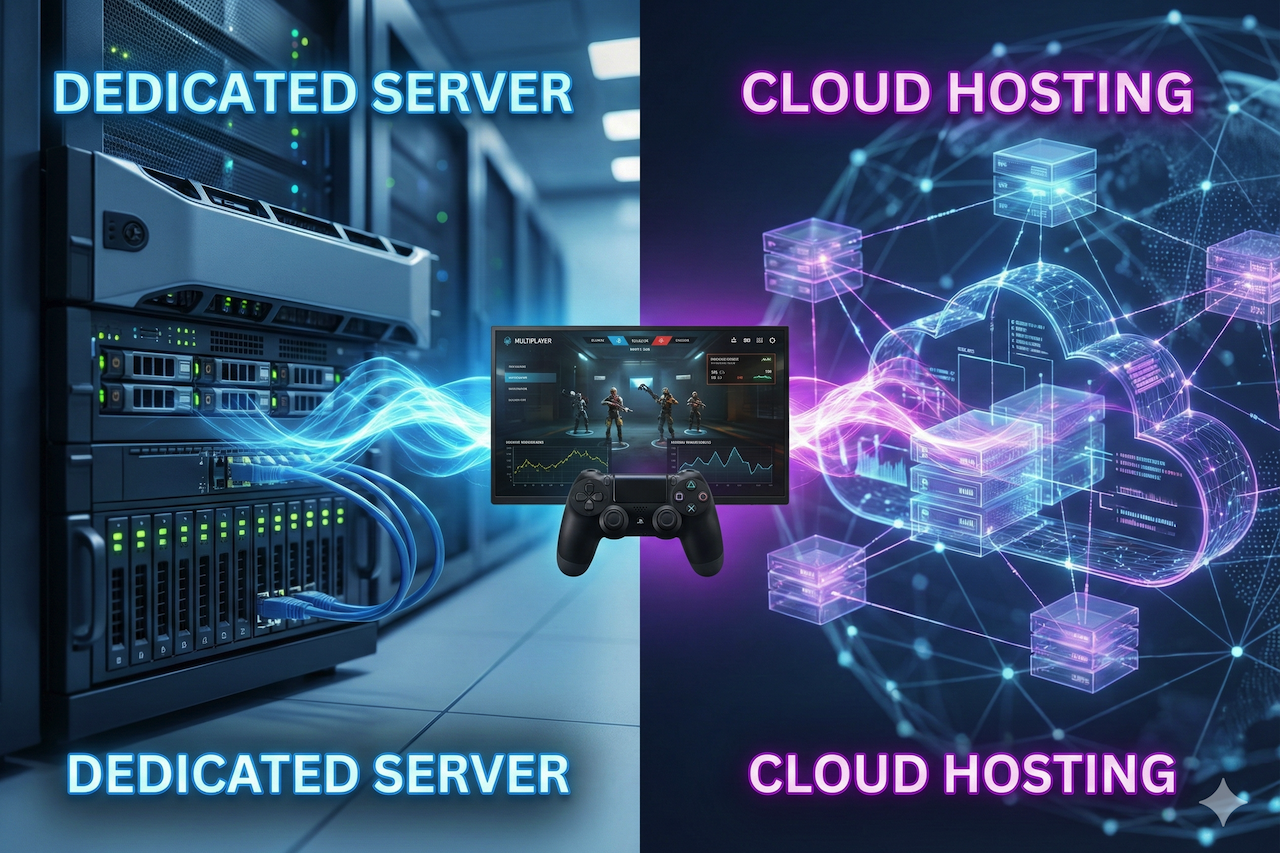
For gaming studios today, choosing the right infrastructure is one of the most important technical decisions. Whether you’re launching an indie multiplayer title, scaling a live-service game, or preparing for esports tournaments, your hosting environment directly impacts player experience, uptime, and operational costs.
Studios often face challenges related to latency, geographic player distribution, and the need for reliable connections between different regions. Because of this, many teams evaluate both dedicated game server hosting and cloud infrastructure options.
So, should you use cloud hosting or a dedicated game server? The answer depends on your development stage, performance goals, and scalability requirements.
Understanding the Two Hosting Models
Dedicated Game Server
A dedicated game server means your studio uses game server hosting to rent or own physical hardware located in a professional data center. All computing resources, including CPU, RAM, storage, and bandwidth, are reserved exclusively for your game.
Typical characteristics:
- Predictable performance
- High control over configuration
- Stable server tick rate
- Strong performance for competitive multiplayer
- Fixed capacity limits
This model is often used for esports infrastructure or high-performance multiplayer environments where consistency is more important than elasticity.
Cloud Hosting for Gaming
Cloud hosting uses virtualized infrastructure deployed across distributed servers. Resources can scale dynamically based on demand.
Key features:
- Auto-scaling based on player load
- Flexible pricing models
- Global edge locations
- Rapid deployment environments
- Integration with backend services
Cloud environments are commonly used by studios building scalable multiplayer infrastructure or launching services quickly without large upfront hardware investments.
Performance and Latency
Latency is one of the biggest concerns in online gaming. Players expect smooth, real-time responsiveness, and poor network performance can negatively impact gameplay and retention.
Dedicated infrastructure typically provides lower and more stable latency because resources are not shared with other tenants. This helps maintain consistent synchronization and smooth gameplay.
Cloud platforms can also deliver strong performance when deployed in regions close to player populations and optimized with content delivery networks and edge routing.
For competitive titles, even a few milliseconds of difference can influence gameplay perception.
Scalability and Traffic Spikes
Player concurrency rarely stays constant. Game launches, seasonal events, patches, and influencer exposure can cause sudden traffic spikes.
Cloud environments excel in these scenarios due to:
- Auto-scaling capabilities
- Load balancing across multiple nodes
- Elastic bandwidth allocation
- Rapid instance provisioning
Dedicated servers, in contrast, require capacity planning in advance. If infrastructure limits are reached during peak demand, studios may experience queues or degraded performance.
However, dedicated systems still perform well for predictable workloads such as stable multiplayer communities or tournament environments.
For studios expecting unpredictable growth, hybrid or cloud-first approaches are often considered.
Cost Considerations for Gaming Studios
Dedicated Server Cost Profile
Pros:
- Fixed monthly pricing
- Better price-to-performance at scale
- No unexpected billing spikes
- Efficient for consistently high workloads
Cons:
- Provisioning commitments
- Hardware upgrades require migration planning
- Risk of overprovisioning
Cloud Hosting Cost Profile
Pros:
- Pay-as-you-use flexibility
- No hardware management
- Ideal for early-stage studios
- Easier testing and experimentation
Cons:
- Costs increase with player concurrency
- Bandwidth charges can escalate
- Long-term costs may exceed dedicated hardware
For mid-size studios running persistent multiplayer environments, dedicated infrastructure often becomes more economical over time.
Security and DDoS Protection
Gaming servers are frequent targets for cyberattacks, especially during competitive play or major events.
Important considerations include:
- DDoS mitigation capabilities
- Network filtering
- Traffic scrubbing
- IP protection
- Firewall customization
- Monitoring and alerting
Dedicated environments may offer strong network-level protection when hosted with specialized providers.
Cloud providers also offer built-in distributed security layers, which can be beneficial for large-scale global deployments.
The right approach depends on threat exposure and operational requirements.
Integration and Backend Needs
Modern multiplayer architecture involves more than game servers. Studios typically require:
- Matchmaking
- Player authentication
- Analytics
- Persistence databases
- Backend services
- Game engine integration
- Microservices orchestration
Cloud environments integrate naturally with managed services and automation frameworks, making them attractive for DevOps-driven teams.
Dedicated infrastructure can also support these needs through container orchestration and hybrid networking models.
Many studios use platforms that combine both dedicated and cloud environments within a unified architecture.
Use Case Scenarios
Launch-Stage Studios
Cloud hosting advantages:
- Low initial investment
- Rapid deployment
- Flexible scaling
- Reduced operational overhead
Best suited for:
- Multiplayer prototypes
- Limited concurrency environments
- Testing and iteration
Growing Multiplayer Games
Dedicated server advantages:
- Stable performance
- Lower latency
- Cost efficiency at scale
- Consistent server tick rate
Best suited for:
- Competitive multiplayer
- Persistent online worlds
- Established player bases
Esports and Competitive Events
Dedicated infrastructure is often preferred because it provides:
- Predictable performance
- Controlled environments
- Minimal latency variation
- High reliability
This is why competitive environments frequently rely on dedicated systems.
Hybrid Model – A Balanced Approach
Many studios adopt hybrid infrastructure, combining dedicated hardware with cloud scalability.
Common strategies include:
- Dedicated servers for core gameplay
- Cloud nodes for overflow traffic
- Cloud-based backend services
- Regional failover and redundancy
- Burst scaling during launches
Hybrid models provide:
- Performance stability
- Cost optimization
- Operational flexibility
- Resilience during demand spikes
Conclusion
There is no universal answer when selecting the best infrastructure for gaming. The decision depends on architecture, player distribution, concurrency patterns, and long-term growth strategy.
Dedicated game servers offer stability, predictable performance, and cost efficiency for established multiplayer environments. Cloud hosting provides scalability, flexibility, and faster deployment for early-stage or rapidly expanding projects. Hybrid models often deliver the most balanced solution by combining performance and elasticity.
Ultimately, infrastructure decisions should prioritize player experience, reliability, and scalability rather than focusing on cost alone.
 FAQs
FAQs
The best server for gaming depends on your requirements. Dedicated servers typically provide the lowest latency and most stable performance, while cloud hosting offers scalability and flexibility for growing or fluctuating player bases.
Yes. Cloud hosting works well for multiplayer games, especially when player numbers vary. Auto-scaling and load balancing help manage traffic spikes and maintain performance during peak activity.
Latency is extremely important in online gaming. Lower latency improves responsiveness, synchronization, and overall player experience. Hosting infrastructure closer to your primary player base can significantly enhance gameplay quality and user satisfaction.
Most esports tournaments prefer dedicated servers because they provide predictable performance, consistent tick rates, and minimal latency variation during competitive matches.
Yes. Many studios use hybrid models that combine dedicated servers for core gameplay with cloud infrastructure for scaling, backend services, and redundancy. This approach provides both performance stability and operational flexibility.
Featured Image generated by Google Gemini.
Share this post
Leave a comment
All comments are moderated. Spammy and bot submitted comments are deleted. Please submit the comments that are helpful to others, and we'll approve your comments. A comment that includes outbound link will only be approved if the content is relevant to the topic, and has some value to our readers.
Comments (0)
No comment