
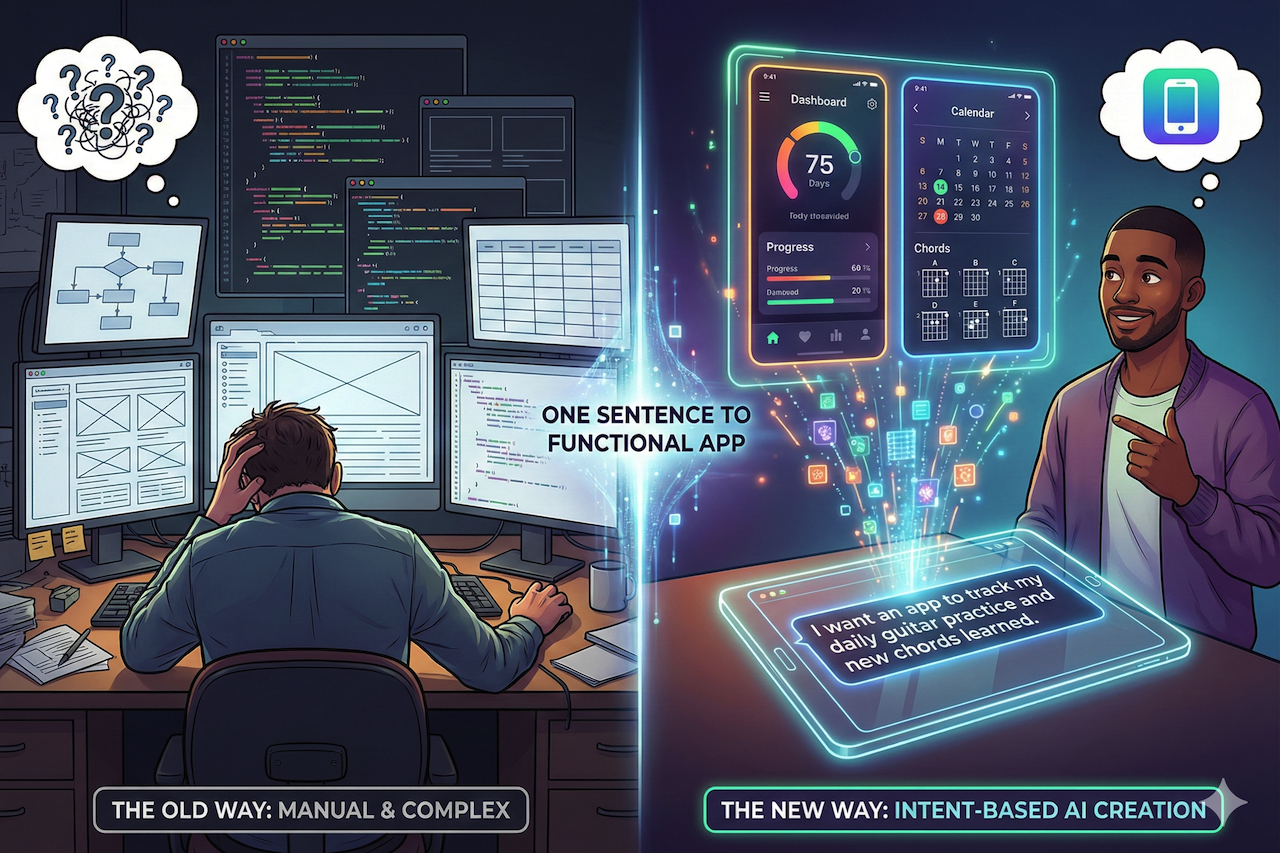
For decades, science fiction has promised a specific kind of interaction with computers. Captain Picard on Star Trek doesn’t open menus or drag widgets onto a canvas. He simply says, “Computer, locate the nearest habitable planet,” and the machine executes complex logic instantly.
In the real world, software creation has traditionally been the opposite. It has been manual, tedious, and logic-heavy. Even the rise of “no-code” tools, meant to make building more accessible, still requires users to think like programmers. You must understand databases, link pages, configure workflows, and anticipate edge cases.
A new generation of AI-driven tools is changing that model entirely by shifting the focus from how to build to what you want to achieve.
This approach is often described as “one sentence creation”. Instead of designing an app step by step, you describe your intent in plain language, and the AI handles the implementation, turning a simple sentence into a functional application in minutes. Platforms such as Macaron are often cited as early examples of this intent-driven model.
The Death of the Blank Page
The hardest part of building anything is starting.
When you open a traditional app builder, or even a spreadsheet, you’re greeted by a blank grid. You immediately face decisions like:
- Do I need a date column?
- Should this be a checkbox or a dropdown?
- How should this data be structured?
Intent-based AI tools remove that friction entirely. Instead of a canvas or schema editor, the starting point is often a conversational interface. This mirrors how humans naturally think: in goals, stories, and outcomes—not database tables.
A user might type something like:
“I want to start a 30-day challenge to learn guitar and track my practice time and the chords I’ve learned.”
Behind the scenes, the AI breaks this down:
- “30-day challenge” → date tracking and countdown logic
- “practice time” → numeric or duration fields
- “chords I’ve learned” → text or tag-based entries
The user never designs the database. They simply describe the outcome they want.
How AI Turns Intent Into Structure
The speed and accuracy of this process are made possible by advances in agentic reinforcement learning and structural intelligence.
Rather than generating static text like a chatbot, these systems are trained to recognize patterns in how tools, trackers, and workflows are constructed. During training, the AI is exposed to large volumes of structured applications, learning how different intents map to different data models and interfaces.
As a result, the system can infer that:
- A habit tracker and a fitness log share similar structures
- A learning journal and a project tracker differ mainly in labels and logic
This allows the AI to assemble functional apps quickly, without forcing users to plan schemas or build screens manually.
Refinement Without Friction
Early AI generators often struggled with flexibility. If the result wasn’t quite right, users had to start over or dig through complex settings.
Modern intent-based systems handle refinement conversationally. If a user realizes something is missing, they simply add another sentence:
“Actually, I also want to upload audio recordings of my practice sessions.”
The AI interprets this as a modification intent, updating the existing app by adding a media upload field, without breaking existing data or workflows. Instead of navigating menus, users collaborate with the system using natural language.
When the Request Is “Weird”
The real test of intent-based creation is not common use cases, but unusual ones.
Consider this request:
“I want an app to track the squirrels in my backyard, what color they are, and whether they ate the peanuts I left.”
An intent-driven AI treats this no differently than a business expense tracker. It identifies:
- Time of sighting
- Color categories
- Yes/no status
- Freeform notes
The result is a custom tool that likely doesn’t exist in any app store—but works perfectly for its purpose. Because the system is driven by intent rather than templates, it doesn’t judge whether an idea is “serious” or “niche.” It simply builds.
Why This Shift Matters
The true impact of one sentence creation isn’t just speed. It removes the barrier between idea and execution.
For years, having a custom tool meant hiring a developer, learning to code, or settling for something that didn’t quite fit. Intent-based AI changes that equation. The primary requirement is no longer technical knowledge—it’s clarity of thought.
Conclusion
As these systems mature, the future of software creation looks less like programming and more like articulation. The ability to clearly describe what you want may soon matter more than knowing how to build it yourself.
The promise once reserved for science fiction is quietly becoming practical reality, not through menus and settings, but through language itself.
Featured Image generated by Google Gemini.
Share this post
Leave a comment
All comments are moderated. Spammy and bot submitted comments are deleted. Please submit the comments that are helpful to others, and we'll approve your comments. A comment that includes outbound link will only be approved if the content is relevant to the topic, and has some value to our readers.
Comments (0)
No comment