
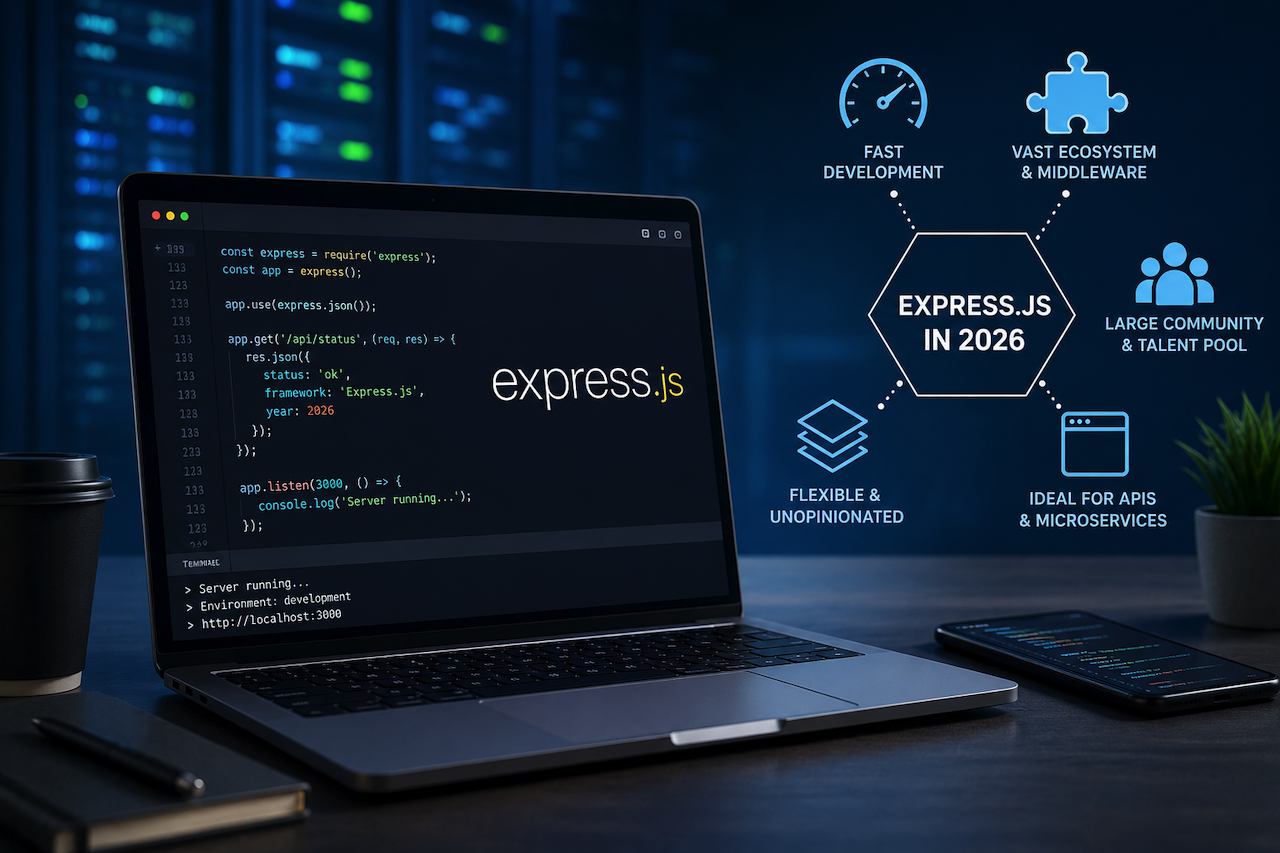
The world of web development is changing rapidly. In 2026, the JavaScript and Node.js ecosystem offers a multitude of modern solutions. Among them are the high-performance Fastify, the architecturally rigorous NestJS, and new runtimes like Bun and Deno. Against this backdrop, Express.js may seem like an industry veteran. This raises a question for businesses and CTOs: Is this framework still relevant today, or should it be retired? The answer is clear: the technology is still going strong. In this article, we will analyze Express.js in 2026, examine its advantages over competitors, and identify commercial scenarios where it remains the optimal choice.
The Main Purpose of Express.js
At its core, Express.js is a minimalist and flexible web framework for Node.js. It takes an unopinionated approach and does not impose strict rules on project structure. Its main goal is to simplify the routing and processing of HTTP requests by providing a thin yet powerful layer of core functionality on top of Node.js's built-in low-level modules. Express's foundation is built on middleware, allowing developers to add features such as authorization, error handling, logging, and request parsing with relative ease. Because of this flexibility, an Express.js development company may continue using the framework for RESTful APIs, microservices, and lightweight backend applications.

Advantages of Express.js Over Other Frameworks
Nowadays, the competitive landscape around Express.js is stronger than ever. However, it remains one of the most widely adopted frameworks due to several undeniable advantages, especially valuable in modern commercial development.
Extensive Ecosystem and Proven Track Record
Express's main strengths are its community and the huge base of ready-made solutions in the npm registry. Unlike newer frameworks like Hono or updated major versions of Fastify, Express has middleware for the most common use cases. It can handle complex authentication (Passport.js), vulnerability protection (Helmet), database integration (Mongoose, Sequelize, Prisma), and many other tasks. Businesses don't need to spend too much time writing custom integrations. Everything has already been written and widely used in production. This significantly reduces technical risks during implementation.
Time-to-Market
Other frameworks, such as NestJS, offer a strict enterprise architecture out of the box with a system of controllers, providers, and dependency injection. Unlike them, Express can be faster to get started with due to minimal setup. Quick validation of business hypotheses is very important for innovative startups and initiatives within large corporations. For such tasks, Express's minimalism becomes a decisive factor.
Low Barrier to Entry and Readily Available Talent
Hiring a qualified Express developer in 2026 is easier and more cost-effective than finding an expert in new technologies. Most Node.js developers are familiar with Express. That is why businesses can quickly scale their development teams, easily hand off projects between contractors, and reduce employee onboarding costs. Extensive technical documentation and detailed Express.js training materials make the IT product development and support process more predictable. Therefore, by choosing Express, a company is investing not in hype but in stability. This often outweighs any slight gains in synthetic performance tests.
When Should You Choose Express.js for Development?
A deep understanding of the technology's strengths allows you to identify the most profitable business scenarios accurately. Using Express.js for such cases will yield the highest return on investment and minimize risks. In 2026, this framework should be chosen in the following situations:
- Rapid MVP development and prototyping: Express.js will be effective when a business's main goal is to get ahead of competitors, quickly bring a digital product to market, and validate an idea. Thanks to the framework's flexibility, a team can deploy a functional backend quickly, integrate payment gateways such as Stripe or PayPal, and enable analytics.
- Creating lightweight microservices: In industries such as global e-commerce or logistics, modern architecture requires the smooth orchestration of dozens of services. Express is ideal for creating compact microservices that perform a single business task. This could be a standalone transactional email notification service, an image processing module, or a PDF report generator.
- Implementation of the backend-for-frontend pattern: Express excels as an intelligent layer between heavyweight enterprise APIs and lightweight client applications such as web interfaces, mobile apps, or IoT devices. It aggregates raw data from different microservices, formats it, and delivers it to the client in a compact form. This reduces the load on client devices and saves bandwidth.
- Building API gateways: Thanks to an extensible middleware system, Express is easily configured for complex traffic routing, secure request authentication to third-party APIs, and detailed auditing of user activity. For example, this can be used for integration with heavyweight CRM systems or bank acquiring systems.
Additionally, a development team may use this framework for building educational platforms or corporate portals. These platforms don't require extremely high loads of millions of requests, but they need stable database operations and complex business logic. In these conditions, Express's ease of deployment and relatively low system resource consumption enable budget savings on server infrastructure and cloud hosting.
Limitations of Express.js
Despite its immense popularity, Express.js confronts several notable technical limitations in the realities of high-load, distributed systems in 2026. Businesses should be aware of them before starting development:
- The framework is clearly inferior to modern solutions such as Fastify or Hono in request-processing speed and maximum throughput. Express uses a classic routing architecture and does not include built-in performance optimizations by default or fast binary JSON serialization.
- Architectural freedom may lead to "spaghetti code" in large, long-term projects. Without strict conventions and oversight by an experienced technical leader, a growing codebase can become unreadable, confusing, and extremely difficult to maintain.
- There's a lack of native TypeScript support. Unlike TypeScript-native frameworks such as NestJS, Express requires developers to configure types manually. This can produce discrepancies between the declared interfaces and the actual data structures. This may be less convenient for large-scale enterprise architectures.
Conclusion
It's safe to say that rumors of Express.js becoming obsolete in 2026 are greatly exaggerated. It doesn't offer trendy architectural patterns. However, over the years, it has evolved into a reliable, time-tested tool. Express.js is a good choice for businesses that value the speed of feature development, the availability of qualified specialists, and a wide selection of tested integrations. Express is a technically rational and cost-efficient choice if your goal is to quickly launch a strong digital product, build a flexible microservices architecture, or design a clear API.
Featured Image generated by ChatGPT.
Share this post
Leave a comment
All comments are moderated. Spammy and bot submitted comments are deleted. Please submit the comments that are helpful to others, and we'll approve your comments. A comment that includes outbound link will only be approved if the content is relevant to the topic, and has some value to our readers.
Comments (0)
No comment