

Investors spend less than four minutes reviewing the average pitch deck. That's what DocSend found after analyzing hundreds of successful fundraising rounds. Four minutes to decide whether your startup gets a second meeting or a polite pass.
And here's what most founders get wrong: they think the content alone will carry them. It won't. A Harvard Business School study found that the typical founder spends about 18 hours preparing their pitch. But if those 18 hours go entirely into spreadsheets and bullet points while the design gets slapped together the night before, you've wasted most of that effort.
So the question isn't whether your pitch deck design matters. It does. The real question is how you should get it done. You've got three options: do it yourself, hire a freelancer, or work with a dedicated presentation design firm. Each one comes with real tradeoffs in cost, quality, speed, and strategic value. Let's break them down honestly.
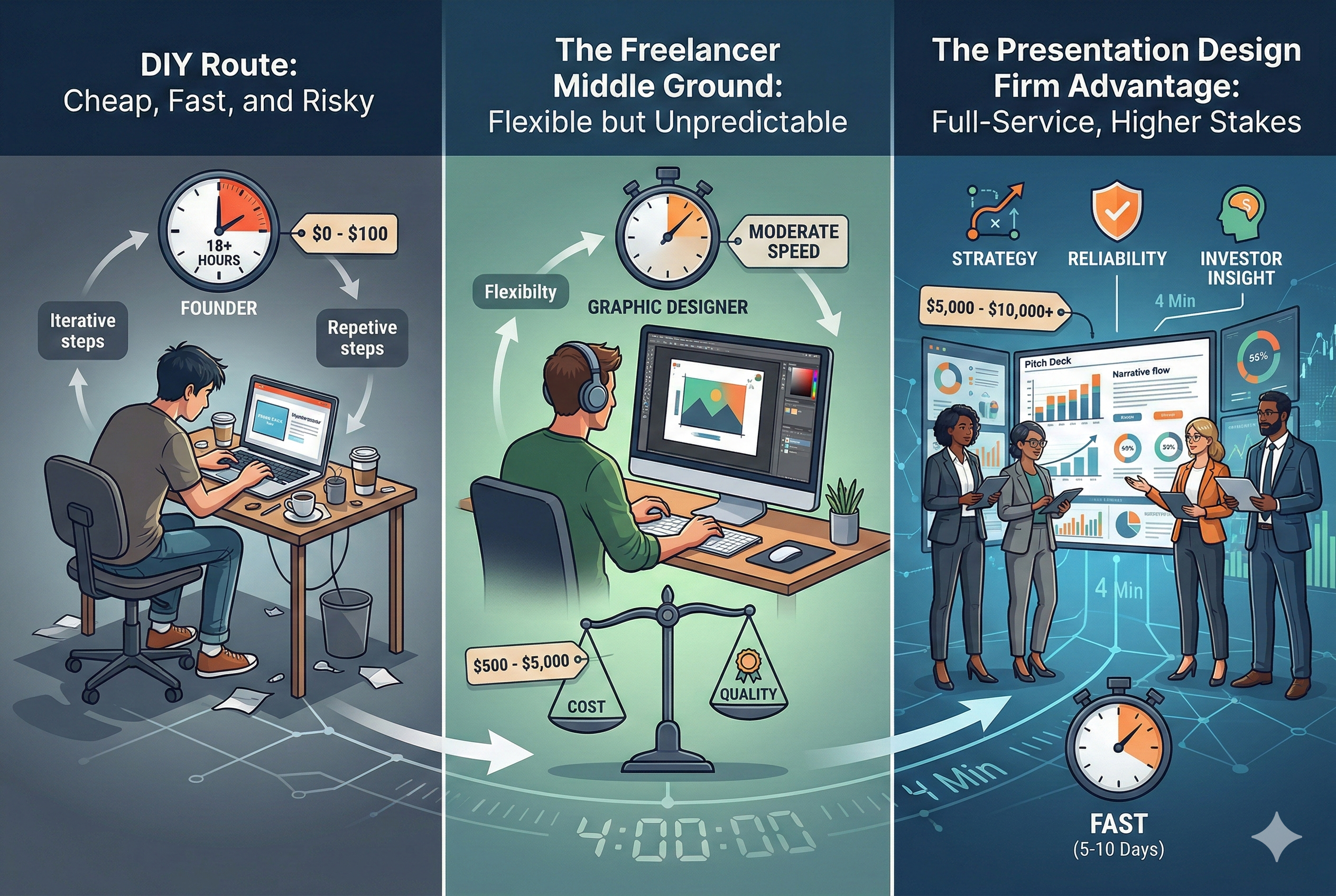
Image generated by Google Gemini.
The DIY Route: Cheap, Fast, and Risky
Every founder considers this first. You've got Canva, Google Slides, Beautiful.ai, Pitch, and dozens of free templates floating around the internet. Total cost? Somewhere between zero and $100 for a premium template.
The appeal is obvious. You know your business better than anyone. You can iterate quickly without waiting on external timelines. And when you're bootstrapping with a $50K runway, spending thousands on design feels irresponsible.
But there's a catch. Knowing your business well can actually work against you when designing a pitch deck. Founders tend to overexplain, cram too much onto each slide, and bury the narrative under data. An angel investor once described founder-designed decks this way: "If you picture your startup as Disneyland, the founder always focuses on explaining the new ride rather than the whole theme park."
Templates help with layout but they can't fix structural problems. They can't tell you that your problem slide is buried on page seven, or that investors will lose interest because your market sizing feels made up. And when every second startup uses the same Canva pitch deck template, your deck starts looking like everyone else's before the investor even reads a word.
When DIY works: You're pre-revenue, validating an idea with friends-and-family investors, or putting together an internal draft before investing in professional help. At this stage, substance matters more than polish. A clean template with a tight narrative can get the job done.
When it doesn't: You're pitching to VCs or angels in competitive sectors, raising a seed round above $500K, or preparing for a demo day where first impressions are everything. The quality gap becomes painfully visible next to professionally designed decks from other startups in the room.
The Freelancer Middle Ground: Flexible but Unpredictable
Hiring a freelance designer through Upwork, Fiverr, or personal referrals is the most common next step. Pricing ranges wildly: $500 to $1,500 on the lower end, $1,500 to $3,000 for mid-tier specialists, and $3,000 to $5,000 for premium freelancers with startup fundraising experience.
The best freelancers can produce beautiful slides. Some have portfolios full of decks that helped startups raise real money. They're typically faster than agencies, more affordable, and you get direct access to the person doing the work: no account managers, no middlemen.
The problem is consistency. Quality varies enormously depending on who you hire. A freelancer who designs gorgeous product interfaces might have zero understanding of what makes an investor deck actually work. Making fonts look nice isn't the same as knowing that your traction slide needs to be positioned before the financial ask, or that Series A investors care more about unit economics than your product roadmap.
There are also logistical risks. Freelancers juggle multiple projects. They don't always meet deadlines. If they get sick or take on too much work, you have no backup plan. And because most freelancers specialize in visual design rather than pitch strategy, you'll still need to handle the narrative structure, content hierarchy, and investor-facing messaging yourself.
A 2024 survey by the National Venture Capital Association found that 89% of venture capitalists expect to see a pitch deck during fundraising conversations. That expectation comes with a quality threshold. When the investor has already seen three professionally crafted decks that morning, yours needs to hold up.
When freelancers work: You have a solid draft with clear content and need visual polish. Your budget is $1,000 to $3,000. You've found someone with specific pitch deck experience (check their portfolio for investor decks, not just marketing materials). And you're comfortable managing the project yourself.
When they don't: You need strategic input on content and structure, not just design. You're working against a tight deadline with no room for delays. Or you've been burned by inconsistent freelancer quality before and can't afford another round of revisions.
The Presentation Design Firm Advantage: Full-Service, Higher Stakes
Full-service agencies sit at the premium end of the market. Pricing typically starts around $3,000 and can go up to $10,000 or more, depending on the scope. Some firms include content strategy, financial modeling, narrative consulting, and multiple rounds of revision in that price.
What separates a presentation design firm from a freelancer isn't just the price tag. It's the depth of the team and the breadth of services. A good firm pairs designers with strategists who understand investor psychology, market positioning, and the storytelling frameworks that get founders past the first meeting.
Consider what goes into a pitch deck beyond the visual layer. There's the narrative arc: how you move from problem to solution to market to traction to ask. There's the data presentation: how you visualize financial projections without making investors squint. There's the emotional pacing: building excitement at the right moments and grounding it with credibility signals at others. A solo designer, no matter how talented, rarely handles all of those layers well.
Agencies also bring consistency and reliability. They have project management systems, defined timelines, revision workflows, and backup designers if someone is unavailable. For founders raising a significant round, this operational reliability is worth paying for. When your Series A timeline depends on getting a polished deck to 30 target investors by a specific date, you can't afford to chase a freelancer for status updates.
The tradeoff is cost and sometimes speed. Agencies need more lead time to onboard (typically 5 to 10 business days for turnaround), and the investment is real. If you're raising a $500K friends-and-family round, allocating $5,000 to $8,000 for deck design might not make financial sense. But if you're targeting a $2M seed round or Series A, the math changes quickly. A deck that helps you close a $3M round is worth many times what you paid for it.
When agencies work: You're raising $1M or more and need a deck that matches the seriousness of the ask. You want strategic input beyond just design. You value reliability and defined timelines. Or your founding team lacks design talent and storytelling experience.
When they don't: Your budget is under $2,000. You're at the idea stage with no product or traction. Or you've already built a strong deck and need a light visual refresh.
The Decision Framework: Match the Investment to the Raise
Here's a practical way to think about it. The widely cited benchmark is to allocate 1% to 3% of your target raise to the pitch deck. For a $500K round, that's $5,000 to $15,000 at the top end. For a $100K friends-and-family check, it might be $100 for a good template.
But the financial math is only part of the equation. The real question is: what does your deck need to accomplish, and what resources do you have in-house?
If you have a co-founder with genuine design chops and fundraising experience, DIY or a light freelance touch might be plenty. If your team is entirely technical and nobody has pitched investors before, the strategic guidance from an agency could be the difference between a funded round and six months of spinning your wheels.
A DocSend analysis of startups that successfully raised seed funding found that the average process takes about 12 weeks and involves presenting to roughly 58 investors. That's 58 chances to make a strong first impression. When those four minutes of investor attention are the bottleneck between your startup and its next stage of growth, the cost of getting your deck right looks different.
What Matters More Than Who Designs It
Regardless of which path you choose, a few things will make or break your pitch deck:
- Story first, slides second: Investors fund narratives, not infographics. Your deck needs a clear, logical arc that answers the "why now" and "why you" questions before anything else. No amount of premium design can save a deck with a weak story.
- Specificity wins: Vague market sizing and hand-wavy projections kill deals. Use real customer data, concrete metrics, and defensible numbers. According to recent Magistral Consulting research, the Problem, Solution, and Market slides account for roughly 90% of investor attention. Make those three sections bulletproof.
- Design is a trust signal: Investors are constantly pattern-matching. A polished deck signals that you care about details, understand your audience, and know how to communicate clearly. Those are exactly the traits that predict operational execution.
- Know your audience: A pre-seed deck for angel investors should feel different from a Series A deck for institutional VCs. Angels invest in people and potential. VCs invest in traction and scalability. Your deck should reflect the conversation you're having.
The Bottom Line
There's no universally right answer here. A scrappy founder bootstrapping a prototype should not be spending $8,000 on deck design. A startup raising a $5M Series A should not be pitching off a Canva template.
Match the investment to the stakes. DIY when you're early and scrappy. Bring in a freelancer when you need visual polish on a solid foundation. And when the raise is big enough that every detail matters, work with professionals who understand both design and investor strategy.
Your pitch deck is often the first thing an investor sees and the last thing they remember. Make the choice that gives it the best shot.
Featured Image generated by Google Gemini.
Share this post
Leave a comment
All comments are moderated. Spammy and bot submitted comments are deleted. Please submit the comments that are helpful to others, and we'll approve your comments. A comment that includes outbound link will only be approved if the content is relevant to the topic, and has some value to our readers.
Comments (0)
No comment