
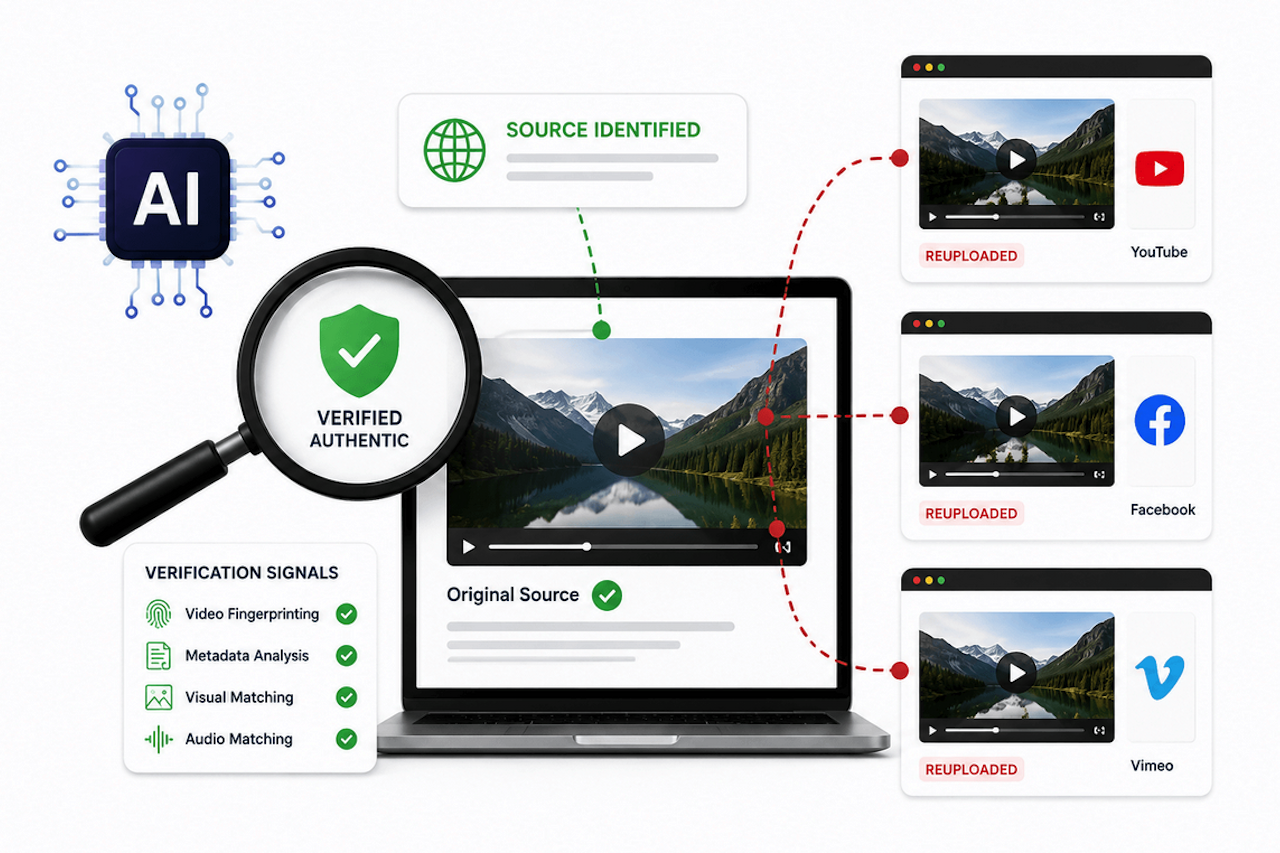
The growth of online video consumption and sharing has affected how information spreads on the internet. Platforms related to social media, streaming, and messaging allow users to upload and distribute video content instantly.
This, however, has a negative outcome. Issues like misinformation spreading and footage manipulation are at an all-time high. As a result, digital verification techniques have become increasingly important.
Video verification techniques are used in a variety of professional and investigative contexts, including journalism, research, and digital forensics. This shows that this technology doesn’t only solve minor copyright problems but also larger, more important ones. In this article, we will dig into the methods by which video source identification becomes possible.
Metadata Analysis
Metadata includes specific information about a video file. This information can be:
- Creation date
- Camera model
- GPS location
- Resolution
- Editing software
- File format
In essence, this data doesn’t tell us anything about the video's content. However, it provides key information when the goal is to identify a file's source. For example, you can find out whether a video came from a phone camera or editing software. This takes you one step closer to finding where the video might have originated from.
The problem with this, however, is that it is not always trustworthy. Social media platforms often remove metadata during uploads. Similarly, people can also edit metadata. So, metadata is more helpful as a supporting tool instead of the main method.
Reverse Video Search Techniques
Reverse video search is a powerful method to find where a video previously appeared online.
Current search engines can find similar text on the internet. This is why images can also be easily traced by extracting text from them. However, videos contain multiple frames, both with and without text. Traditional search engines become less useful for this.
Therefore, there are online tools that can analyze a video and find similar ones online. These tools use computer vision and AI to compare uploaded videos against large online datasets and identify similar content across the web. Reverse video search tools, including platforms such as Revideo.io, can assist with this process by identifying visually similar videos and potential reuploads across the internet.
Keyframe Extraction
A more manual method for identifying a video's source is keyframe analysis. Videos contain thousands of frames, but some are more important than others. These are known as keyframes. These could be frames in which scenes change or in which something unique appears. We can study these keyframes and find videos with similar frames. These frames often contain useful clues such as:
- Street signs
- Buildings
- Weather conditions
- Vehicles
- Clothing
This makes analysis faster and easier. However, as you may have noticed, the scope of this method is comparatively limited.
Artificial Intelligence in Video Verification
Artificial intelligence can also recognize videos. However, you can also use simple AI tools to perform less complex video searching. The main capability of AI in this regard is its ability to scan large volumes of video much faster than humans. To be a bit more specific, AI can:
- Detect duplicate footage
- Compare visual similarities
- Recognize objects
- Spot manipulated frames
- Track edited versions of videos
By studying such visual cues, AI might be able to identify clips even after resizing or re-encoding. This is why it can also be used to detect deepfakes. But once again, AI is not perfect. Human investigators are still needed because AI can make mistakes or miss important context.
Key Challenges in Video Verification
As you can see from the methods described above, video verification is not easy. There are techniques, but most of them have certain limitations. On top of that, videos themselves are a complex format to study. For example:
- Compression lowers video quality
- Metadata may disappear
- Cropping removes important details
- Filters and subtitles can hide evidence
- Reuploads, AI-generated voices, and synthetic editing tools are improving quickly. These allow for a single video to have multiple versions at multiple sites on the internet.
Another major issue is speed. False information spreads very quickly online, while proper verification takes time. So this creates a bottleneck as well. However, different verification methods are suited to different situations, and investigators often use multiple techniques together to improve accuracy and reliability.
Conclusion
To summarize, digital verification techniques help identify the origin of videos. Investigators can use a variety of methods to perform such verification, including metadata analysis, reverse video search, keyframe analysis, and AI-assisted tools. As the volume of online video continues to grow, these techniques play an increasingly important role in verifying content, tracing sources, and addressing challenges related to misinformation and manipulated media.
 FAQs
FAQs
You can identify the source of a video using metadata analysis, reverse video search, and keyframe extraction techniques. These methods help trace where a video may have originated and whether it has appeared elsewhere on the internet.
Video source verification is important because it helps identify original content and prevent misinformation. It enables journalists, investigators, and content creators to verify whether a video is authentic or misleading.
AI can assist by detecting duplicate footage, identifying visual similarities, recognizing objects, and spotting signs of manipulation. However, human review is often needed to provide context and confirm findings.
Yes. Metadata can be removed automatically when videos are uploaded to certain platforms, and it can also be edited manually. Because of this, metadata is often used alongside other verification techniques rather than as the sole source of evidence.
Disclaimer
This article is provided for informational and educational purposes only. The video verification methods, tools, and techniques discussed may not always produce accurate, complete, or definitive results. Verification outcomes can vary depending on the quality of the source material, available metadata, platform restrictions, and other factors. References to third-party tools, platforms, or services are provided as examples only and do not constitute an endorsement or recommendation. Readers are responsible for independently evaluating any tools or services they choose to use. IPLocation.net makes no representations or warranties regarding the accuracy, reliability, or effectiveness of any third-party products, services, or verification results and shall not be liable for any losses, damages, claims, or decisions arising from the use of the information contained in this article.
Share this post
Author

Leave a comment
All comments are moderated. Spammy and bot submitted comments are deleted. Please submit the comments that are helpful to others, and we'll approve your comments. A comment that includes outbound link will only be approved if the content is relevant to the topic, and has some value to our readers.
Comments (0)
No comment