

The conversational layer of the internet has changed shape. A few years ago, a "chatbot" was a scripted widget answering a handful of canned questions. Today, customer-facing AI agents read your knowledge base, call internal APIs, complete multi-step tasks, and maintain context throughout a conversation. That leap in capability is also a leap in exposure. An agent that can do things on a user's behalf touches more data, more systems, and more regulatory surface area than the form it replaced.
For anyone running a website, a support queue, or a customer portal, the question in 2026 is no longer "should we use an AI agent?" but "how do we deploy one without leaking data, inviting an attack, or breaking a disclosure law we did not know existed?" This guide covers the privacy, security, and compliance fundamentals for any customer-facing deployment and how the conversation changes when it involves regulated data, such as protected health information.
Why Conversational AI Widens Your Attack Surface
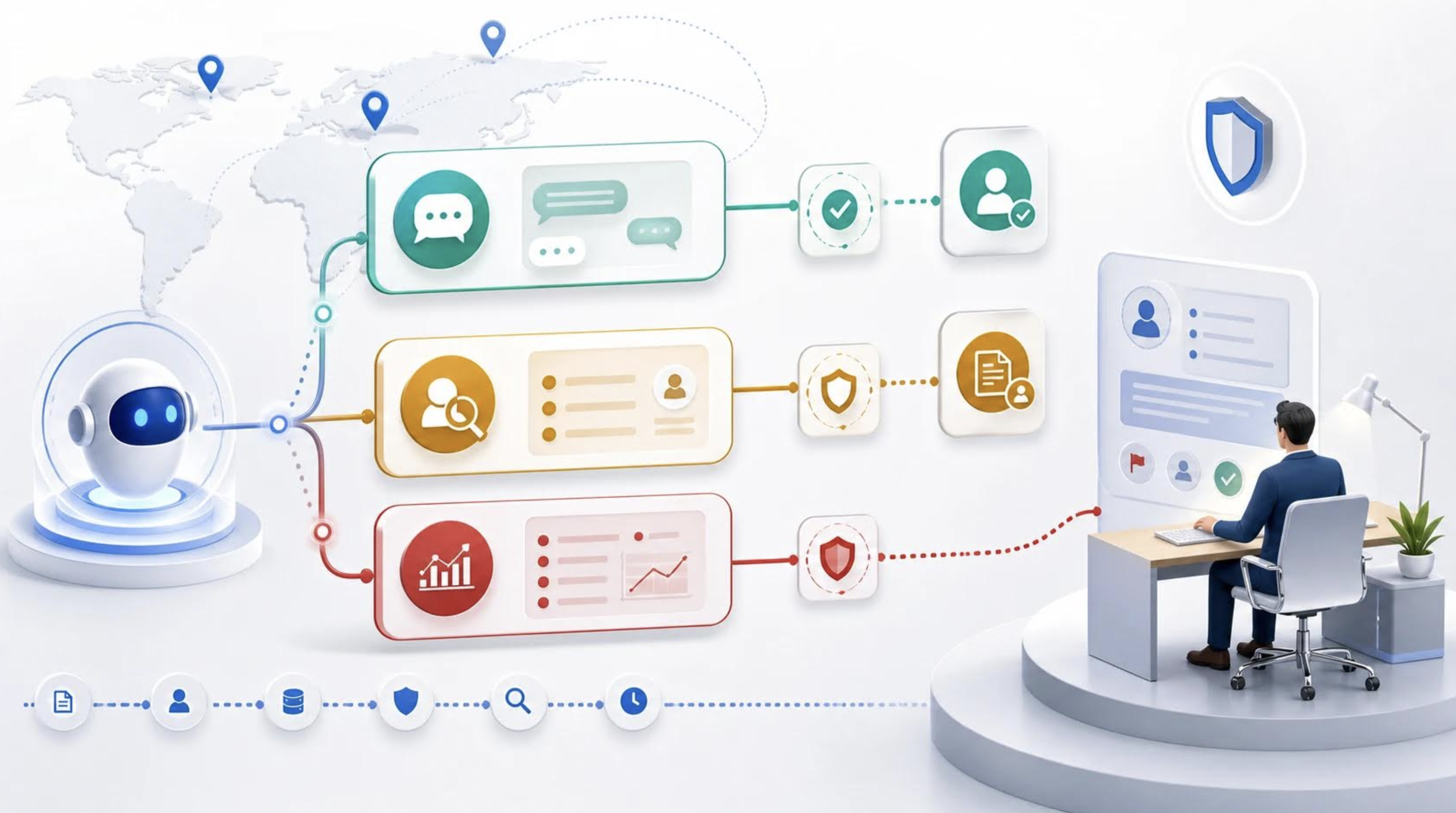
A traditional web form is predictable. It accepts a fixed set of fields, validates them, and stores them. An AI agent is the opposite. It accepts free-form natural language, interprets intent, and often acts on that interpretation by querying systems or triggering workflows. That flexibility is the product and the problem.
Three properties make agents harder to secure than the tools they replace:
- They ingest unstructured input: Users type anything, including sensitive details you never asked for. The agent now "holds" data you did not intend to collect.
- They connect to other systems: Tool calls, API integrations, and automation hooks mean a single compromised conversation can reach into a CRM, a billing system, or a database.
- They are vulnerable to prompt injection: Malicious instructions hidden in user input—or in a document the agent reads—can attempt to override the agent's guardrails, exfiltrate data, or trigger unintended actions.
None of this is a reason to avoid AI agents. It is a reason to treat them as production software with a real threat model, not as a marketing widget.
The Privacy Foundation: Collect Less, Protect More
The most reliable way to prevent a data breach is not to hold the data in the first place. Data minimization, collecting only what a task genuinely requires, is both a privacy best practice and an explicit expectation under laws such as the GDPR and the CCPA/CPRA. Before you deploy, map exactly what your agent will store, for how long, and why.
A few practices that consistently reduce risk:
- Set retention limits: Conversations should expire on a schedule rather than accumulating indefinitely.
- Anonymize personal data: Stripping or masking emails, phone numbers, and identifiers before they reach model providers or analytics dashboards limits the blast radius if any single system is compromised.
- Be explicit about purpose: Data a user shares to resolve a support ticket should not quietly become training data or marketing fuel without consent.
- Keep a deletion path: Users—and regulators—increasingly expect a clear, fast way to erase personal data on request.
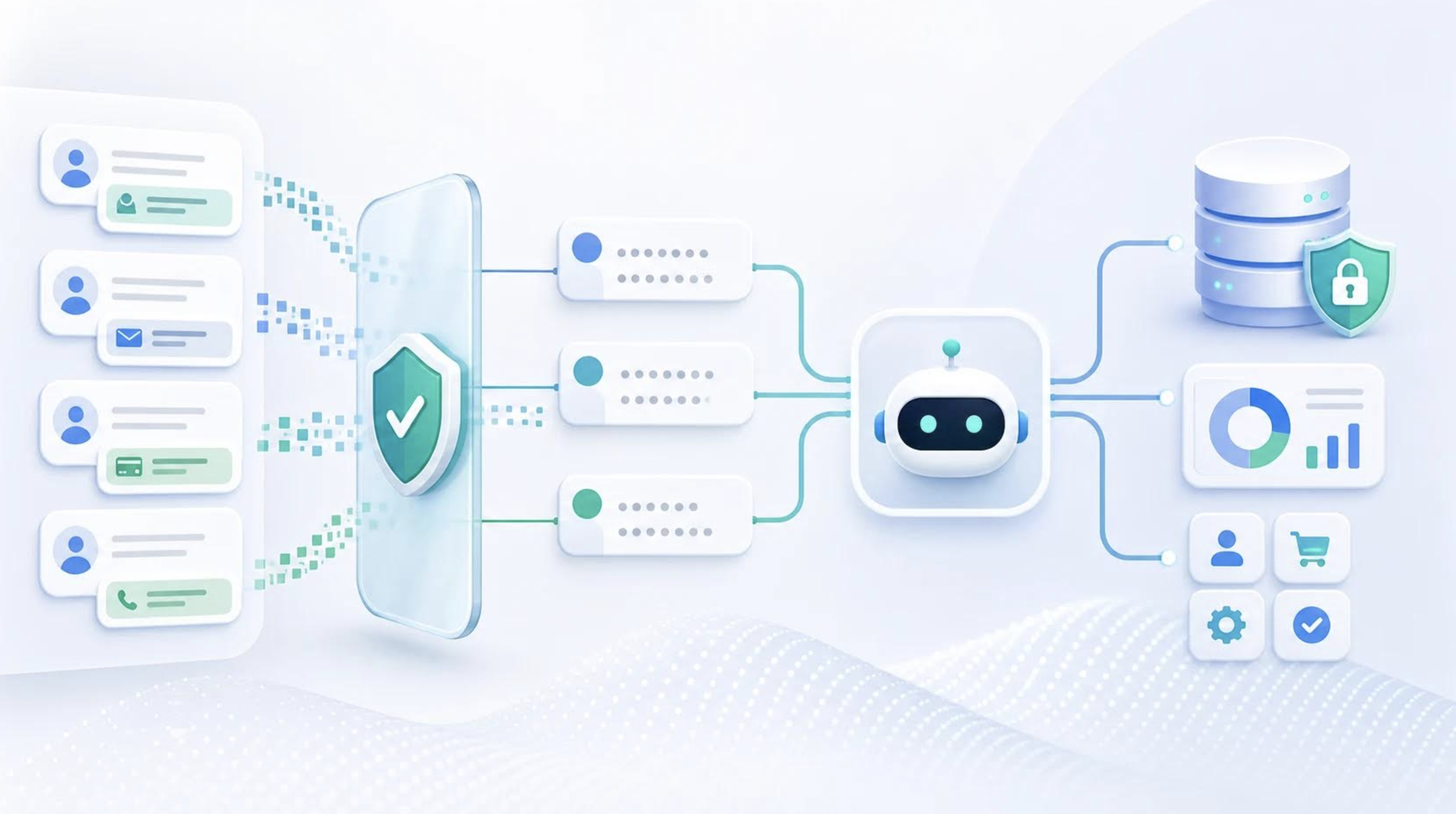
As adoption grows, many platforms that support AI agents for small businesses are incorporating privacy and security features such as anonymization, role-based access controls, and retention management. These controls can help organizations maintain more consistent governance throughout the deployment lifecycle.
Hardening the Deployment: A Security Checklist
Privacy is about what you collect; security is about who can reach it and how it is protected. A customer-facing agent should meet the same bar as any other internet-facing service:
- Encrypt everywhere: Use TLS for data in transit and strong encryption for data at rest. This is table stakes, not a differentiator.
- Authenticate and scope access: Apply role-based access control so staff, admins, and integrations each see only what they need, and treat API keys as secrets to rotate.
- Constrain tool and action permissions: If your agent can call tools or trigger automations, limit their number and scope. An agent that can do only five well-defined things is far easier to reason about than one with open-ended access.
- Defend against prompt injection: Validate and sanitize inputs, separate trusted instructions from untrusted content, and never let an agent execute privileged actions purely on the strength of conversational text.
- Log and monitor: Keep audit trails of who accessed what and when, and watch for anomalies. Early detection turns a potential breach into a contained incident.
- Vet your vendors: A third-party model or platform becomes part of your trust boundary. Confirm their security controls, data-handling commitments, and willingness to sign the agreements your industry requires.
The last point deserves emphasis. In a layered AI stack, your weakest dependency defines your real security posture, and a flawless front end means little if an upstream provider quietly retains and trains on everything it sees. The NIST AI Risk Management Framework offers a vendor-neutral structure for mapping, measuring, and governing these AI-specific threats.

Location Signals: Useful for Risk, Unreliable as Proof
Because a customer-facing agent sits on the open internet, the metadata around each conversation, including IP address, approximate geolocation, and whether the connection arrives via VPN or proxy, is worth watching. These signals are useful for risk scoring and routing. For instance, a returning customer who normally connects from one region but arrives through a known proxy to change account details can trigger step-up verification.
What they are not is proof. IP geolocation is approximate, often accurate only to a city or region, and trivially masked by a VPN, so treat it as one weak signal among many, never as confirmation of identity. Disclosure obligations, by contrast, are best applied universally rather than gated on detected location, precisely because that location can be wrong or deliberately hidden.
That logic generalizes into a simple decision model: match the control to the action's risk.
| Action Tier | IP / Location Role | Required Control |
|---|---|---|
| Low — FAQs, product questions | Usually not needed | Standard disclosure and logging |
| Medium — order status, account lookups | Useful as a risk signal | Authentication and scoped access |
| High — account changes, refunds, medical or financial guidance | Anomaly detection only | Step-up verification or human review |
The 2026 Disclosure Landscape: Tell People They Are Talking to AI
Compliance for conversational AI has shifted decisively toward transparency. The simplest and most universal rule in 2026 is this: if a user might reasonably think they are talking to a human, you must tell them they are not.
The regulatory pressure is coming from several directions at once:
U.S. State Laws Are Expanding
A growing number of states have introduced and, in some cases, enacted chatbot and AI transparency requirements. Some, like California's companion-chatbot rules, may carve out customer-service bots; others, such as Utah's and Maine's, apply disclosure obligations more broadly to AI interactions. The patchwork is uneven and still shifting, so businesses serving a national audience often adopt the strictest applicable standard rather than tracking each statute.
Federal Consumer-Protection Law Already Applies
Even without a state-specific statute, failing to disclose that a customer is interacting with AI can constitute a deceptive practice. Disclosure is the safe default regardless of geography.
The EU AI Act Raises the Global Bar
Article 50's transparency rules require that anyone interacting with an AI system in the EU be informed of that fact, with no general exemption for customer-service use. Generative outputs may also need machine-readable labeling. For any business with European users, this is now a hard requirement, not a nice-to-have.
Practical disclosure is not hard: a clear statement at the start of the conversation, persistent visibility of the agent's identity, and an obvious path to a human. The mistake is treating it as an afterthought rather than a design requirement.
When the Stakes Rise: Regulated and Healthcare Deployments
Everything above intensifies when an agent handles regulated data. Healthcare is the sharpest example. For covered entities and their vendors, the moment a conversation touches protected health information (PHI), HIPAA's requirements may apply in full, and PHI is defined broadly. A message containing "58-year-old, type 2 diabetes, ZIP 90210, prescribed metformin" can identify a person even without a name attached.
Two requirements typically separate a compliant healthcare deployment from a liability:
- A Business Associate Agreement (BAA): Under HHS guidance, a vendor or model provider that creates, receives, or processes PHI on your behalf is generally treated as a business associate and must sign a BAA committing them to protect that data. Most consumer-grade general assistants will not sign one, which makes them unsuitable for PHI by default.
- Clinical-grade grounding and escalation: In medicine, a confident but wrong answer is dangerous. Systems built for this setting ground responses in verifiable evidence and hand off to a clinician when complexity or risk crosses a threshold.
The design philosophy matters as much as the paperwork. For example, a healthcare organization deploying a HIPAA-compliant medical chatbot would typically ground responses in sources such as PubMed and published guidelines, surface citations that a clinician can verify, and route anything ambiguous to a human. This creates a very different risk profile from that of a general-purpose assistant repurposed for health questions.
Final Thoughts
Customer-facing AI agents are no longer experimental; they are becoming a default channel for support, sales, and service, so the bar for deploying them responsibly is rising in step. The organizations that get this right in 2026 are not the ones with the flashiest demos, but the ones that treated privacy, security, and disclosure as first-class design constraints from day one.
The playbook is consistent across industries: collect the minimum data you need, encrypt and access-control what you keep, constrain what the agent can do, tell users plainly they are talking to AI, and pick vendors whose commitments match your regulatory obligations. In regulated fields, add the contracts and clinical-grade guardrails that the stakes demand. Do that, and an AI agent becomes a controlled, auditable customer interaction layer rather than a risk you merely tolerate.
 FAQs
FAQs
In most cases, yes. A growing number of U.S. states require disclosure, federal consumer-protection rules treat undisclosed AI as potentially deceptive, and the EU AI Act mandates disclosure for any AI system interacting with EU users. The safest approach is to disclose clearly at the start of every conversation and always offer a path to a human.
Data minimization. The data you never collect cannot leak, be misused, or be subpoenaed. Pair that with automatic retention limits and anonymization of personal details in logs and provider traffic.
Prompt injection is an attack where malicious instructions are hidden in user input or in documents the agent reads, attempting to override its guardrails. It matters because agents that can call tools or access systems could be manipulated to leak data or take unintended actions. Input validation, instruction isolation, and tightly scoped permissions are the core defenses.
Not for anything involving protected health information unless the provider will sign a Business Associate Agreement and the system meets HIPAA requirements. Tools built specifically for clinical use add evidence-based grounding, verifiable citations, and human escalation that general assistants typically lack.
Ask what data they store and for how long, whether they encrypt at rest and in transit, how they handle access control and audit logging, whether they train on your data, and which compliance agreements (such as a BAA) they will sign. Their answers define your real risk posture because their controls become part of your trust boundary.
Disclaimer
The information provided in this article is for general informational and educational purposes only and should not be construed as legal, medical, financial, cybersecurity, or compliance advice. Readers should consult qualified professionals regarding their specific circumstances, regulatory obligations, and compliance requirements.
While every effort has been made to ensure the accuracy of the information presented, laws, regulations, and industry standards may change over time. Readers are responsible for independently verifying any information before making business, legal, technical, or compliance decisions.
This article may contain links to third-party websites for reference and convenience. These external websites are not owned, operated, or controlled by IPLocation.net. IPLocation.net does not endorse, guarantee, or assume responsibility for the accuracy, completeness, availability, privacy practices, products, services, or content of any third-party website. Accessing external links is done at the reader's own risk.
IPLocation.net, its owners, contributors, employees, and affiliates shall not be liable for any loss, damage, claim, liability, or consequence arising from the use of this article or from reliance on any information, products, services, or content available through external websites referenced herein.
Featured Image generated by ChatGPT.
Share this post
Leave a comment
All comments are moderated. Spammy and bot submitted comments are deleted. Please submit the comments that are helpful to others, and we'll approve your comments. A comment that includes outbound link will only be approved if the content is relevant to the topic, and has some value to our readers.
Comments (0)
No comment