
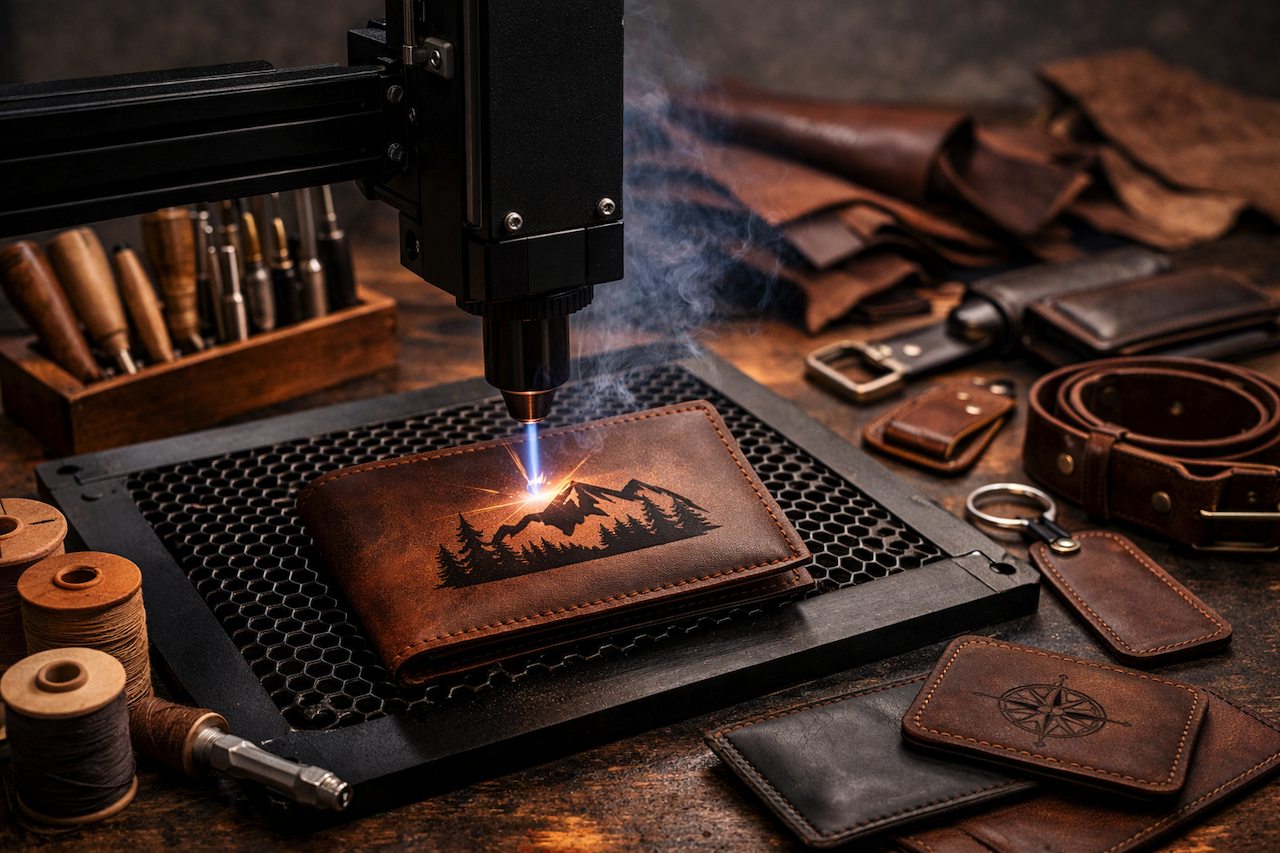
In a small custom workshop, a leather craftsman was trying to scale his business beyond one-off handmade pieces.
The demand was already there. Personalized wallets, belts, bags, patches, and custom gift items—orders kept coming in. But the problem wasn’t getting customers. It was keeping the results consistent.
One day, a batch of products went out. Same design, same layout, same process. But when placed side by side, they didn’t match. Some were darker, some lighter. A few had edges that looked slightly burned.
Customers noticed.
That’s when the issue became real.
When “It Works” Isn’t Good Enough
At the beginning, the process seemed simple. Load the design, set the parameters, run the engraving.
And for the first few pieces, it worked.
But as production increased, small inconsistencies became impossible to ignore. The craftsman tried adjusting power, reducing speed, even switching materials.
Nothing fully solved the problem.
The machine was doing its job. But the output still varied.
The Problem Wasn’t Obvious at First
It took time to realize what was happening.
Leather isn’t uniform. Even pieces from the same supplier behave differently. Some absorb more energy, others less. Surface treatment, grain structure, even slight moisture differences all play a role.
At a small scale, these differences don’t stand out.
At a larger scale, they become a problem.
This is where laser engraving leather shifts from a simple process to a consistency challenge.
Where Most Adjustments Fall Short
The first instinct is always to adjust settings.
Lower the power. Increase the speed. Try different passes.
Sometimes that improves the result, but only temporarily.
Because the issue isn’t the settings themselves. It’s that the material keeps changing, while the process tries to stay the same.
This mismatch is what creates inconsistency.
What Changed the Workflow
The turning point came when the focus shifted away from constant adjustment and toward control.
Instead of reacting to each piece, the craftsman started looking for a setup that could handle variation without requiring constant intervention.
This is where systems, like the Xlaserlab E3, started to make a difference.
Rather than forcing the material to behave, the process became more stable. The engraving results stopped drifting. Pieces began to look like they belonged to the same batch.
For someone running a growing workshop, that change mattered more than speed.
Why Control Matters More Than Speed
In custom leather work, speed is useful, but consistency is what builds trust.
Customers don’t compare your product to your intention. They compare it to your last piece.
If results vary, it shows immediately.
A reliable laser engraver for leather doesn’t just produce clean engravings. It produces repeatable ones. That’s what allows a workshop to move from handcrafted to scalable.
How This Applies to Everyday Projects
The same pattern shows up across different types of work.
Wallets require clean contrast without over-burning.
Belts need consistent depth across long surfaces.
Bags, patches, and accessories demand precision because they’re often highly visible or customized.
In each case, small variations become noticeable quickly.
When the process is stable, these variations become manageable. When it isn’t, they multiply.
What This Means for Small Businesses
For individual creators, inconsistency is frustrating.
For businesses, it’s expensive.
Time spent reworking pieces adds up. Materials get wasted. Delivery timelines slip.
But when results become predictable, everything changes.
Production becomes smoother. Output becomes reliable. Customers come back because they know what to expect.
That’s when a workshop stops being experimental and starts becoming operational.
Conclusion
Leather engraving often looks simple from the outside, but the real challenge is consistency over time.
What starts as a creative process eventually becomes a system problem. And solving that problem requires more than adjusting settings; it requires better control over how the process interacts with the material.
For many workshops, tools are part of that transition. Not because they promise perfect results, but because they reduce the gap between intention and outcome.
And in custom work, that gap is everything.
Featured Image generated by ChatGPT.
Share this post
Leave a comment
All comments are moderated. Spammy and bot submitted comments are deleted. Please submit the comments that are helpful to others, and we'll approve your comments. A comment that includes outbound link will only be approved if the content is relevant to the topic, and has some value to our readers.
Comments (0)
No comment