
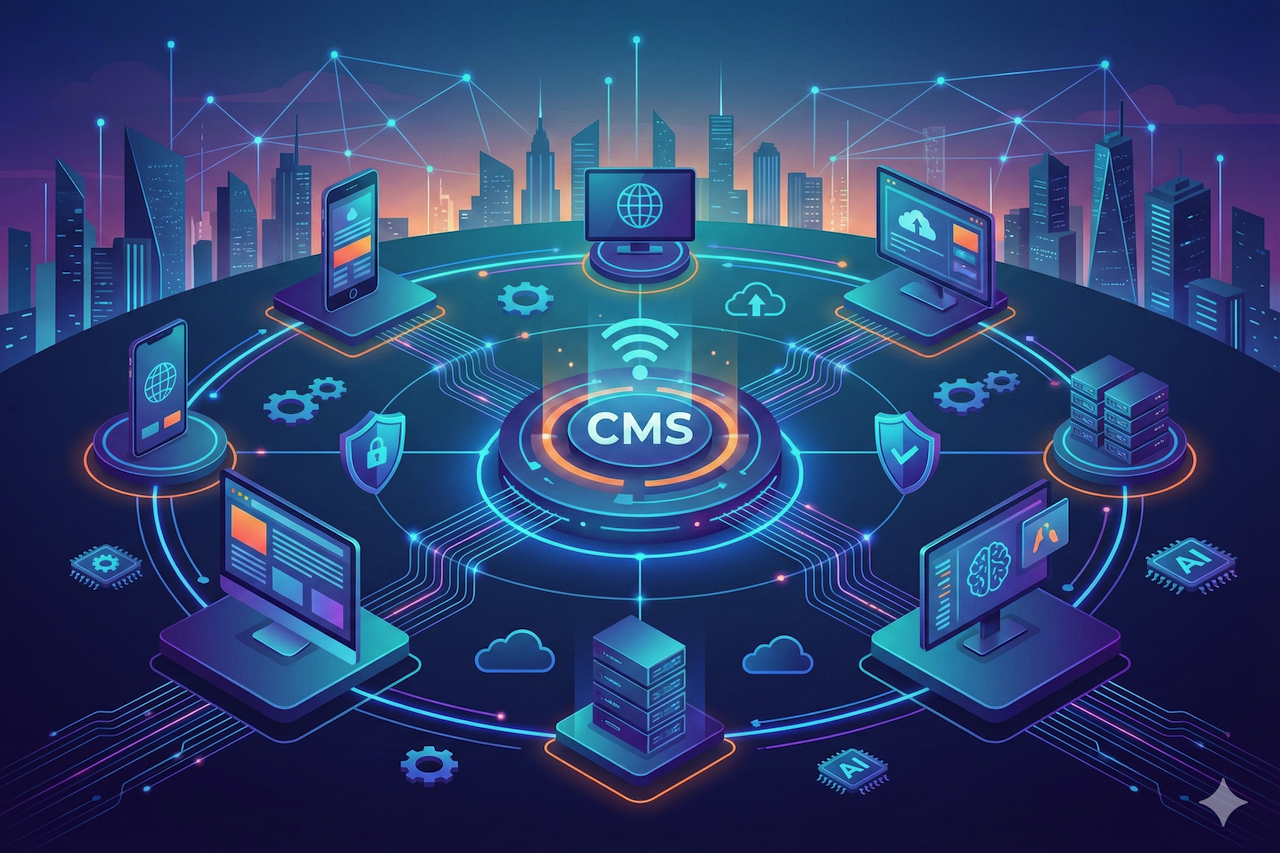
Content Management Systems (CMS) have advanced far beyond simple tools for publishing websites. Today, these platforms serve as the foundation of digital ecosystems that include mobile apps, APIs, connected devices, and emerging digital interfaces. As user expectations continue to grow, priorities such as security, performance, scalability, and seamless integration have become essential. Modern CMS platforms are evolving rapidly to support these demands and enable businesses to deliver consistent digital experiences across channels.
In this article, we explore the most influential CMS trends shaping today’s digital landscape, with a focus on architecture, security, performance, and integration. These trends are important for businesses, developers, and digital teams working with modern content platforms and evaluating solutions offered by a CMS development company.
Below are ten key trends driving innovation in the CMS space:
- Headless and decoupled CMS architectures
- API-first integration strategies
- Enhanced security and privacy controls
- Cloud-native and SaaS-based CMS platforms
- Edge delivery and performance optimization
- Data- and AI-driven personalization
- Developer-friendly CMS environments
- Structured and reusable content
- Governance, compliance, and auditability
- Composable and future-ready CMS ecosystems
1. Headless and Decoupled CMS Architectures
One of the most significant shifts in CMS evolution is the move toward headless and decoupled architectures. Unlike traditional monolithic platforms, headless CMS separates content management from the presentation layer. This allows organizations to deliver the same content across multiple digital touchpoints without being tied to a single frontend.
Why this matters:
- Content is delivered through APIs such as REST or GraphQL
- Frontends can be built with any framework or device
- Faster performance and improved scalability
- Easier integration with third-party platforms
2. API-First Integration Strategies
Modern CMS platforms increasingly follow an API-first approach. This enables seamless integration with CRM systems, analytics platforms, identity providers, marketing tools, and other enterprise solutions. For organizations managing complex digital ecosystems, API-driven architecture is becoming a core requirement.
Key benefits include:
- Faster development cycles
- Improved interoperability
- Greater flexibility in system design
- Support for microservices and composable architectures
3. Enhanced Security and Privacy Controls
Because CMS platforms often manage sensitive user data and critical business content, security and privacy have become central priorities. Modern platforms focus on secure infrastructure and access management to reduce risks and protect digital assets.
Current security trends include:
- Role-based access control (RBAC)
- Multi-factor authentication (MFA)
- Granular permissions
- Secure API authentication using OAuth and JWT
- Privacy and compliance-ready resources
4. Cloud-Native and SaaS-Based CMS Platforms
Cloud-native CMS solutions are becoming the preferred choice for organizations seeking scalability and flexibility. SaaS-based models allow teams to focus on content and user experience instead of infrastructure management.
Advantages of cloud-based CMS platforms:
- Automatic updates and patches
- Elastic scalability
- High availability and disaster recovery
- Lower operational and maintenance costs
5. Edge Delivery and Performance Optimization
Performance directly affects SEO, user experience, and conversions. Modern CMS solutions are prioritizing speed and global accessibility through advanced delivery methods.
Examples include:
- Static site generation
- Global CDN distribution
- Edge caching and rendering
- Optimized API delivery
These strategies reduce latency and improve experiences for users across different regions.
6. Data- and AI-Driven Personalization
Personalization has become a core requirement in digital experiences. CMS platforms are integrating data and AI capabilities to deliver tailored content based on user behavior, preferences, and context.
Emerging capabilities include:
- Rule-based personalization
- AI-assisted recommendations
- Behavioral segmentation
- Context-aware content delivery
7. Developer-Friendly CMS Environments
Modern CMS platforms are focusing on flexibility and efficiency to support collaboration between content and technical teams. Developer-friendly environments help accelerate innovation and streamline workflows.
Key considerations include:
- Clean and well-documented APIs
- Flexible content modeling
- SDKs and CLI tools
- Support for modern frameworks
- Version control and automation
8. Structured and Reusable Content
Structured content is becoming essential in omnichannel strategies. Instead of treating content as isolated pages, organizations now view it as reusable data that can be distributed across channels.
Benefits include:
- Consistency across platforms
- Easier localization
- Improved automation
- Enhanced analytics and reporting
9. Governance, Compliance, and Auditability
Enterprises and regulated industries require strong governance and transparency. Modern CMS platforms support advanced compliance and monitoring capabilities.
Key features include:
- Approval workflows
- Version control
- Audit trails
- Activity monitoring
10. Composable and Future-Ready CMS Ecosystems
CMS platforms are no longer standalone tools. They are part of composable digital experience stacks that include search, analytics, commerce, and personalization systems. This modular approach enables organizations to adapt quickly as technology evolves.
Future-ready CMS strategies focus on flexibility, scalability, and seamless integration across the digital ecosystem.
Conclusion
CMS platforms are undergoing a major transformation driven by the need for performance, security, scalability, and personalized experiences. Trends such as headless architecture, API-first integration, cloud-native infrastructure, and AI-driven personalization are redefining how content is created, managed, and delivered.
By understanding these trends, organizations can build flexible and secure content ecosystems that support evolving digital experiences. As expectations continue to rise, modern CMS strategies will play a critical role in enabling innovation and long-term growth.
Featured Image generated by Google Gemini.
Share this post
Leave a comment
All comments are moderated. Spammy and bot submitted comments are deleted. Please submit the comments that are helpful to others, and we'll approve your comments. A comment that includes outbound link will only be approved if the content is relevant to the topic, and has some value to our readers.
Comments (0)
No comment