
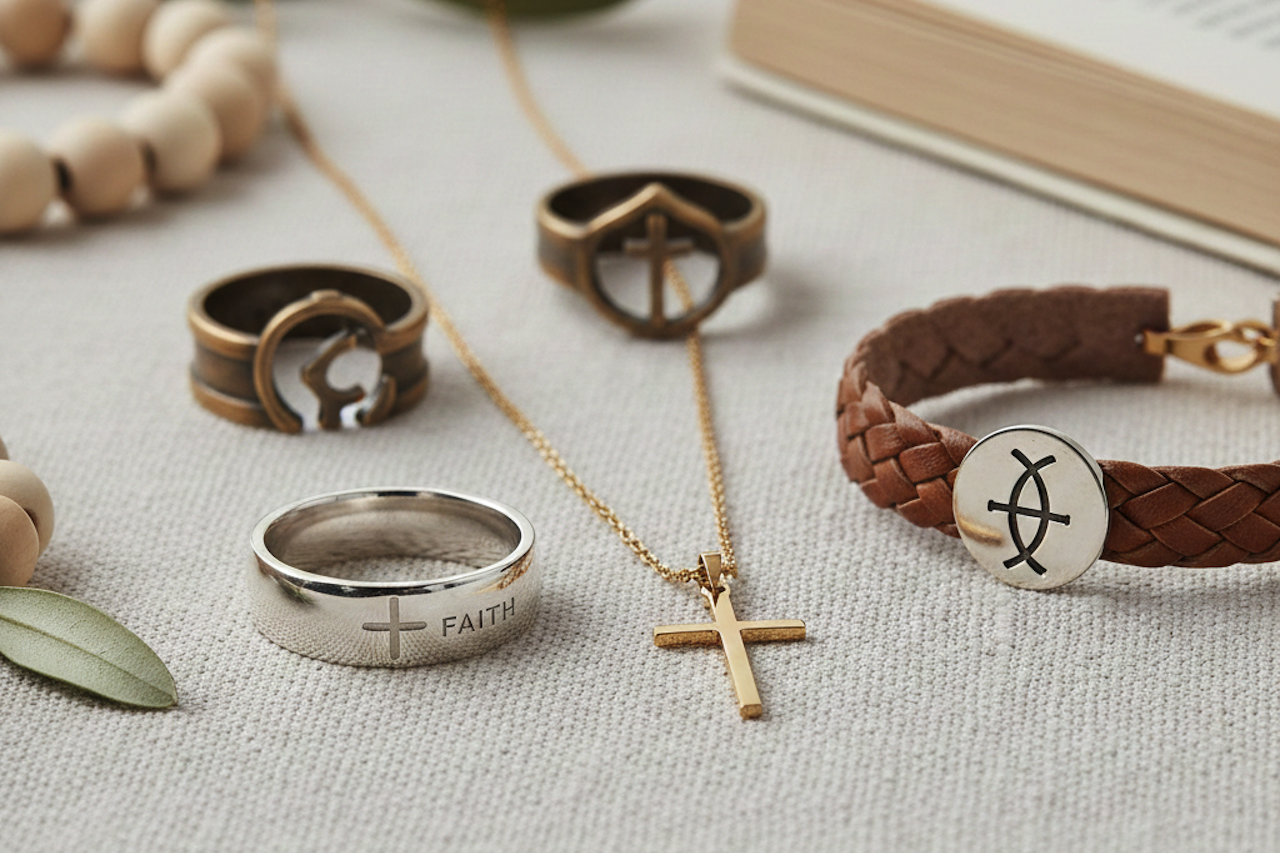
Christian jewelry refers to accessories worn by some individuals as a reflection of religious identity, cultural heritage, or personal belief. These items have appeared in various forms for centuries and continue to be used today for a range of reasons that extend beyond purely religious practice.
Examples range from simple cross necklaces to engraved rings, such as a Confidein Christian ring, which may be worn as a personal or cultural symbol rather than a formal religious requirement.
While meanings vary widely among wearers, Christian jewelry often functions as a symbol of tradition, identity, or personal values rather than as a requirement of faith.
Historical Background of Christian Jewelry
The use of jewelry associated with Christianity dates back to early Christian communities. During periods when open worship was discouraged or restricted, symbols such as the ichthys (fish) were used discreetly to signal shared belief. Over time, these symbols became more openly worn as Christianity gained legal and social acceptance.
By the medieval period, crosses, medallions, and engraved rings were commonly worn across Europe, sometimes indicating religious affiliation and sometimes reflecting broader cultural norms. In many cases, such jewelry also carried social or familial significance rather than purely spiritual meaning.
Common Symbols Found in Christian Jewelry
Christian jewelry often incorporates recognizable imagery drawn from Christian tradition. Common elements include:
- The cross, representing Christianity’s central narrative
- The ichthys (fish), an early Christian symbol
- Scripture references or abbreviated verses
- Words such as “faith,” “hope,” or “grace”
- Doves or anchors, which historically symbolize peace or stability
These symbols may be presented prominently or subtly, depending on the wearer’s preference and the design.
Cultural and Personal Reasons for Wearing Christian Jewelry
People wear Christian jewelry for many different reasons. For some, it reflects religious belief. For others, it represents family tradition, cultural background, or personal identity. In certain cases, jewelry is worn primarily for aesthetic reasons, with symbolism playing a secondary role.
Christian jewelry is also frequently exchanged as a gift during culturally significant moments such as baptisms, confirmations, weddings, or graduations. In these contexts, the jewelry often serves as a commemorative object rather than a statement of belief.
In recent years, symbolic jewelry has become more visible across many communities, including faith-based accessories. For some wearers, these pieces reflect personal identity or tradition, while for others they function primarily as culturally meaningful design elements.
Materials and Design Styles
Christian jewelry is produced in a wide range of materials, including silver, gold, stainless steel, and alternative metals. Designs range from minimal and modern to ornate and traditional, reflecting both contemporary fashion trends and historical influences.
Some pieces emphasize durability and everyday wear, while others are intended for ceremonial or occasional use. Advances in jewelry manufacturing have expanded design options, allowing symbolic elements to be integrated in subtle or abstract ways.
Christian Jewelry in Modern Society
Today, Christian jewelry exists at the intersection of religion, culture, and fashion. In pluralistic societies, it is often worn alongside other forms of symbolic jewelry representing cultural, spiritual, or personal identity.
Rings are one common form of Christian jewelry, alongside necklaces and bracelets. They may feature crosses, brief inscriptions, or understated motifs, and are sometimes chosen for everyday wear because they are durable and easy to keep on hand.
Its presence in mainstream jewelry collections reflects a broader trend toward personalized accessories that convey meaning beyond appearance. For many wearers, Christian jewelry functions as a quiet expression of identity rather than an outward statement directed at others.
Conclusion
Christian jewelry occupies a unique place within cultural and religious expression. Rooted in historical tradition and adapted to modern design, it serves different purposes for different people. Whether worn for faith, heritage, or aesthetic reasons, these pieces continue to reflect the diverse ways individuals connect symbolism with personal meaning.
 FAQs
FAQs
Christian jewelry refers to accessories that incorporate symbols or imagery associated with Christianity. These items may reflect religious belief, cultural heritage, personal identity, or historical tradition, depending on the wearer.
Common symbols include the cross, the ichthys (fish), short Scripture references, and words such as “faith,” “hope,” or “grace.” Some designs also include doves, anchors, or other historically significant motifs.
Not necessarily. While some individuals wear Christian jewelry as an expression of belief, others choose it for cultural, family, or aesthetic reasons. Meanings vary widely among wearers.
Yes. Rings are one of several common formats, along with necklaces and bracelets. They are often chosen for everyday wear because of their durability and convenience.
Christian jewelry is made from a variety of materials, including silver, gold, stainless steel, and alternative metals. Material choice often depends on style preferences, durability needs, and intended use.
Christian jewelry is sometimes exchanged during cultural or religious milestones such as baptisms, confirmations, weddings, or graduations. In these contexts, the jewelry often serves as a commemorative item rather than a formal religious requirement.
Many people choose to wear Christian jewelry alongside other symbolic or decorative pieces. Styling choices vary based on personal preference and cultural context.
Yes. Christian jewelry is produced in a wide range of designs intended for different styles and preferences. Many pieces are designed to be unisex.
Modern Christian jewelry reflects a mix of historical symbolism and contemporary design. Today, it often appears alongside other forms of symbolic jewelry and may function as a personal or cultural identifier rather than a public statement.
Featured Image generated by Google Gemini.
Share this post
Leave a comment
All comments are moderated. Spammy and bot submitted comments are deleted. Please submit the comments that are helpful to others, and we'll approve your comments. A comment that includes outbound link will only be approved if the content is relevant to the topic, and has some value to our readers.
Comments (0)
No comment