
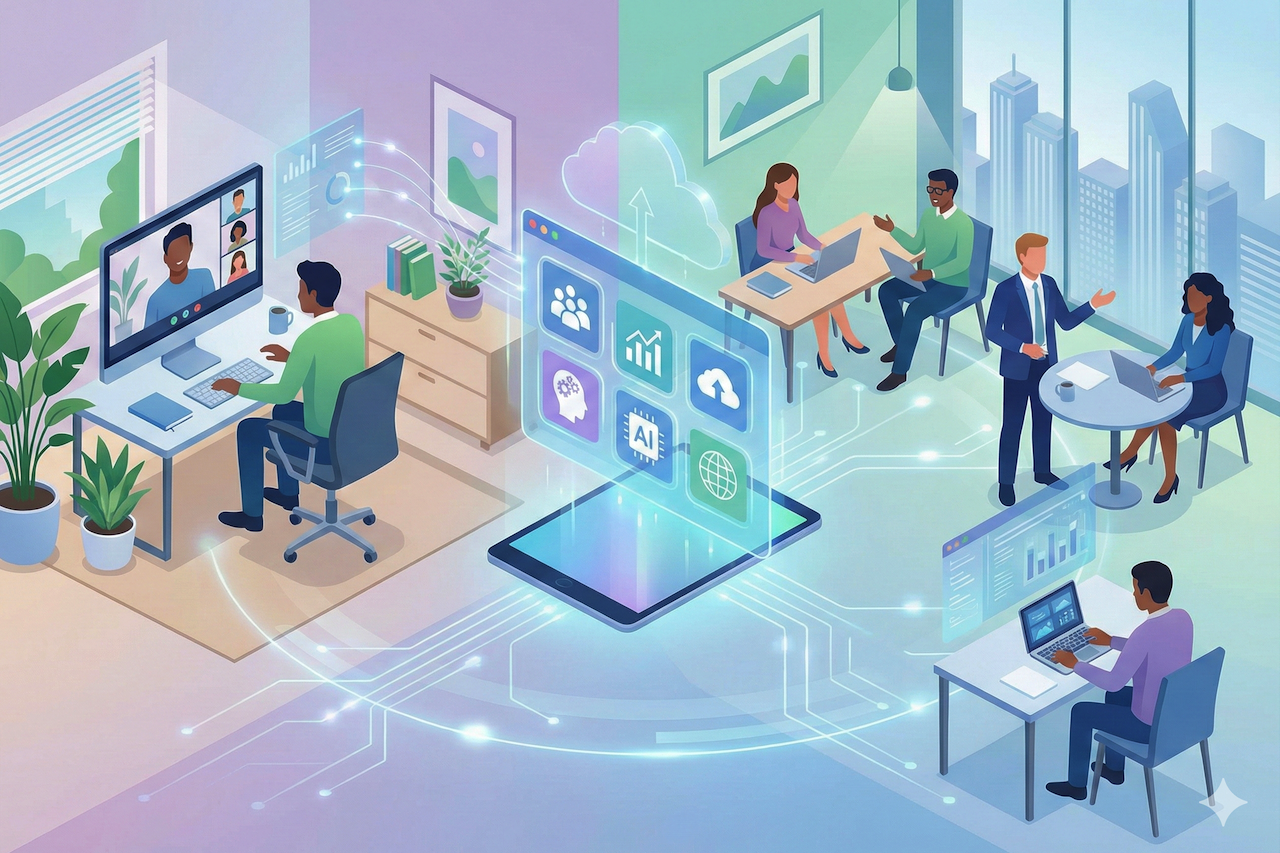
Hybrid work has fundamentally altered employees' expectations in the workplace. Effectiveness is no longer measured by physical presence or office infrastructure. Instead, the accessibility of tools, collaboration with teams, and timely support are considered more crucial. As a result, flexibility is now a baseline expectation, and seamless digital experiences are critical to employee satisfaction and engagement.
Recent workforce studies indicate that more than 72% of employees prefer hybrid or remote work models, making flexibility a strategic necessity rather than an optional benefit. Organizations that cannot meet these expectations risk low productivity and increased employee turnover.
Traditional workplace models struggle to support this shift. Systems designed for centralized offices, fixed schedules, and on-premises tools do not scale effectively across distributed, cloud-first environments. Fragmented collaboration platforms, reactive IT support, and inconsistent device experiences introduce friction that directly impacts productivity and operational efficiency.
To succeed in a hybrid-first world, your organization must shift from location-centric models to experience-centric design. Work should be consistent, reliable, and intuitive across locations, devices, and roles. Employees expect technology to adapt to their workflows, not the other way around.
The modern digital workplace addresses this need by unifying people, platforms, services, and devices into a cohesive, intelligent experience. Powered by automation, analytics, and AI, it enables organizations to support productivity, collaboration, and service delivery at scale.
This blog outlines how organizations can build a modern digital workplace by rethinking experience design, collaboration, IT support, productivity engineering, automation, device management, and business outcomes for a hybrid-first world.
Redefining Workplace Experience for Hybrid-First Reality
The hybrid-first work model requires organizations to rethink the workplace as an ongoing digital experience rather than a physical location. It should be based on providing sustained, natural, and confident connections that enable staff to operate efficiently across different geographic areas, devices, and time zones.
Such a shift demands a new approach to how work is designed, delivered, and supported in a hybrid-first environment, built around the following core focus areas.
From Location-Based Work To Experience-Driven Work
The connection between productivity and physical presence has been disrupted by hybrid work. Employees can now travel with ease among home, company, and third-party offices. In such an environment, productivity depends on the quality of the digital experience, not the employee’s location.
Organizations need to abandon office-centric models that assume equal access to resources. Work driven by experience emphasizes uniformity, reliability, and practicality in the environment. Experience, performance, collaboration, and support are similar for employees regardless of whether they are at headquarters or in a remote location.
Designing consistent experiences across locations reduces friction, increases trust in technology, and enables employees to focus on outcomes rather than workarounds. For instance, a global consulting firm that standardizes collaboration tools and device configurations across all offices and remote employees ensures faster project delivery and fewer support requests.
Experience-First Workplace Design
A change of priorities is called experience-first design. Organizations optimize employee productivity and satisfaction instead of infrastructure availability or system uptime. This strategy balances workplace services with the way employees actually work, communicate, and solve problems.
In this model, digital workplace services play a central role by integrating collaboration platforms, support services, automation, and analytics into a unified experience layer. Workplace design decisions are informed by real usage patterns, employee sentiment, and performance data rather than assumptions or legacy standards. This further results in a workplace that adapts to employees, not the other way around.
Establishing Hybrid-Ready Foundation
A hybrid-ready foundation requires a unified digital environment spanning devices, tools, networks, and security layers. Fragmented systems make the experience more complex and inconsistent. Integrated systems facilitate easier access, reduce support hassle, and enable scalability.
This foundation supports growth, accommodates diverse workstyles, and ensures hybrid work remains resilient as organizational needs evolve. In the absence of this foundation, improvement of experience is not transformative but tactical.
Enabling Seamless Collaboration Through Digital Workplace Platforms
Hybrid work depends on digital collaboration, as teams use online tools to organize, communicate, and make decisions across locations. Such effective collaboration across platforms provides continuity, common ground, and ease in the entire interaction.
To enable this level of collaboration in a hybrid environment, organizations must focus on the following key elements.

Image by Freepik.
Unified Collaboration Ecosystems
Hybrid teams rely on collaboration platforms to replace much of the informal interaction enabled by physical proximity.
The lack of integration among messaging, meetings, file sharing, and task management tools leads to the development of silos that retard decision-making and dilute responsibility. On the other hand, unified collaboration ecosystems integrate communication, productivity, and knowledge-sharing capabilities into cohesive platforms. These environments enable employees to easily switch among discussions, documents, and processes without losing context.
Intelligent Collaboration Support
Artificial intelligence improves collaboration by reducing friction in day-to-day activities. AI-based capabilities enhance meeting efficiency, streamline file access, and standardize routine coordination tasks. Moreover, smart support ensures continuity of digital touchpoints even when employees switch devices or locations.
These abilities shift cooperation from reactive coordination to proactive empowerment. Teams also spend less time managing tools and more time on value creation.
Step-by-Step Collaboration Enablement
Such capability is enabled through a structured and repeatable approach:
- Assess collaboration needs across roles, teams, and workflows
- Standardize tools and platforms to reduce fragmentation
- Optimize experiences through continuous monitoring and feedback
This iterative model ensures collaboration platforms evolve alongside employee needs rather than becoming static systems.
Transforming IT Support with Proactive and Intelligent Services
IT support has risen to the forefront of the employee experience due to the hybrid work environment. Support models need to be transformed to anticipate issues, minimize disruptions, and enhance productivity in distributed environments.
To deliver reliable and experience-driven IT support in a hybrid environment, organizations must focus on the following key capabilities.
From Reactive Helpdesks To Proactive IT Experiences
Conventional helpdesks operate on a reactive, ticket-based model, in which services are provided in response to disruptions. This strategy results in downtime and a loss of trust in IT services in the hybrid environment.
Proactive IT practices focus on anticipating and preventing problems before they affect employees. This shift transforms support from a cost center into a productivity enabler.
AI-Powered Service Desks And Self-Service
AI-powered service desks use virtual agents, automation, and contextual intelligence to accelerate resolution. Self-healing capabilities automatically address known issues, while self-service tools empower employees to resolve common problems independently. These features minimize turnaround times, enhance customer satisfaction, and free the support team to focus on complex matters that require a human touch.
Step-by-Step Intelligent Support Model
An intelligent support model progresses through three stages:
- Monitor workplace signals and sentiment across applications and devices
- Predict incidents using AI and historical patterns
- Resolve automatically or assist agents with contextual insights
This model aligns support operations with experience outcomes rather than ticket volumes.
Enhancing Employee Productivity Through Experience-Centric Engineering
Employee efficiency in a hybrid workplace is determined by how smoothly technology facilitates everyday operations. Experience-driven engineering promotes focus, efficiency, and performance of workplace systems rather than creating friction.
To improve productivity in a hybrid environment, organizations must focus on the following experience-centric engineering practices.

Image by Freepik.
Personalized Digital Workplace Experiences
Experience-centric engineering tailors digital environments to user context, role, and work patterns. Such personalized access, performance optimization, and contextual tools improve productivity by reducing unnecessary friction. Consistent uptime and responsiveness across devices and applications ensure employees can maintain momentum throughout the workday, regardless of location.
Continuous Experience Optimization
Employees need to evolve continuously. Experience optimization relies on analytics and observability to refine workplace performance over time. These insights reveal friction points, usage trends, and performance gaps that impact productivity. Adapting environments based on real data ensures the workplace remains aligned with how work actually happens.
Step-by-Step Experience Engineering
Experience-centric engineering operates as a continuous improvement loop:
- Measure employee experience metrics across touchpoints
- Identify friction points affecting workflows
- Continuously optimize digital environments
This approach treats experience as an ongoing product, not a one-time initiative.
Streamlining Operations with AI-First Workplace Automation
Operational efficiency becomes increasingly critical as hybrid environments scale. AI-first automation helps organizations handle complexity and provides consistency, speed, and governance.
To achieve operational efficiency at scale, organizations should focus on the following automation-driven capabilities.
Intelligent Automation Across Workplace Operations
Hybrid work increases operational complexity. Manual operations struggle to scale onboarding, provisioning, compliance, and support processes. Smart automation minimizes manual labor and operational risk through standard execution.
Automation improves accuracy, accelerates response times, and enables consistent service delivery across distributed environments.
Integrated Operations Model
The integrated operations model integrates service management, support, and device operations into a single execution framework. This integration provides a seamless flow between activities in the workplace lifecycle, from onboarding to offboarding. Such unified operations remove redundancy, enhance transparency, and governance.
Step-by-Step Operational Optimization
Operational efficiency is achieved through the following phased approach:
- Automate repetitive workflows with high volume and low complexity
- Integrate platforms and tools to enable orchestration
- Optimize operations using AI insights and performance data
This model sustainably delivers value through automation, not just a one-time efficiency gain.
Modern Device and Lifecycle Management for Hybrid Employees
The most common point of contact for workers with the digital workplace is their devices. Successful lifecycle management ensures that all tools consistently support productivity, security, and the user experience.
To support productivity and experience in hybrid environments, organizations must adopt the following device lifecycle management practices.
Beyond Traditional Device Provisioning
The hybrid employee experience is centered on devices. Lifecycle management in the modern era treats devices as assets of experience rather than merely fixed equipment. Employees need tools that are safe, highly effective, and perform well in all environments. This approach ensures employees remain productive from day one.
Proactive Device Support And Visibility
Predictive maintenance reduces downtime by detecting faults before the system fails. Constant visibility of the device performance makes various functions more transparent, controllable by cost, and safety-oriented. Proactive support also builds trust and minimizes disruptions.
Step-by-Step Device Lifecycle Approach
Modern device management follows a proactive lifecycle model:
- Provision devices seamlessly with role-based configurations
- Monitor performance continuously for early indicators of issues
- Refresh, support, and retire devices proactively
This model aligns device management with experience and sustainability goals.

Image by Freepik.
Delivering Measurable Business Outcomes Through Digital Workplace
The digital workplace of the modern world provides distinct, quantifiable business value. Experience, efficacy, and scalability are directly converted into organizational performance and stability. These outcomes are realized through the following key business impact areas.
Productivity And Employee Satisfaction
Experience-centric workplaces minimize everyday interruptions and enable employees to focus on meaningful work. Improved experiences directly correlate with higher engagement and retention. Organizations with mature digital workplace capabilities achieve measurable improvements in productivity, resilience, and cost efficiency. The resulting improvements also help reduce employee burnout and align personal performance with organizational objectives.
Cost Efficiency And Operational Resilience
Automation and platform consolidation lower support costs while improving reliability. Hybrid-ready operations scale without proportional cost increases. Predictive support and automated workflows also reduce unplanned downtime and operational disruptions. This resilience enables organizations to continue providing the service even during periods of high change or sudden disruptions.
Enterprise-Wide Scalability
Modern digital workplaces support diverse teams, geographies, and workstyles. This scalability creates a foundation for future growth and organizational agility. Standardized platforms and single governance provide homogeneous experiences across regions and business units. A classic example is a multinational technology company that implements AI-driven service desks and predictive device maintenance, reducing downtime and improving employee satisfaction across multiple geographies.
Scalable workplace models can accommodate mergers, expansions, and workforce changes without significant redesign. This flexibility helps organizations adapt swiftly to the needs of a changing market and workforce.
Conclusion
The digital workplace has become an essential business competency, not a support function, due to the transition to hybrid work. A hybrid-first world relies on delivering coherent, user-friendly, and insightful digital experiences that enable employees, regardless of their workplace location.
Scalability, governance, and ongoing optimization are essential to sustain the workplace digital transformation as hybrid workspaces are developed.
Organizations that adopt a step-by-step approach to the digital workplace can achieve long-term success by prioritizing user experience, cohesive operations, and technology alignment with business outcomes. This structured, adaptable foundation enables enterprises to build resilient, productive, and employee-centered hybrid environments, where the digital workplace is not merely a place to enable work but a platform that defines how future work succeeds.
Featured Image generated by Google Gemini.
Share this post
Author

Read the latest articles from Rebecca Smith
7 Effective Ways To Use An XAUUSD Chart To Hedge Your Portfolio Against Inflation

April 24, 2026
Inflation is one of the biggest challenges to sustained financial growth. When inflation starts to bite deep into your purchasing power, conventional investments such as cash and bonds usually struggle. Gold has always proven to be one of the safest options for safeguarding oneself from such an economic trend.
Learn moreVideo Compressor Guide: Reduce Size Without Quality Loss

February 9, 2026
You create a valuable video, only to realize it's too large to upload, share, or even send. Slow uploads, platform file restrictions, and storage congestion soon turn a simple one into a frustrating one. This causes you to waste more time trying to resend or reformat the same video file. At this point, a [...]
Learn moreLeave a comment
All comments are moderated. Spammy and bot submitted comments are deleted. Please submit the comments that are helpful to others, and we'll approve your comments. A comment that includes outbound link will only be approved if the content is relevant to the topic, and has some value to our readers.
Comments (0)
No comment