
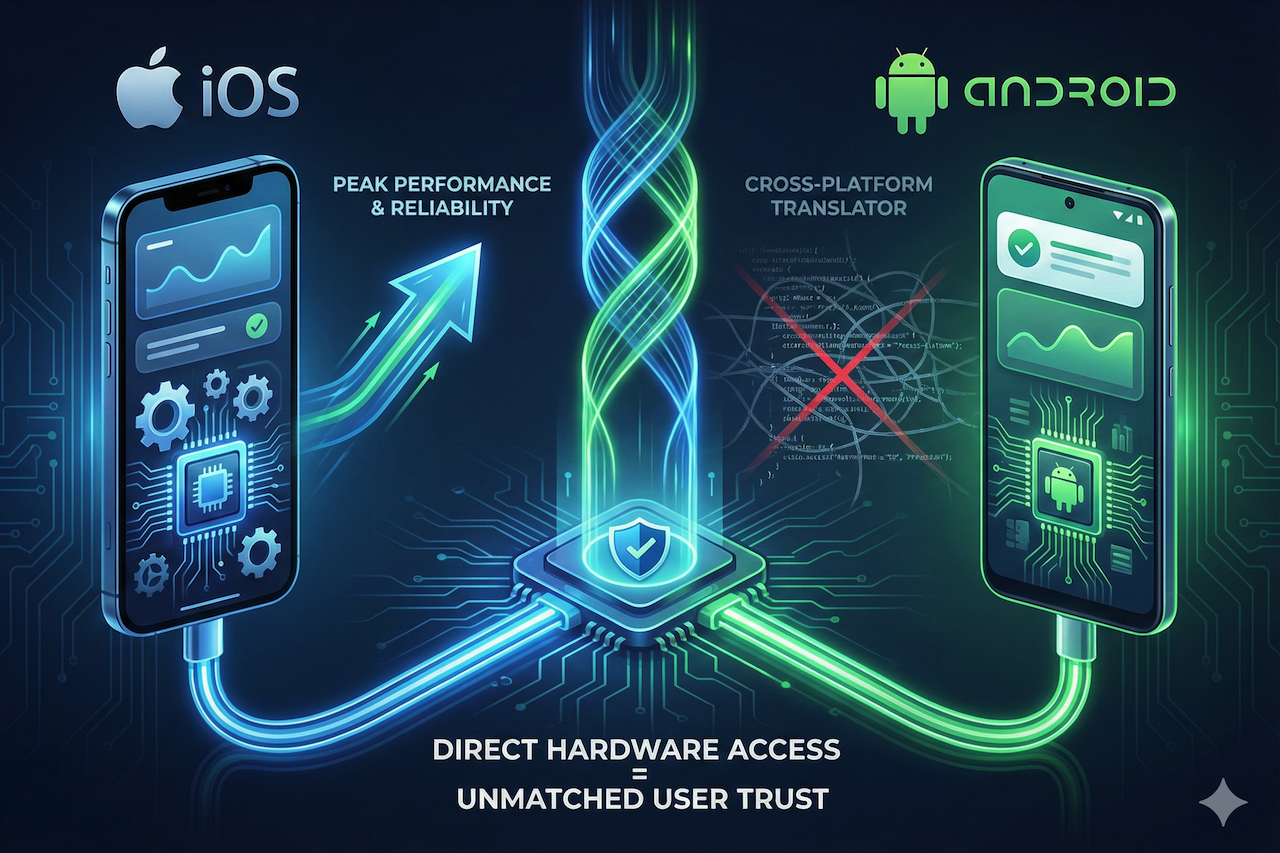
Performance is not a luxury. It is the foundation of user trust. In the world of mobile apps, reliability is often treated as a technical checkbox. Something developers fix after the launch. In reality, reliability is the most significant factor in whether a user keeps your app or deletes it in 10 seconds.
When you build a mobile app with native development, you are not just writing code. You are speaking the phone's mother tongue. You are using the specific tools Google and Apple built for their own hardware. At the end of the day, native development is about stability, speed, and a smooth feel that hybrid apps can't mimic.
We've seen this with startups and enterprise brands. Often, the decision to go native is all about the long game. It’s about preserving the user experience and preventing the app from crashing when it gets complicated.
Native Speaks the Language of the Hardware
Every phone has a brain. An iPhone uses iOS. A Samsung or Pixel uses Android. They work differently. They think differently. Native app development focuses on using the exact languages these brains understand—Swift for iOS and Kotlin/Java for Android.
When the code is native, the application can communicate directly with the hardware. The application speaks directly to the camera, the GPS, and the sensors without a translator in between. This eliminates the middleman, allowing the application to respond instantly.
It doesn't lag. It doesn't stutter when you scroll through a long list. It feels like it belongs there.
Reliability Reduces User Frustration
A reliable app is a quiet one. It does its job without drawing attention to its failures. Most mobile users expect an app to work perfectly every time. If it freezes, they leave.
Native development offers better memory management. It handles background tasks more efficiently. This means your app doesn't drain the battery. It doesn't make the phone hot. These small technical details create a sense of quality. Users don't know why the app feels solid, they know it works. Reliability builds a reputation that marketing can't buy.
Native UI is Faster
User Interface (UI) is where the user touches your business. If the button click feels slow, the whole brand feels slow. Native development uses the built-in interface components of the operating system.
When Apple updates a button style, a native app gets that update easily. The animations are fluid. They run at 60 frames per second, or even 120 on newer screens. This creates a high-end feel. Hybrid apps often try to imitate these looks. But the human eye can spot the difference. It feels off. Native UI is not an imitation; it is the real thing.
Faster Troubleshooting and Security
Problems happen. Bugs are part of the game. But with native development, finding why is much faster. The developer tools for Swift and Kotlin are incredibly advanced. They tell you exactly where the memory leak is. They show you why the crash happened on a specific version of Android.
Security is another big win. Native apps receive the latest security patches immediately. They use the phone's native encryption and biometric locks (like Face ID) for greater stability. For any app handling payments or personal data, this isn't just a benefit. It is a requirement.
Performance Under Pressure
What happens when your app goes viral? Or when a thousand users try to upload photos at once? Reliability is tested most when the load is high.
Native apps are compiled specifically for the phone's processor. They are lean. These apps are lightweight because, unlike cross-platform apps, they don’t carry the extra weight that ensures cross-platform apps always feel universal.
The fact that these apps are lightweight gives them an advantage over cross-platform apps when performing heavy tasks, such as editing videos or processing data. You would not want your app to face challenges when growth accelerates.
Better Integration with Ecosystems
An app does not exist in isolation. It exists within an ecosystem. Native development enables seamless integration with, for instance, an Apple Watch, Google Home, or Siri.
These integrations are often clunky in non-native apps. They break after OS updates. Native development helps you stay ahead of the curve. You can swiftly adopt new features once they are announced at WWDC or Google I/O. So, your app feels modern. It shows the user that you are active and up to date.
Long-Term Cost Efficiency
There is a myth that native is too expensive because you build two apps. In the short term, yes, the initial build might take more time. But look at the long-term.
Maintenance is where hybrid apps get expensive. Every time a new OS comes out, the translator framework needs an update. Often, things break. You spend weeks fixing bugs that native developers don't even have. Native development is an investment in stability. You pay more upfront to avoid constant firefighting later.
Faster Iteration Through Better Testing
Native code is easier to test. You can write unit tests that verify every small piece of the app. Because the environment is predictable, your testing results are reliable.
When you know the foundation is strong, you can add features faster. You aren't afraid that a new button will break the whole app. Speed in development doesn't come from rushing. It comes from having a stable base that allows you to move with confidence.
The Advantage of App Store Optimization (ASO)
Apple and Google love native apps. Because of better performance, they are featured more often. The App Store and Play Store have strict quality guidelines. Native apps find it easier to meet these standards.
Better performance leads to better reviews. Better reviews lead to higher rankings. Higher rankings lead to more users. It is a virtuous cycle. If your app is reliable, users will say so. And the algorithms are listening.
Lowering the Barrier to Feature Adoption
When Apple or Google drops a new update, they don’t wait for third-party frameworks to catch up. They release new APIs for native developers on day one. If you want to use the latest Augmented Reality (AR) tools or the newest Lock Screen widgets, native is the only way to go.
Native app development give you the first mover advantage. You can launch cool, new features while your competitors are still waiting for their cross-platform plugins to be updated.
As a result, you can stay on top of the "What’s New" charts. It also shows users that you genuinely care about the platform they opt for. Being fast with features is more than code; it means staying up to date in a marketplace where everything happens at lightning speed.
Offline Reliability That Actually Works
The internet isn't always perfect. Users go into elevators, subways, or dead zones. A reliable app needs to handle these dark spots without spinning a loading wheel forever. Native development allows for much more robust local data storage.
You can cache high-resolution images or user data directly on the phone’s hardware. This means that even when the signal strength is weak, the app feels fast. Syncing issues that hybrid apps experience when the signal is lost can cause many problems for users that native apps can overcome.
With native, the app remains functional and snappy, syncing up seamlessly the moment the 5G kicks back in. This always-on feeling is what separates a professional tool from a basic website wrapped in an app.
The Psychology of Platform Familiarity
Users have muscle memory. An Android user expects the back button to work a certain way. An iPhone user expects specific swipe gestures to navigate. When you build a native app, you inherit these standard behaviors for free. It makes the app feel intuitive.
You don't have to teach the user how to use your app because it follows the rules of the phone they already own. When a hybrid app tries to force an Android style menu on an iPhone, it creates cognitive friction.
The user feels like something is wrong, even if they can't name it. Native development removes this friction. It builds immediate trust because the app behaves precisely as the user expects.
Reduced Technical Debt for Growing Startups
Technical debt is the cost of fixing messy code later. Many startups choose a hybrid to save money today, only to find that their app can't handle 100,000 users next year. They end up having to re-write the whole thing in native anyway.
Wasting time and money is a choice. You don't want to make the wrong one. Choosing native development feels like a big jump at first. But it stops the re-build nightmare before it starts. You get a clean, documented codebase. Any pro developer can jump right in without scratching their head.
As your team grows, you need a foundation that actually scales. You don't want a patchwork of random plugins and messy workarounds. That's a ticking time bomb. Native is simply the cleanest way to build for the future. It's about doing it right once so you don't pay for it twice.
Final Thoughts
Native development is about respecting the platform. It is about giving the user the best possible version of your idea. It protects your brand from the cheap feeling of laggy interfaces and random crashes.
At the end of the day, people stick with apps that actually make life easier. Reliability is the silent hero of that whole experience. If the app doesn't crash, they don't leave. By choosing native, you are picking a path of high quality, tight security, and long-term success.
Don't settle for good enough today to regret it tomorrow. Build it right the first time. Your users will stay for the long haul because the experience feels premium. It is about respect for the user's time and their device. Native development is how you turn a one-time download into a daily habit.
Featured Image generated by Google Gemini.
Share this post
Leave a comment
All comments are moderated. Spammy and bot submitted comments are deleted. Please submit the comments that are helpful to others, and we'll approve your comments. A comment that includes outbound link will only be approved if the content is relevant to the topic, and has some value to our readers.
Comments (0)
No comment