

Cybersecurity, Password, Information Technology
How to Choose a Privileged Access Management Platform (Without the Year-Two Invoice Shock)

Most privileged access management projects don't fail on encryption strength or vault architecture. They fail on adoption. Pull up enough Gartner Peer Insights and G2 reviews of the major platforms and the pattern is obvious: the complaints are rarely about the crypto. They're about deployment timelines, licensing complexity, and the moment six months in when an admin routes around the tool because it's slower than just typing the root password.
A vault nobody opens isn't security. It's an audit prop.
One framing point before the framework: privileged access is only one layer. If your public-facing infrastructure is already leaking intelligence to attackers, a PAM platform is a lock on a door with the wall missing — it's worth understanding how hackers use IP addresses to map and target networks before deciding where the budget goes.
So instead of ranking vendors, this is a framework for evaluating one: what a privileged access management platform actually needs to do, the questions worth asking before a demo, and where the category is quietly changing shape in 2026.
What PAM Is Actually Supposed to Do

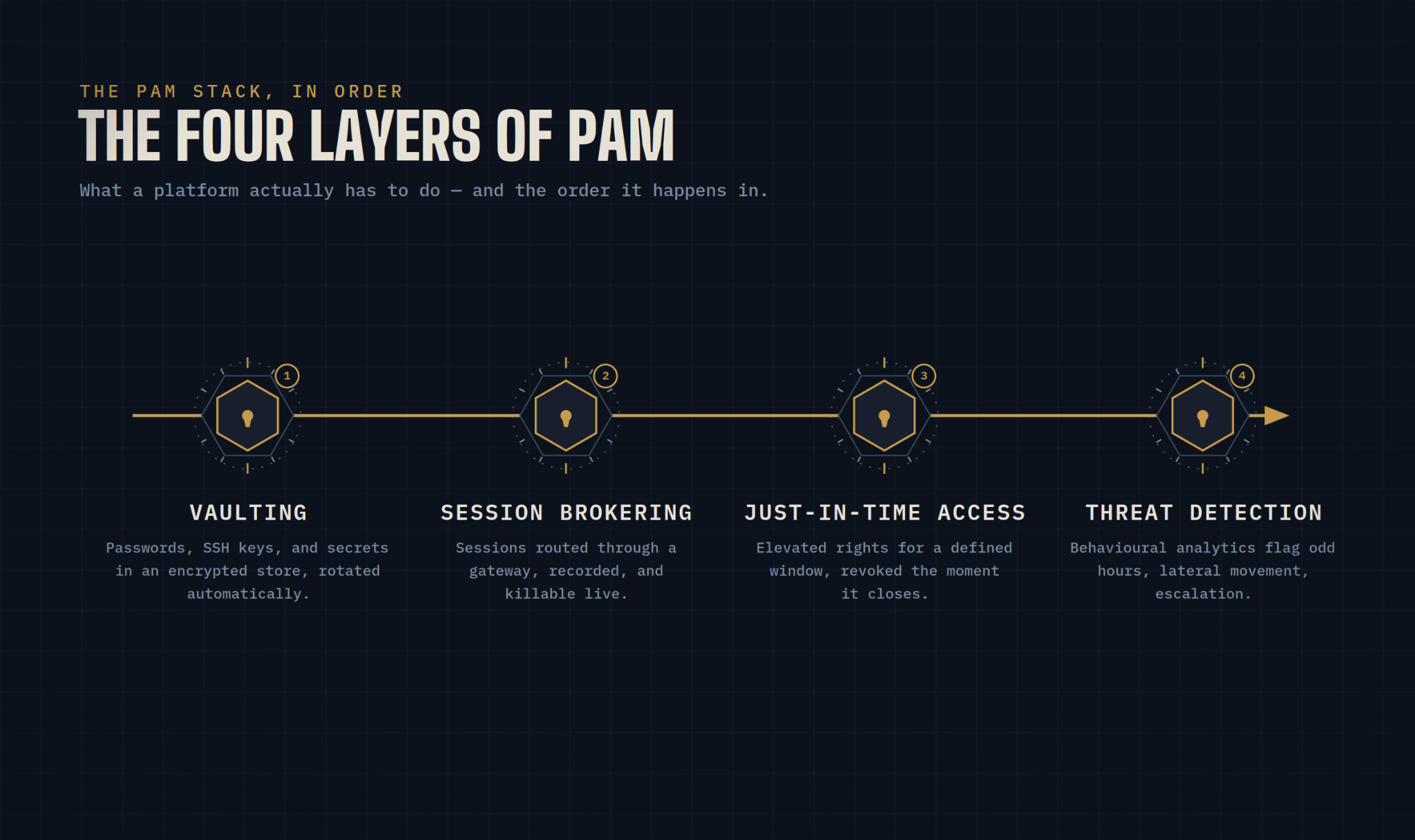
Privileged access management governs your most dangerous accounts — domain admins, root, service accounts, API keys, and the machine identities nobody has audited since 2023. A platform worth buying operates across four layers, and it's worth knowing them cold before a vendor call, because sales decks tend to blur them together.
- Credential vaulting: Privileged passwords, SSH keys, and secrets sit in an encrypted store with automated rotation, so static credentials stop circulating in spreadsheets and Slack DMs.
- Session management: Privileged sessions route through a gateway, get recorded with keystroke and video capture, and can be killed live if something looks wrong.
- Just-in-time access: Elevated rights are granted for a defined window through an approval workflow, then revoked automatically. This is the mechanism behind "zero standing privilege" — nobody sits on admin rights they aren't actively using.
- Threat detection: Behavioral analytics flag anomalies: logins at odd hours, lateral movement, escalation outside the normal baseline for that user or service.
The wrinkle nobody planned for: machine identities now outnumber human users in the average enterprise. Service accounts, CI/CD runners, and AI agents all hold privilege, and most PAM programs were designed years before that was true. Any platform on your shortlist needs to treat non-human identities as first-class citizens, not a bolt-on module you buy in year two.
Four Questions Before You Shortlist Anyone
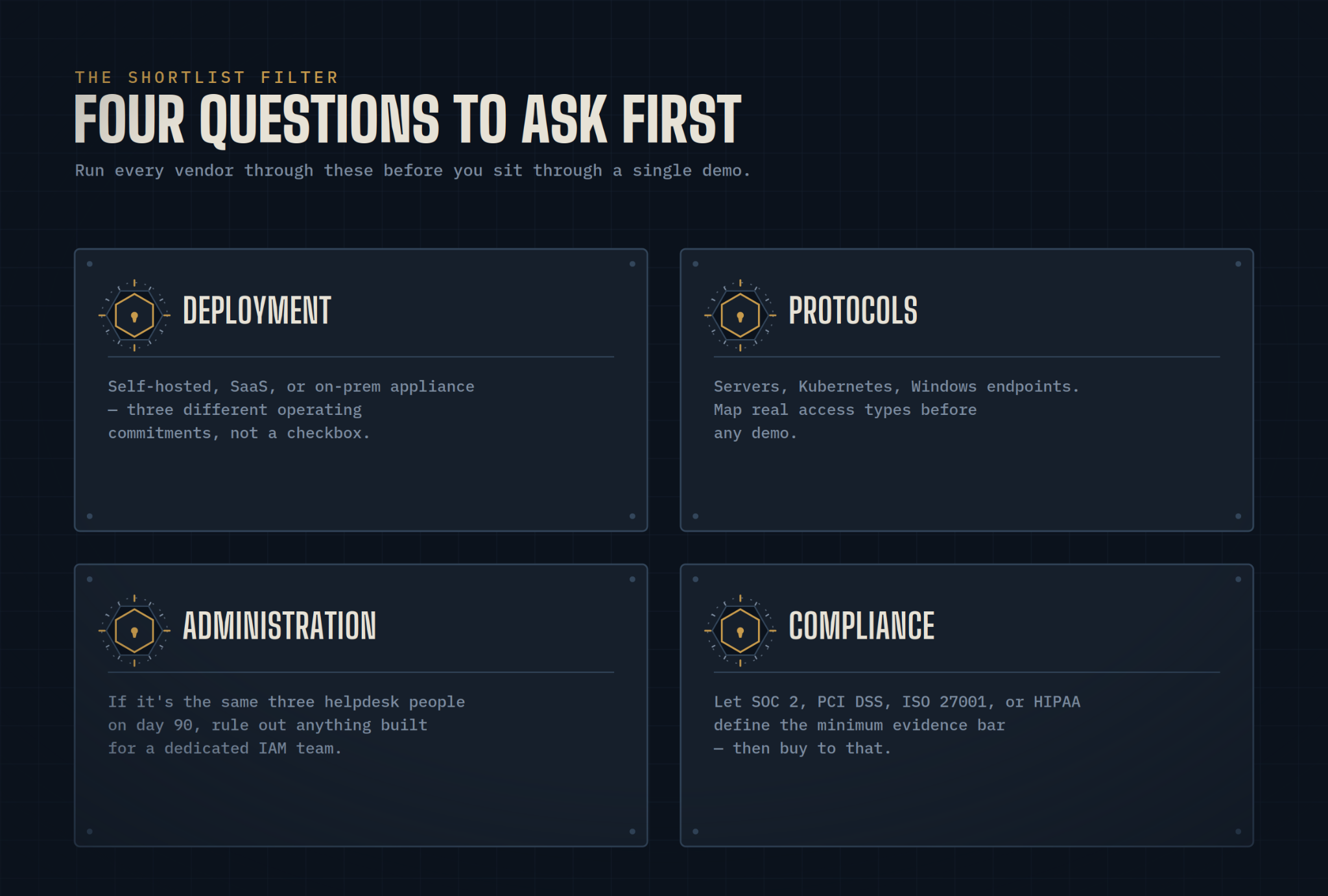
What's your actual deployment constraint? Regulated industries with data residency requirements usually need self-hosted. Cloud-native teams almost always prefer SaaS. Self-hosted, SaaS, and on-prem appliance are three genuinely different operating commitments — not a checkbox difference.
What protocols do you actually run? Broad protocol coverage across servers, databases, and network devices matters for infrastructure-heavy estates. Kubernetes-first shops need certificate-based tooling built for that world. Windows-heavy environments need strong endpoint privilege management specifically. Map your real access types before anyone shows you a demo environment that conveniently avoids your edge cases.
Who administers this on day 90? If the honest answer is "the same three people already running the helpdesk," rule out anything that assumes a dedicated IAM function. This is the single biggest predictor of whether a PAM rollout is still running in a year, and it's the question sales reps answer least directly.
What's the compliance driver? SOC 2, PCI DSS 4.0, ISO 27001, HIPAA, and NIS2 all require privileged access controls and audit trails, but they don't all require the same evidence. Let the framework define your minimum bar, then buy to that instead of the vendor's full feature list.
The question most teams forget: how do third parties get in?
The data on this has moved sharply. Verizon's Data Breach Investigations Report has flagged third-party involvement in a growing share of confirmed breaches year over year. Vendors are no longer an edge case in the threat model; they're close to the median case.
If contractors or vendors reach your systems today over a shared VPN credential, that access should be considered separately from privileged access management. A VPN authenticates a connection, but it does not necessarily log or control what a vendor does after connecting. Businesses using VPNs for remote access should also understand their capabilities and limitations, including why businesses use OpenVPN for secure remote access. Similarly, understanding how to handle malicious login attempts on web applications can help strengthen authentication and reduce the risk of credential-based attacks alongside privileged access controls.
Where Privileged Access Management Platforms Fit
Run those four questions against a mid-market or mid-to-large IT team—no dedicated IAM headcount, a mixed Windows/Linux environment, or a SOC 2 or ISO compliance deadline—and the priority often becomes deployment speed rather than feature count.
A privileged access management platform is designed to address these requirements by combining credential vaulting, just-in-time access, session recording, and endpoint privilege management. For example, Securden offers these capabilities within a single platform, while other solutions may provide them as separate modules. Comparing licensing models, deployment complexity, and long-term operating costs can help organizations identify the option that best fits their environment.
It is also important to distinguish between a password manager and a full privileged access management (PAM) platform. A password manager primarily stores and manages credentials, whereas a PAM solution also brokers privileged sessions, enforces time-bound access, and generates detailed audit trails. Some vendors, including Securden, offer both types of solutions, but understanding the distinction can help organizations choose the option that best meets their operational and compliance requirements.
The right approach ultimately depends on an organization's size, existing infrastructure, compliance requirements, and available administrative resources. While some environments benefit from integrated, easy-to-deploy platforms, others may require more complex enterprise solutions that align with established identity and access management programs.
The Layer Everyone Locks Down Last
Most PAM programs stop at the infrastructure. Domain admin gets vaulted, root gets rotated, and then standing admin rights quietly persist across the SaaS stack that actually touches money — the billing platform, the payment gateway, the invoicing tool. Those consoles can move funds, export customer data, and rewrite payment terms, and they're frequently governed by one shared login sitting in a password manager that nobody's audited since it was set up.
The principle doesn't change just because the tool isn't a server: scope roles to the task, expire access when the task ends, and log who did what. Many modern invoicing and billing platforms now support role-based access controls to help reduce reliance on shared administrator accounts. For example, platforms such as InvoPilot include role-based permissions alongside other administrative controls. Whatever platform you use, it's worth asking the same question you'd ask a PAM vendor: who has standing access, and why haven't they had to request it recently?
PAM Doesn't Work Alone
Two adjacent controls decide whether the PAM investment actually holds up.
The first is authentication. PAM assumes the person checking out a credential is who they claim to be — a password alone doesn't establish that. Pair whatever platform you choose with proper multi-factor authentication for business, and if you're planning further out, it's worth understanding how the FIDO passwordless standard works before committing to a token strategy — it's the direction MFA is heading anyway.
The second is monitoring. Vaulting a credential without recording what happens after checkout gives you a log entry, not evidence. If an auditor asks what an admin actually did during a session, "we know they logged in" isn't an answer — this breakdown of privileged session monitoring and recording tools covers what separates real session control from screen-capture theatre.
Getting Started with PAM Evaluation
A practical starting point is to identify and inventory privileged accounts across the organization. This process often reveals more privileged accounts than expected, providing a clearer understanding of the scope of access that requires management and monitoring.
Organizations can then evaluate privileged access management platforms based on factors such as deployment complexity, protocol support, long-term administration, and compliance capabilities. Considering these practical requirements alongside technical features helps ensure the selected platform aligns with operational needs rather than marketing claims.
Conclusion
Privileged access management plays an important role in protecting sensitive accounts, reducing the risk of unauthorized access, and supporting regulatory compliance. Choosing the right platform involves more than comparing feature lists—it requires evaluating deployment requirements, administrative overhead, integration capabilities, and long-term operational needs. By taking a structured approach to assessing these factors, organizations can select a privileged access management solution that aligns with their security objectives and evolving infrastructure.
Comments
Comments are available to signed-in users and are moderated to keep the discussion useful and respectful. Spam, automated submissions, and low-value promotional comments are removed. Outbound links may be approved when they are relevant and genuinely helpful to readers, but they are displayed as plain text rather than clickable hyperlinks.
No comments have been published yet.
Please sign in to submit a comment.