

Privacy, Security, Web Development
How Manifest V3 Is Reshaping the Browser Extension Ecosystem in 2026

In 2019, Google framed Manifest V3 as a routine security upgrade for Chrome extensions. Seven years later, the routine upgrade has become the defining fault line of the browser world. Chrome 150 and 151 finished the job in mid-2026, stripping out the last flags that let users and IT administrators keep old-style extensions running.
At the same time, the websites those users visit have gotten sharper. As browser-based ad blocking weakened, publishers and ad networks poured resources into scripts that detect and punish anyone still running one.
Google calls Manifest V3 progress. Critics, including the Electronic Frontier Foundation, call it the most consequential handoff of user control to a corporate advertising interest that the browser has seen in a decade. Ad blockers sit at the center of that argument, and their fate over the past two years is the clearest way to understand what Manifest V3 actually changed and who it actually serves.
What Is Manifest V3 Browser Extensions
Manifest V3 is Chrome's current extension specification, and it rewires how extensions can access network traffic. Under Manifest V2 (MV2), the webRequest API gave an extension a live view of every request the browser made. It could intercept a request before it left the browser, inspect it, and modify or cancel it in real time.
Manifest V3 replaces that model with the declarativeNetRequest API (DNR). Instead of watching traffic live, an extension submits a static set of blocking rules up front, and Chrome itself, not the extension, decides what to block. The extension never sees the raw request.

But DNR comes with hard limits. Extensions are capped on the number of rules they can register. Google raised the original ceiling from 30,000 to roughly 330,000 after years of developer pushback, but rules still can't be added or changed dynamically at runtime, unlike MV2 filtering. Background pages, which used to run persistently, were replaced by service workers that can be shut down by the browser to save memory, complicating efforts to keep anything alive and watching for new threats. And Manifest V3 blocks extensions from loading and executing remote code entirely, closing off a real attack vector but also killing any extension architecture that depended on shipping logic outside the Chrome Web Store review process.
Google's stated rationale is straightforward: better performance, tighter security, more auditable code. The friction point critics keep returning to is structural rather than technical. Chrome commands roughly two-thirds of the global browser market, and the company that wrote these rules generates the majority of its revenue from advertising. The specific capability Manifest V3 removed, dynamic real-time filtering, happens to be exactly what made ad blockers effective.
The Ad Blocker Reckoning: Biggest Losers and Biggest Winners
No extension category illustrates the stakes of Manifest V3 like ad blockers, and the past two years have sorted the field into clear winners and losers.
The biggest loser is also the most symbolic one. uBlock Origin, used by an estimated 40 million people on Chrome at its peak, cannot be rebuilt under Manifest V3 without losing what made it effective. Its developer, Raymond Hill, has said plainly on the project's own documentation that there is no true Manifest V3 version of the extension — what exists instead is uBlock Origin Lite, a deliberately scaled-back rewrite built on DNR's static rule model. Lite ships with a fraction of the original's filter lists, drops cosmetic filtering (the technique that hides ad containers and page clutter rather than just blocking network requests), and, by Hill's own account, struggles against sites that actively try to detect and defeat ad blockers. Chrome began auto-disabling the full extension in 2024 and closed the last workarounds, flags that let enterprises and power users keep MV2 alive, with Chrome 150 and 151 in mid-2026. Any extension that relied on dynamic filter list updates or deep cosmetic filtering shares uBlock Origin's fate to some degree.
The winners split into two camps. The first is adapted from inside Chrome's new rules. AdGuard rewrote its Chrome extension natively for Manifest V3, pushing hard against the rule caps and shipping frequent updates to squeeze as much filtering power as DNR allows — a meaningful improvement over Lite, though still short of MV2-era capability. Ghostery rebuilt its tracker-blocking extension for MV3, starting with version 10, kept the core functionality intact, and now openly recommends Firefox to users who want everything the extension offers.
The second approach does not rely solely on Chrome's extension framework. Some tools, including AdLock, also offer system-level or network-level filtering that operates outside the browser. In these cases, traffic may be filtered before it reaches the browser, reducing reliance on browser-specific extension APIs.

That architecture makes Manifest V3 a non-issue: there's no extension permission model to work around because there's no browser extension in the critical path. The same approach covers every browser and every app on the device, not just Chrome, which is the opposite of the MV3-native strategy of squeezing more out of a shrinking rule budget. Brave took a third path, building ad blocking directly into the browser engine, a layer Manifest V3 was never designed to reach at all.
The pattern across all three winning strategies is the same: the tools that survived Manifest V3 either adapted aggressively within the new limits or, more effectively, stopped depending on the browser extension model altogether.
Beyond Ad Blockers: Who Else Is Affected?
While ad blockers dominate the headlines, Manifest V3’s rule changes impact the entire extension ecosystem unevenly.
- Hit hardest are privacy and security tools (like Privacy Badger, fingerprinting protection, and parental controls). These extensions rely on adapting to threats and filtering content in real time—the exact dynamic response that Manifest V3 restricts. Some developer debugging tools also lost functionality.
- Barely affected are productivity extensions (password managers, note-taking tools) and browser-level VPNs. They never required live network interception, so their core functionality remains untouched.
The extensions that suffered most are precisely those designed to protect users from tracking and unwanted content. Critics of Google point to this clear correlation as the strongest circumstantial evidence of the company's true motives.
The Other Side of the Coin: Ad Blocker Detection in 2026
Manifest V3's rule changes didn't happen in a vacuum. As browser-based ad blockers lost effectiveness, publishers and ad networks recognized an opening and moved to widen it, investing heavily in scripts specifically designed to detect and penalize ad blocker use.
The mechanics of this ad blocker detection are straightforward. A site embeds bait elements, such as a decoy div styled to look exactly like an ad slot or a script tag that mimics an ad-network request, and checks whether the browser blocked them. If the bait never loads, the site infers an ad blocker is active and responds with a "please disable your ad blocker" overlay, a hard paywall, or throttled content. These probes evolve constantly because any static signature an ad blocker learns to recognize can be swapped out on the publisher's side within hours.
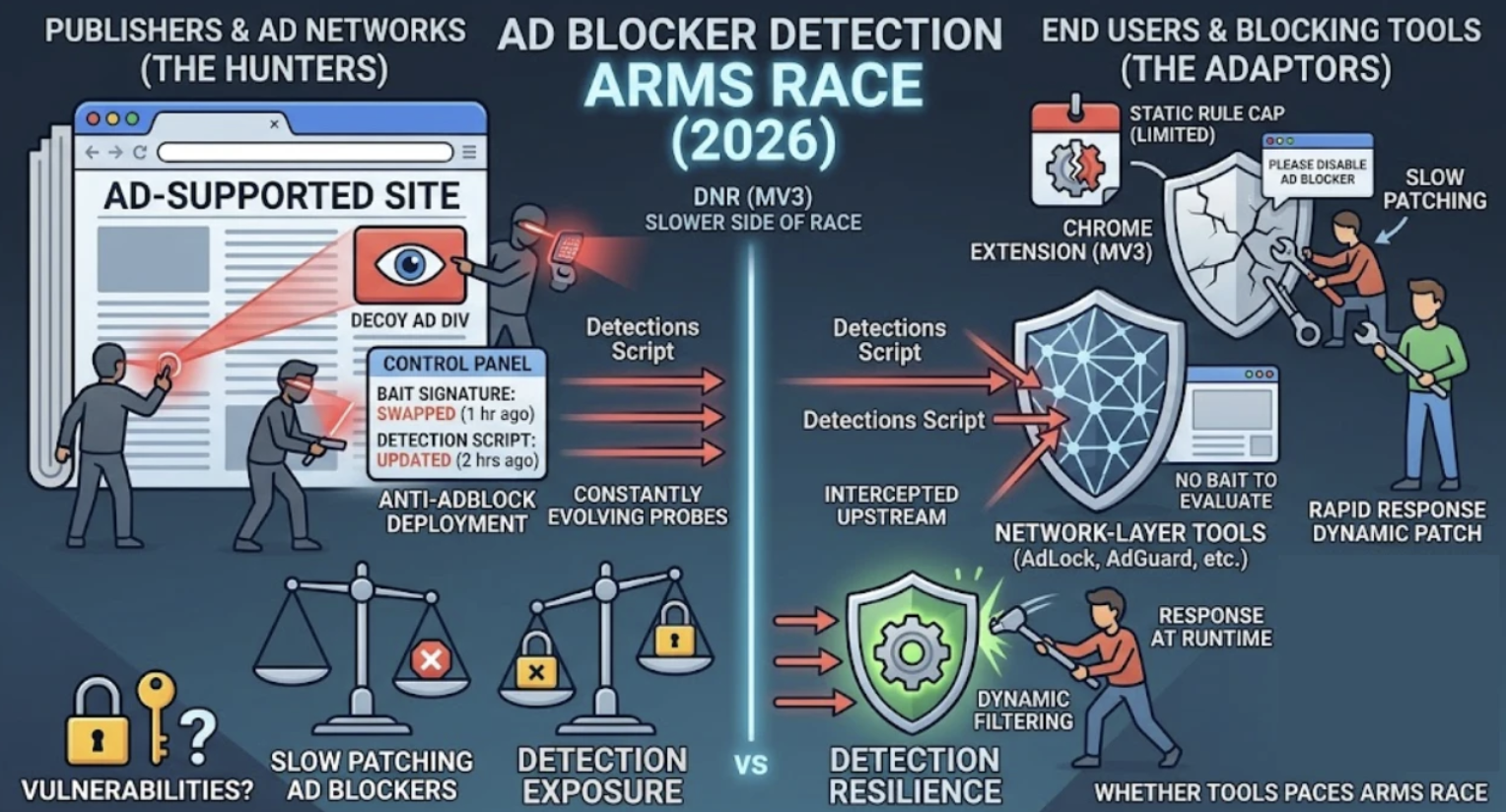
This is where Manifest V3's static rule model becomes a genuine liability rather than a mere inconvenience. Countering a new detection technique means pushing an updated dynamic filter that ad blockers could apply immediately. Under DNR's rule-cap model, updating countermeasures means submitting new static rules that must still fit within a fixed budget and can't respond to a detection script's behavior at runtime. The arms race has tilted decisively toward whoever updates faster, and MV3-constrained extensions are structurally the slower side of that race.
That dynamic sorts tools by architecture rather than brand reputation:
- Browser extension ad blockers on Chrome: Browser extension ad blockers on Chrome are the most exposed. Static rule caps limit how quickly they can patch around a new detection method, and Lite-tier extensions in particular fall behind fast-moving publisher countermeasures.
- Network-level filtering tools: These are structurally harder to detect in the first place because they filter traffic before it ever reaches the page's DOM. A bait script checking for a blocked ad div inside the browser has nothing to observe if the request was already intercepted upstream at the network layer. The page simply never receives the tracking probe to evaluate.
- Firefox running full uBlock Origin: This remains the strongest combination against detection scripts because Mozilla's continued support for dynamic webRequest filtering lets the extension respond to new bait techniques as fast as they appear, the same capability Chrome extensions lost.
YouTube's escalating anti-adblock enforcement, tightening news paywalls, and more aggressive streaming-site detection all intensified through 2025 and into 2026 — not solely because of Manifest V3, but with an opening MV3 clearly helped create.
The Browser War MV3 Accidentally Started
Manifest V3 was designed to be a Chrome extension policy. It ended up reshuffling the browser market share.
Firefox drew the sharpest contrast. Mozilla committed to keeping full MV2-style webRequest filtering supported indefinitely, while also shipping declarativeNetRequest for compatibility, giving developers dynamic power without Chrome's rule caps. The result: Firefox paired with full uBlock Origin became the setup privacy communities, tech journalists, and Reddit threads converge on almost automatically when someone asks how to keep real ad blocking. Firefox's global share is still in the low single digits in the browser market. Still, its user base skews toward exactly the technically literate, ad-blocker-using audience most affected by MV3, giving the shift outsized visibility relative to its raw numbers.
Brave leaned into the opposite strategy: rather than preserving an old extension API, it built ad blocking directly into the Chromium engine underneath its browser. Manifest V3 governs what extensions can do; it says nothing about what the browser itself does before an extension ever runs, which is exactly the gap Brave occupies.
Safari sits outside this fight entirely. Apple's Content Blocker API was never MV2 or MV3; it was designed from the start so the extension never sees raw traffic, working from declarative rule sets similar in spirit to DNR but predating it by years. That's arguably validation of Google's stated security rationale, since Apple independently reached a comparable privacy-preserving design.
Opera and Vivaldi, both Chromium-based, adopted Manifest V3 as Google shipped it but leaned on their own built-in ad-blocking features to soften the blow for users who don't want to manage extensions manually. Microsoft's Edge, also Chromium-based, has taken a more permissive stance on MV2 extensions than Chrome itself in some builds, giving power users another Chromium-engine path to full-strength ad blocking without leaving the ecosystem.
The net effect: for the first time in years, Chrome's roughly 65% global market share is facing organized, ideologically motivated pressure from alternatives that are explicitly marketing themselves on what Chrome no longer allows.
How Extension Developers Are Responding
The developer response to Manifest V3 split into resignation, protest, and reinvention:
- Resignation: A meaningful number of small developers left the Chrome Web Store. Rebuilding extensions to accommodate new constraints requires significant engineering effort that often isn't worth the investment for hobby or low-revenue projects.
- Protest: The open-source community turned the transition into a public argument. For instance, the uBlock Origin Lite documentation functions as a protest document, explicitly laying out what capabilities were lost rather than pretending the replacement is equivalent to the original.
- Reinvention: While lobbying pushed Google to raise rule limits from 30,000 to roughly 330,000, static caps still cannot scale like dynamic lists. Consequently, development is shifting toward network- and DNS-level filtering tools that operate outside the browser's control.
Developers can no longer patch anti-detection rules as fast as publishers roll out new tracking probes—a direct consequence of trading dynamic filtering for a static rule budget.
Is MV3 Really About Security — Or About Ads?
The debate over Manifest V3 features valid arguments on both sides. The security justification is real: remote code execution was a heavily exploited vulnerability. A compromised extension with full network access could inject scripts or steal data, whereas MV3’s static rules and memory-efficient service workers are far easier to audit.
However, critics argue these benefits do not justify the specific restrictions chosen. MV3 heavily restricts dynamic filtering, which effective ad blockers require, while leaving observational APIs largely intact. Since Google derives most of its revenue from advertising, this choice directly aligns with its financial interests. Furthermore, Mozilla’s decision to support dynamic filtering in Firefox undercuts the claim that Google's strict rule caps were the only way to achieve safety.
Ultimately, Manifest V3 is a real technical modernization to fix genuine security gaps. Still, it was executed in a way that perfectly suited the business goals of the company that built it.
What Should Users Do in 2026?
The right setup depends on what a person is optimizing for.
- Chrome users who want both effective ad blocking and resistance to detection scripts are best served by a network-level tool like AdLock, which operates outside the DOM entirely and is harder for bait-script detection to spot, or by AdGuard's MV3 extension for a browser-native option that still fights hard within Chrome's constraints.
- Power users unwilling to compromise on filtering strength should move to Firefox with full uBlock Origin. It's the only mainstream combination that preserves true MV2-style dynamic filtering, and it remains the strongest option against both ads and detection countermeasures.
- Users who want zero configuration are well served by Brave, which blocks at the engine level by default, requires no extension setup, and, as a side effect of not routing blocking through a visible extension, is harder for some detection scripts to fingerprint than extension-based blockers.
Developers and IT administrators should audit internal Chrome extension deployments for Manifest V3 compliance now if that hasn't happened already; Chrome 151 removed the last enterprise policy override, so there's no remaining grace period.
Anyone prioritizing privacy above all else gets the most complete coverage by combining a browser-level solution, Brave or Firefox, with a network-level tool, covering both in-browser tracking and the system-wide traffic that browser extensions were never able to see in the first place.
What Comes Next? MV3 in 2027 and Beyond
Google's continued deprecation milestones mean that remaining Manifest V2 exceptions will keep narrowing. This is creating a genuine bifurcation in the ecosystem, leaving Chrome as an MV3-only platform while Firefox remains the sole holdout preserving MV2-style dynamic filtering alongside MV3 compatibility.
Consequently, filtering logic is migrating entirely out of the browser extension layer and into the network and DNS layers. System-level tools are becoming the future of privacy filtering because building outside the browser sandbox completely sidesteps rule caps and the detection arms race; traffic filtered before it reaches the page's DOM remains invisible to anti-blocking scripts.
While regulatory pressure from the EU's Digital Markets Act adds a wildcard that could force market-specific changes, the direction of the arms race seems settled. Publishers will continue deploying faster detection scripts, and the tools best equipped to keep pace are those that never depended on a browser vendor's permission to operate.
Conclusion
Manifest V3 represents more than a routine update to Chrome's extension platform. It changes how browser extensions interact with network traffic, reshaping the capabilities of ad blockers, privacy tools, and other extensions that rely on dynamic filtering.
While the new model introduces security and performance benefits, it also changes the balance between browser vendors, extension developers, publishers, and users. As browser ecosystems continue to evolve, organizations and individuals will need to evaluate how these changes affect their privacy, security, and extension choices rather than assuming every browser offers the same capabilities.
Related Articles

June 30, 2026
How to Block YouTube on Android, iPhone, Windows, and Mac
Step-by-step guide to blocking YouTube on Android, iPhone, Windows, Mac, and using monitoring apps.
Read More
June 27, 2026
7 Best Parental Control Apps for Families in 2026
Qustodio handles screen-time and web filtering well but lacks messaging visibility. Here are seven alternatives that address that and other gaps.
Read More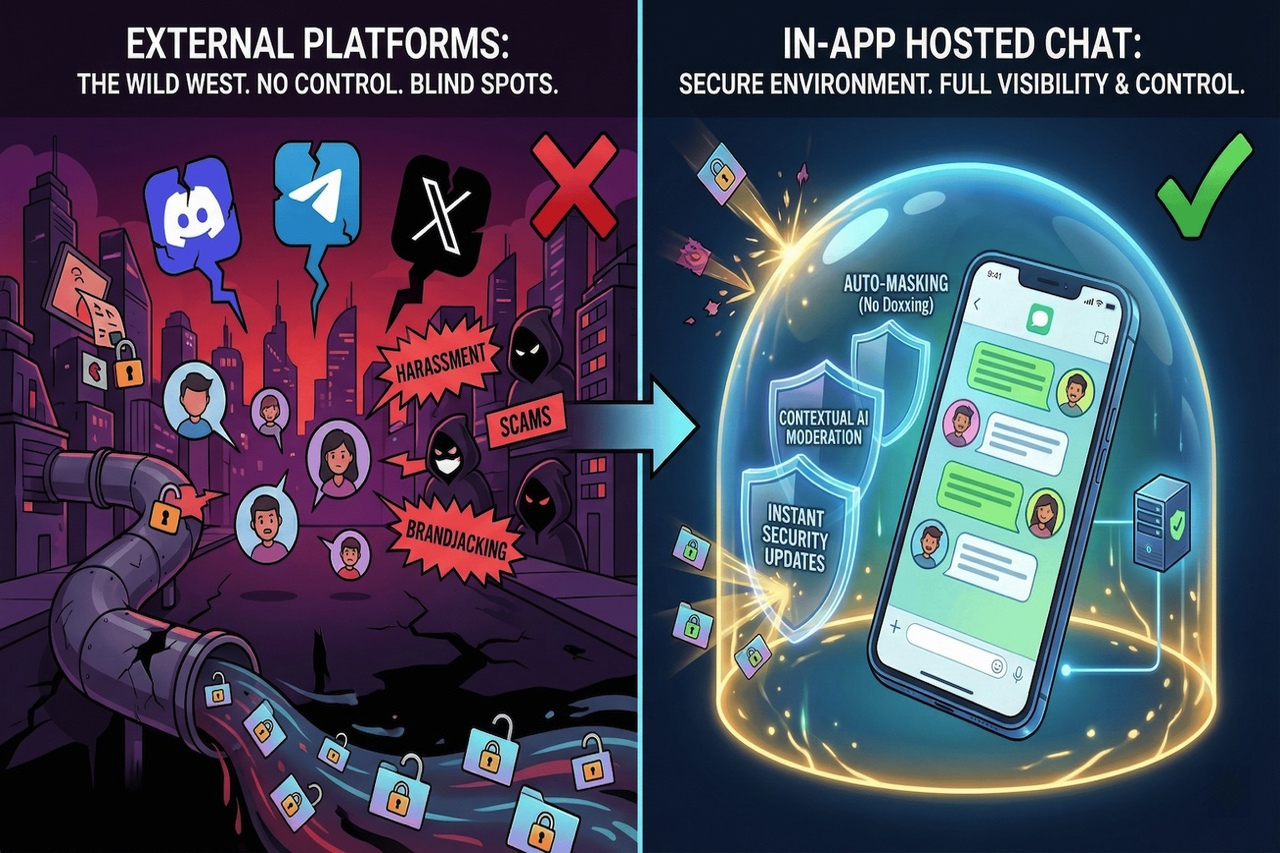
January 12, 2026
Community Security: Why In-App Hosted Chats are Safer than External Platforms for User Data Privacy
The answer to community-building over the last five years was, “Just create a Discord server or a channel on Telegram.” This is everything you could want as a shortcut—not to w...
Read More
Comments
Comments are available to signed-in users and are moderated to keep the discussion useful and respectful. Spam, automated submissions, and low-value promotional comments are removed. Outbound links may be approved when they are relevant and genuinely helpful to readers, but they are displayed as plain text rather than clickable hyperlinks.
No comments have been published yet.
Please sign in to submit a comment.