

Beyond Firewalls: 9 Best Data Access Governance Tools That Actually Cut Risk in 2026
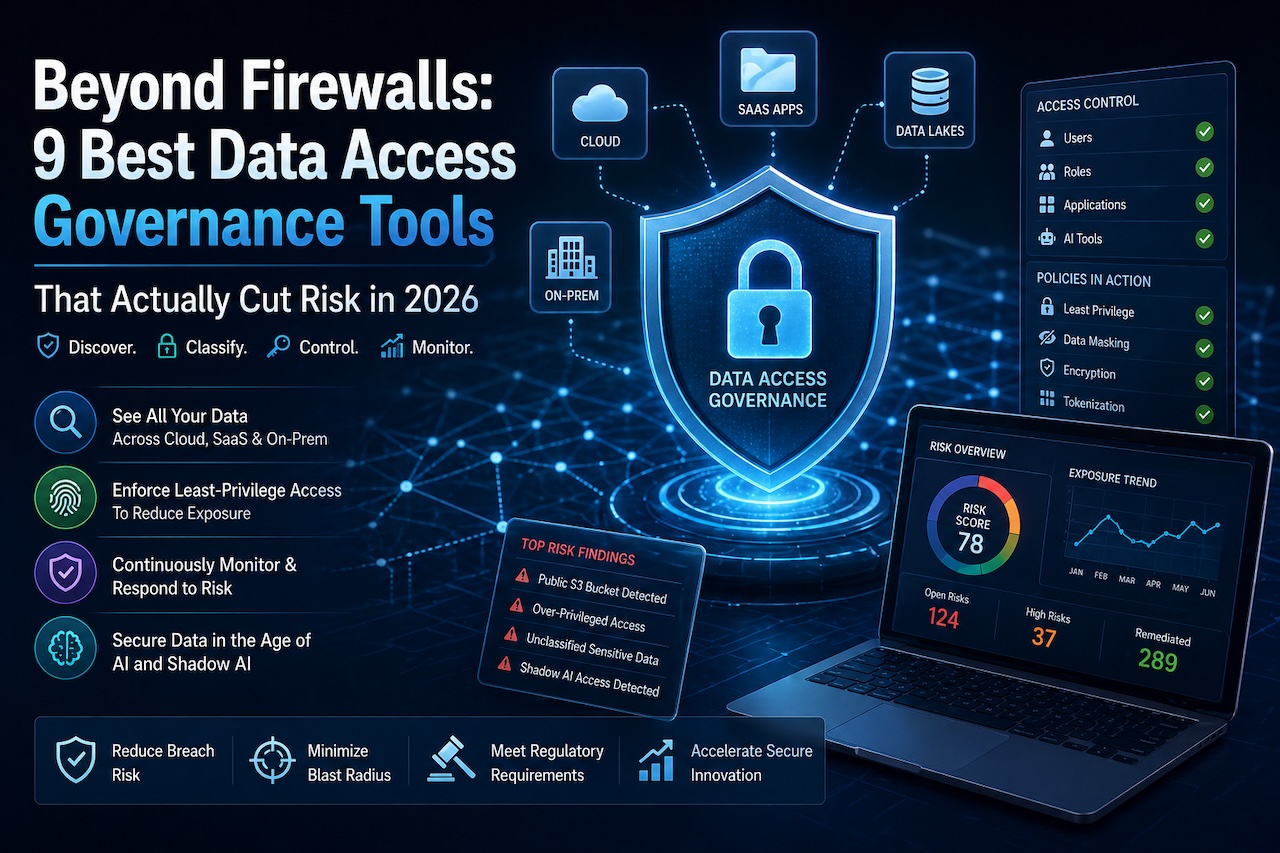
When most companies picture “security,” they still imagine concentric rings of firewalls, VPNs, and endpoint agents. Yet 2026 reality looks very different: sensitive data lives in dozens of SaaS apps, petabyte-scale data lakes, and AI model repositories that employees connect to from anywhere.
If you can’t see where the data resides or who can touch it, you can’t secure it. That is why data access governance (DAG) tools—platforms that discover, classify, and continuously control data—are replacing pure perimeter defenses.
Below are the nine best data access governance tools that stand out for actually shrinking breach probability and blast radius, not just generating more alerts.
Why Traditional Perimeter Defenses No Longer Suffice
Cloud migration, remote work, and the AI gold rush have dissolved the old network perimeter. According to Gartner, 95% of new digital-workload deployments now occur on cloud-native platforms, effectively erasing the traditional network perimeter.
Attackers bypass firewalls by abusing OAuth tokens, “low-code” connectors, or unsanctioned ChatGPT plugins. Meanwhile, regulators are tightening rules around data residency and automated decision-making.
The pressure shows in the numbers: The global average cost of a data breach fell slightly to $4.44 million in 2025—but U.S. incidents still average $10.22 million.
When every workload is public-facing by default, the only durable control is to govern the data itself.
What “Data Access Governance” Means in 2026
DAG platforms combine four capabilities:
- Automated discovery of structured and unstructured data across cloud, SaaS, and on-prem stores.
- Context-enriched classification that tags data by sensitivity, residency, and lineage.
- Policy engines that enforce least-privilege access, masking, or tokenization in real time.
- Continuous monitoring and automated remediation when exposure drifts.
[For additional background, IPLocation.net explains how IP geolocation insights strengthen broader security postures.]
Key Evaluation Criteria
- Coverage breadth (cloud, SaaS, on-prem)
- Precision of classification (false-positive rate)
- Remediation & automation options
- AI / shadow-AI controls
- Deployment speed & total cost of ownership
Remember: 97% of organizations hit by an AI-related breach in 2025 admitted they had no AI access-control framework in place. Any tool you pick must close that gap.
9 Best Data Access Governance Tools That Actually Reduce Risk
1. Cyera – AI-Native DSPM & Omni DLP
Modern data estates are large, fast, and constantly morphing. Cyera was built specifically for that reality. The platform combines Data Security Posture Management (DSPM) with data loss prevention and an Access Trail module that maps users, service accounts, and AI identities interacting with data.
- <1 day to value: deploys in minutes and auto-discovers data across major clouds and SaaS apps.
- 95%+ classification precision thanks to an AI engine that learns business context.
- Omni DLP blocks exfiltration in real time while reducing “DLP noise” with automated risk scoring.
- AI Guardian detects shadow-AI tools and prevents sensitive prompts from leaking.
Together, those pieces let security teams cut the attack surface quickly rather than chase alerts. If you need a single control plane to protect both data in motion and data at rest, Cyera should be first on your demo list.
2. BigID – Privacy-First Discovery & Classification
BigID built its reputation on privacy compliance (GDPR, CCPA) and still leads in deep data discovery, including mainframes and legacy file shares.
- ML-driven identity correlation links data back to individuals for DSAR workflows.
- “Auto-Label” applies granular sensitivity tags that downstream DLP or SIEM tools can consume.
- Integrated consent management ensures marketing teams honor data-subject preferences.
- New AI Data Firewall masks or blocks regulated data inside LLM prompts.
BigID is ideal when privacy offices drive the budget and need provable compliance reports alongside security benefits.
3. Varonis Data Security Platform – File-System Least-Privilege Automation
Varonis focuses on file systems—Windows, NAS, SharePoint, Microsoft 365—and goes deep on NTFS permissions.
- Automated access-privilege recommendations trim legacy groups safely.
- Threat Models detect ransomware behavior in real time.
- Classification Engine scans content and combines it with permissions graphs.
- “Edge” sensors extend visibility to perimeter devices for cohesive forensics.
Organizations drowning in overlapping file shares love Varonis for making least privilege achievable without breaking collaboration.
4. Immuta – Dynamic Data Access & Policy Enforcement
Immuta targets data & analytics teams that live inside Snowflake, Databricks, Redshift, or Starburst.
- Attribute-based access control (ABAC) dynamically masks or tokenizes columns based on user attributes.
- Native integrations avoid performance hits—policies compile into the warehouse query plan.
- “Equalized Views” let data scientists explore datasets safely without seeing PII.
- Audit logs map every query to identity for painless compliance evidence.
If your biggest risk is analysts duplicating production data into unsecured notebooks, Immuta closes that hole elegantly.
5. Laminar – Agentless Cloud DSPM with Real-Time Remediation
Laminar takes an agentless approach similar to cloud CSPM tools but focused on data.
- Discovers S3, GCS, Azure Blob, RDS, and BigQuery assets continuously via cloud APIs.
- Graph engine builds data lineage and flags shadow copies.
- “Radials” visualizations make it obvious where data flows break policy.
- Integrates with Jira or Tines so misconfigurations trigger automated fixes.
Laminar shines for fast-moving cloud-native teams that prefer remediation through existing DevOps pipelines.
6. Securiti.ai – Unified Data Privacy & Sovereignty Controls
Securiti.ai coined “PrivacyOps” and extends that concept to security and sovereignty.
- Data Command Center provides single-pane visibility across structured and unstructured data.
- Residency Maps show where each record is stored versus regulatory boundaries.
- AI Governance module inventories models and prompts for risk scoring.
- Built-in robo-advisor suggests remediation steps and auto-generates proof of compliance.
Multinationals juggling EU, U.S., and APAC data-sovereignty laws appreciate Securiti.ai’s policy templates.
7. Symmetry Systems DataGuard – Object-Level Authorization Analytics
Symmetry inserts at the identity layer: it maps every data object to the IAM role or KMS key that could reach it.
- Graph analytics reveal high-risk identity-data relationships (“toxic combinations”).
- “Blast Radius” simulation predicts what an attacker could touch if a key or role is compromised.
- Supports hybrid estates—S3 buckets, Postgres tables, even on-prem MySQL.
- Lightweight deployment via read-only cloud APIs, no data leaves your tenant.
For security teams prioritizing proactive risk modeling over reactive alerting, Symmetry delivers unique depth.
8. Open Raven – Cloud & SaaS Data Mapping with Attack-Path Insights
Open Raven’s open-core roots make it popular with DevSecOps practitioners.
- Continuous asset inventory across AWS and GCP, plus SaaS connectors.
- Schema-aware scanning classifies sensitive PII, PHI, and PCI fields.
- “Attack Paths” overlay network reachability on top of data maps.
- JSON-based policy language fits neatly into Terraform pipelines.
If you want transparency and API-first integrations, Open Raven is a strong candidate.
9. OneTrust Data Governance – Enterprise-Scale Metadata & Stewardship
OneTrust is best known for cookie banners but has quietly built a full data governance suite.
- Data Catalog ingests metadata from BI tools, databases, and ETL platforms.
- Business Glossary aligns technical assets with plain-language definitions.
- Policy Engine links usage policies to catalog entries, enforcing them via plugins.
- Stewardship workflows assign owners and track certification status.
Enterprises that view DAG as part of a broader governance transformation will like OneTrust’s non-technical stakeholder features.
Real-World Wake-Up Call: The 2026 Vercel Shadow-AI Breach
On 20 Apr 2026, frontend-hosting provider Vercel disclosed that an employee linked an unsanctioned generative-AI tool to internal Git repositories, exposing customer source code and tokens. The incident mirrors what IBM’s breach study calls the “shadow-AI oversight gap.” A platform such as Cyera’s AI Guardian or BigID’s AI Data Firewall could have blocked the connector, or at least flagged unusual token scopes before exfiltration occurred.
Implementation Tips to Maximize ROI
- Map before you buy. Inventory critical data stores and business processes; use that list to shortlist vendors.
- Start with quick-win policies. Mask testing environments, auto-remove dormant users, and alert on public S3 buckets.
- Engage data owners. Many platforms route findings to asset owners; leverage that to build accountability.
- Automate remediation. Integrate with ticketing or security-orchestration tools so fixes happen within minutes, not quarters.
Caveats & Counterpoints
DAG is not a silver bullet. False positives can fatigue teams if classification is sloppy. Tools still rely on IAM hygiene: if root-level keys are hard-coded in scripts, any governance layer sits downstream of compromise. Finally, culture matters; employees must understand why certain AI plugins are blocked, or they will look for workarounds.
Conclusion: Make 2026 the Year Data Gets Its Own Perimeter
Perimeters will keep eroding, but control of who can touch which data, when, and why is timeless. The nine best data access governance tools above show that actionable governance is possible today—from Cyera’s AI-native approach to OneTrust’s enterprise stewardship.
Evaluate them against your estate, pilot quickly, and shrink both breach probability and blast radius before the next shadow-AI incident hits.
Featured Image generated by ChatGPT.
Related Articles

June 3, 2026
What Could Go Wrong? The Risk of AI Misuse for Company Security and Data
The development of and focus on adopting artificial intelligence in the workplace has had an empowering effect on employees. However, the gains are counterbalanced by misuse, espec...
Read More
April 27, 2026
Digital Risk Monitoring for Enterprises: Seeing Threats Before They Surface
Cybersecurity incidents rarely begin with a loud alarm. More often, they start as faint signals scattered across the internet — a leaked credential, a suspicious domain, a forgotte...
Read More
March 6, 2026
The Security Risks of Standard Data Sharing
Most professional workflows are a patchwork of insecure habits. To move a project forward, you probably use a combination of email, SMS, and generic cloud storage. You assume that...
Read More
Comments
Comments are available to signed-in users and are moderated to keep the discussion useful and respectful. Spam, automated submissions, and low-value promotional comments are removed. Outbound links may be approved when they are relevant and genuinely helpful to readers, but they are displayed as plain text rather than clickable hyperlinks.
No comments have been published yet.
Please sign in to submit a comment.