
Residential proxies are an essential part of numerous businesses and individual activities alike. From highly complicated applications such as web scraping to improved anonymity and privacy, a good residential proxy pool covers it all.
Independent of your personal use case, whether that’s for bypassing geographical restrictions or for better privacy, residential proxy providers are a dime a dozen nowadays. Each one tries to tell you they’re the best, but there are clear differences between all of them.
We’ve decided to review the most popular and well-known residential proxy providers. Each provider offers several proxy types and other solutions; however, we’re focusing on their residential proxy network.
Which Types of Residential Proxies Are the Best?
There are at least three major types of residential proxies: static, rotating, and dedicated. Every residential proxy type has its own benefits and drawbacks.
| Type | Exclusivity | Performance | Rotation | Pricing model |
|---|---|---|---|---|
| Static residential proxies | Shared or private | High | None, unless built by user | IP based |
| Dedicated proxies | Private | Highest | Depends on the provider | IP or traffic based |
| Rotating proxies | Shared | Each user decreases performance | Rotation customizable depending on provider | Traffic based |
Your choice of residential proxy type should primarily depend on the use case, secondarily on budget. Static residential proxies (also known as ISP proxies) are best when you need a small number of IPs that have top-notch performance.
Rotating residential proxies are a catch-all as they can do most tasks well. You can use them for SERP scraping, travel fare aggregation, various monitoring tools, etc.
Dedicated residential proxies are best used for use cases where you need to maintain an identity for an extended period of time. These are usually account management over various platforms, some cybersecurity applications, etc.
Best Residential Proxy Providers to Consider in 2024
1. Decodo
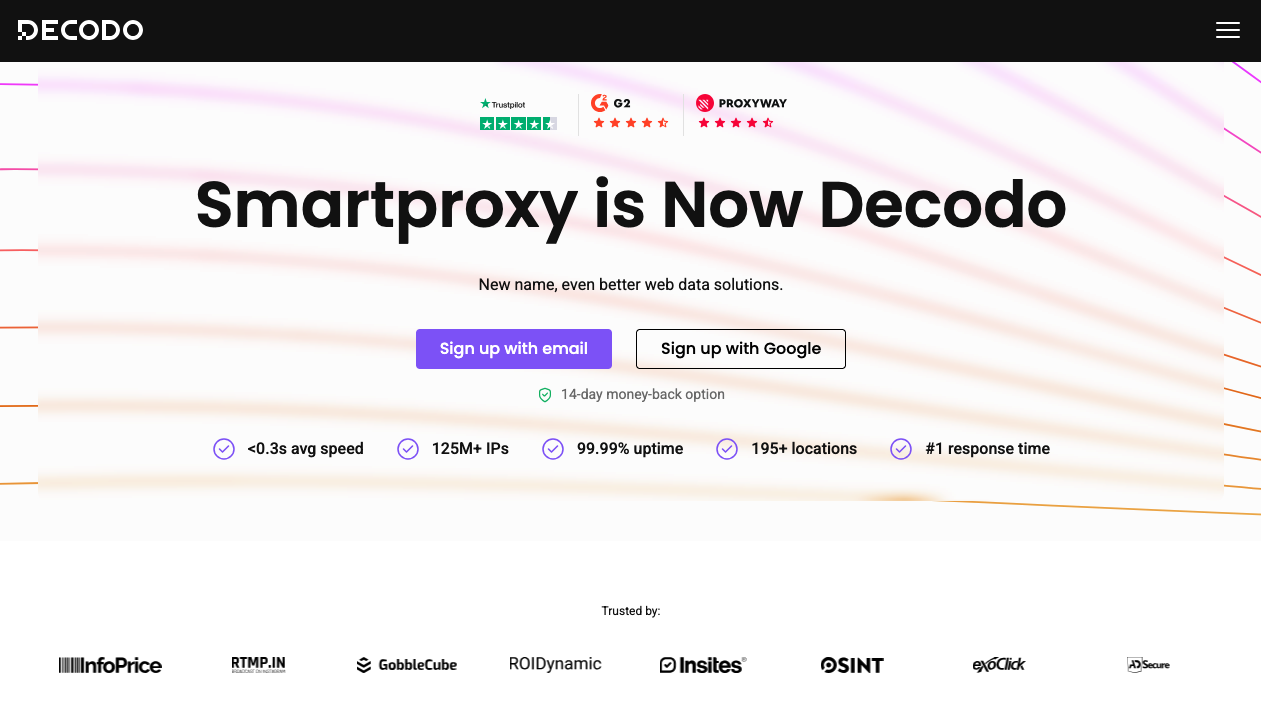
Decodo offers shared and residential proxies that are easy to use and backed by great customer service. The company distinguishes itself by balancing cost and performance, making it a popular choice among developers and small businesses.
Decodo maintains a pool of 115M residential proxy IPs across more than 195 loations worldwide. With pricing lower than premium-oriented competitors like Oxylabs and Bright Data, Decodo remains competitive among the top datacenter proxy providers.
The service is available under two pricing models: pay-per-GB and pay-per-IP. The residential plans feature unlimited traffic and unrestricted access to all domains without extra charges or hidden fees. You face no target limits and can establish unlimited parallel connections. Proxies rotate with each connection request but can be configured for 24-hour sticky sessions.
Decodo's dashboard allows you to choose between sequential or non-sequential IPs and select either SOCKS5 or HTTP(S) protocols. You can refresh your entire IP list or retain the same IPs upon subscription renewal.
Decodo delivers good value by providing high-performance proxies at affordable prices, albeit with fewer bells and whistles than the premium segment.
2. IPRoyal
Residential proxy pool size: 32M+
Pricing model: Traffic-based
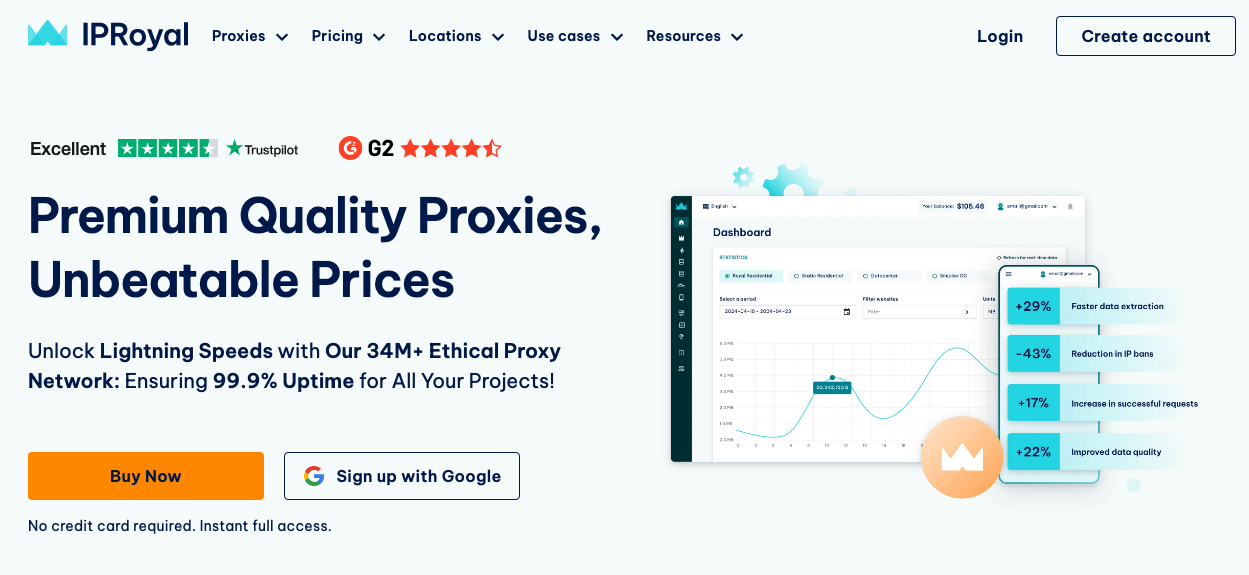
IPRoyal is one of the best residential proxy providers on the entire market today. They have a decently sized pool compared to other, older competitors; however, they offer highly competitive pricing through a unique model. Residential proxy quality does not falter either, and their commitment to continually upgrading the network is evident in their work.
With over 32 million residential IP addresses scattered across 195+ countries, you’ll definitely be able to find enough proxies in nearly any location in the world. Many of them come from highly sought-after locations such as the United States and Germany, so there are plenty of residential proxies to go around even if you need IPs from those countries.
You can also further narrow down your residential proxy network to a city or a state level, allowing you to select a highly niche set of IPs.
Additionally, the IP addresses provided are fully dedicated. You can be sure that no one is using the same residential proxy in tandem with you.
Rotation options also stand out, as you can retain a single IP address for up to 7 days. Other rotation options include switching residential proxies on each request or any other time up to the limit above.
IPRoyal’s pricing structure is unique as well, and it benefits the end-user instead of the company. They use traffic-based pricing that has no expiration date. Many other companies use a subscription-based model in which you still pay the same amount each month, even if you don't use all your traffic.
So, instead of having to pay each month, you only pay when you’ve used up your residential proxy traffic. Such a model saves a lot of money in the long and, if you buy bandwidth in bulk, you get even more savings.
Finally, all of the user support is no slouch either. Residential proxy performance matches most premium providers in success rates (~99.7%) and if you run into any issues, IPRoyal customer support is available 24/7.
3. Oxylabs
Residential proxy pool size: 177M+
Pricing model: Traffic-based
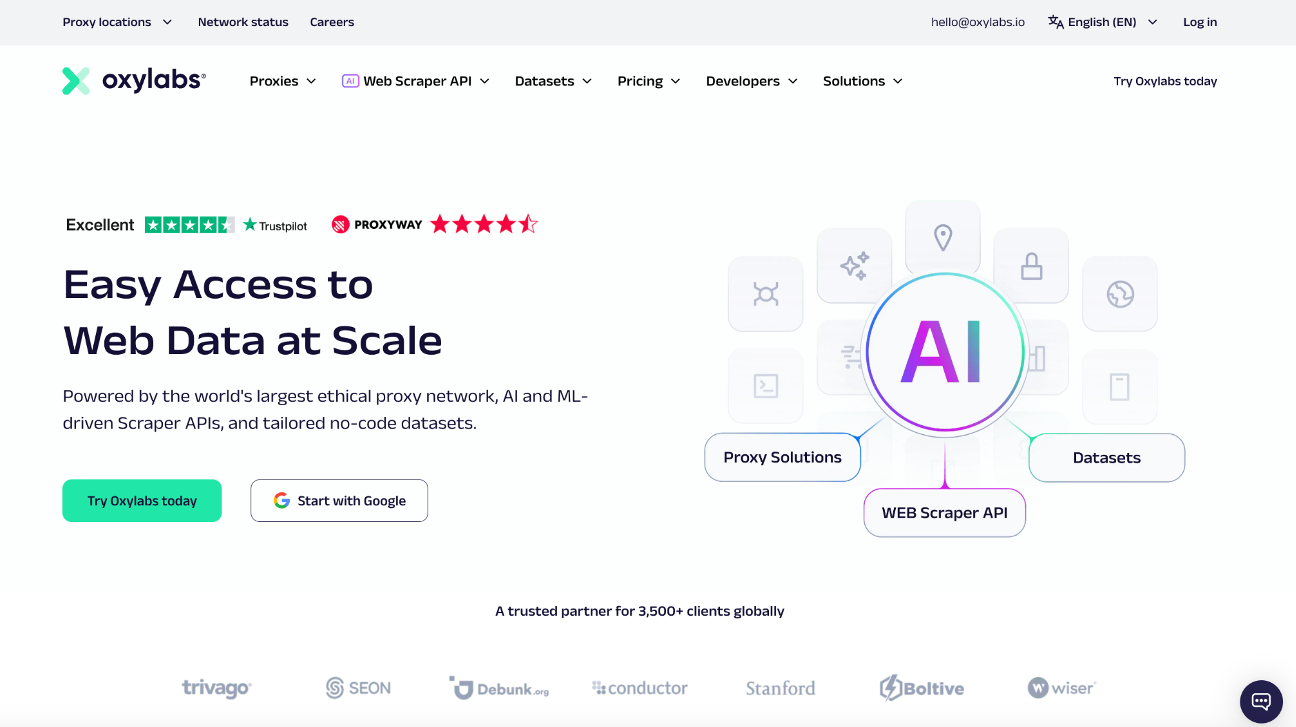
Oxylabs is considered to be one of the best and most reliable proxy providers in the market. Residential proxies are Oxylabs’ main proxy product, with one of the largest pools on the market – a vast proxy network of 177M+ IPs from almost every country in the world.
As a provider, Oxylabs primarily targets business clients. This is reflected mainly in the performance metrics – the residential proxies by Oxylabs have an average 0.41s response time in tandem with a 99.82% success rate. All of the proxies are filtered by latency, bandwidth, and quality to ensure that the clients are always connected to the most reliable IPs.
Oxylabs’ proxies are ethically sourced, meaning you don’t have to worry about the legality of your scraping activities. With over 100 million residential IPs in its proxy pool, Oxylabs allows its clients to choose IPs from 195 countries, including heavily sought-after countries like the United States, UK, Germany, and China.
Oxylabs offers exceptionally precise granulation. For no additional cost, you can filter your targets by country, city, state, continent, ZIP code, coordinates, and ASN.
The flexible session control feature for Oxylabs’s proxies allows users to choose whether they prefer to use sticky sessions or rotate their proxies – it’s possible to specify any duration between one and 30 minutes. While the traffic use of the rotating proxies is metered, the number of connection requests a user can make is unlimited.
Oxylabs charges for traffic only. With a pay-as-you-go plan, there is no commitment – clients only have to top up their accounts with as little as $8 per GB without committing to the whole subscription. This plan lets you buy up to 50 GB of traffic per month.
However, Oxylabs has recommendations in place on when to switch to a subscription-based model. As an enterprise client, you can optimize your spending with predictable costs and clear usage statistics in your dashboard, where you can manage your usage and control users all in one place. If you reach the cap of any plan, there’s even an option to top up without getting a new plan.
Lastly, Oxylabs offers exceptional customer support. Whether you’re a client or not, you can easily contact them via live chat or email 24/7; however, enterprise clients also have a dedicated account manager to assist them with any problems.
4. Webshare
Pool size: 30M
Pricing model: Subscription-based
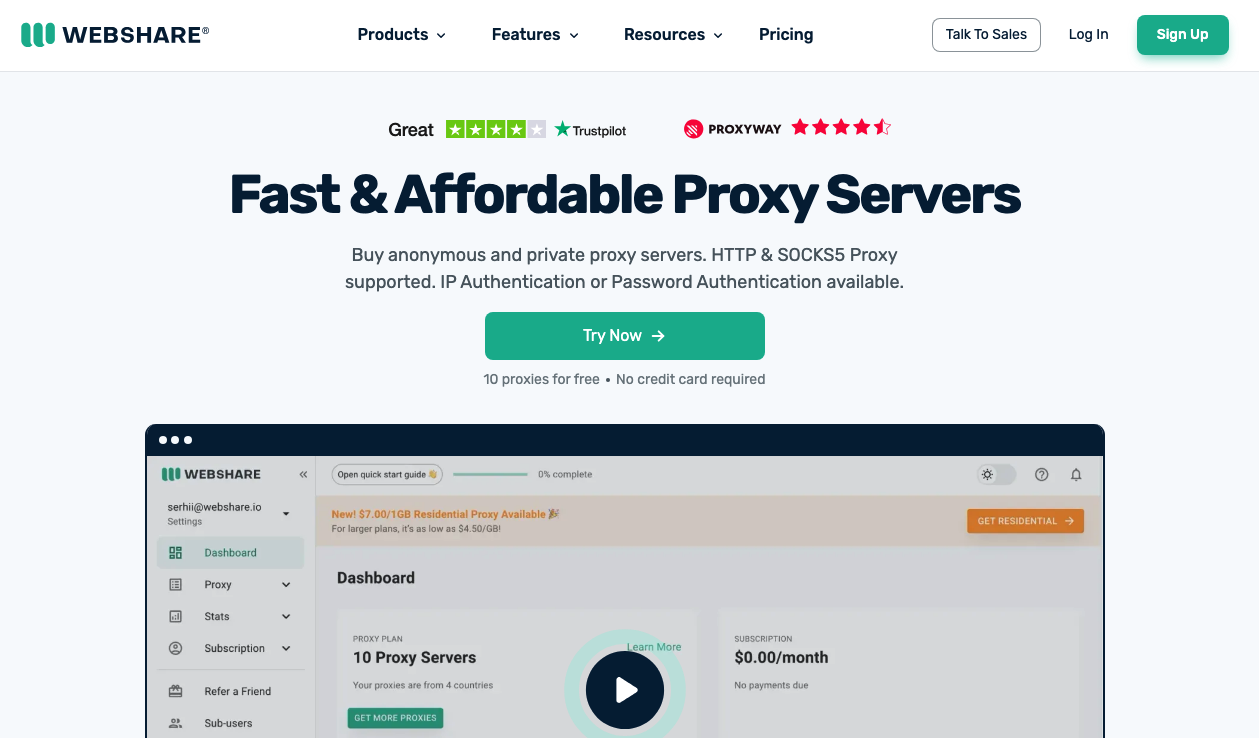
Webshare is a smaller company that sells residential proxies among many other types. It started as an independent brand but has since been acquired by another company. However, it seems that Webshare retains the independent feel and focuses on smaller businesses.
One of the standout features that few competitors on the market have is that they offer free proxy servers. They’re not free residential proxies, though, as the company has only paid plans for those. We believe the free servers to be datacenter proxies.
For a smaller company, Webshare does have quite a sizable pool of residential proxies that cover 195 countries all over the world. Interestingly, they seem to have a large portion of Chinese IP addresses, which can be highly beneficial to some companies.
Their residential proxies, performance-wise, are definitely competitive. There’s support for both HTTPS and SOCKS5 protocols, 99.97% network uptime, and an intuitive dashboard.
While they state themselves to be the cheapest option on the market, it definitely doesn’t seem so, at least for residential proxies. Pricing-wise they are in direct competition with IPRoyal who also give bigger discounts for larger packages while MarsProxies have a lower starting price for the smallest package.
Additionally, their model is subscription-based. While it’s somewhat of an industry standard, you have to be sure to use up all of the bandwidth allotted to your rotating residential proxies as otherwise you’ll be paying even more per gigabyte.
Webshare is a good choice for those who are just starting out and want a simple process. While you’re not getting the best bang for your buck, there’s something to be said about intuitive dashboards and easy integration.
5. Swiftproxy
Residential proxy pool size: 10M+
Pricing model: Traffic-based
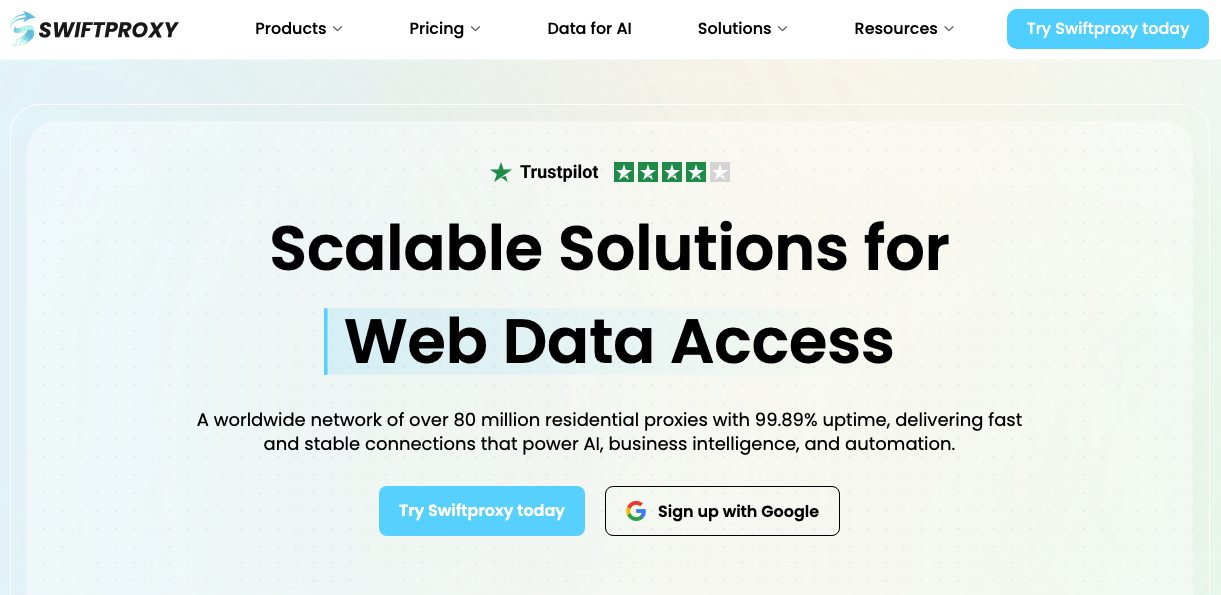
Swiftproxy specializes in residential proxy services designed to deliver reliable, location-specific access to the web while maintaining strong performance and ease of use. The platform appeals to users who need authentic residential IPs for data collection, market research, automation, and localized testing without the high price tag of premium enterprise providers.
Swiftproxy maintains a sizable pool of residential IPs sourced from real devices across multiple countries and regions. While its global coverage may be more streamlined compared to the very largest proxy vendors, its residential network is engineered to offer stable performance, fast response times, and flexible rotation options suitable for most scraping and research workloads.
Plans are structured with simplicity in mind—residential tiers typically include unlimited traffic, broad domain access, and the freedom to target any website without extra usage fees or restrictive blocks. Users can run multiple concurrent threads and choose between rotating IPs for each request or longer sticky sessions when session continuity is required, enabling both high-volume crawling and tasks that depend on persistent identity.
Swiftproxy supports HTTP(S) and SOCKS5 protocols, making integration straightforward across browsers, automation frameworks, and scraping tools. Its dashboard allows users to configure session behavior, proxy formats, and geographic targeting with minimal setup time, reducing friction for developers and analysts who need fast deployment.
For users seeking dependable residential proxies at accessible pricing, Swiftproxy provides strong value. While it may not offer the extensive feature catalogs or massive IP counts of top-end competitors, it delivers residential IPs that are consistent, easy to manage, and aligned with the needs of teams focused on practical, cost-effective proxy usage.
How Residential Proxies Are Priced
Residential proxies are typically priced based on factors such as bandwidth usage, number of IPs, rotation frequency, geographic targeting, and additional features. These proxies are sourced from real residential devices, making them more expensive than data center proxies. Below is a breakdown of residential proxy pricing.
- Bandwidth-Based Pricing: Users are charged per GB of data usage. This is the most common model for residential proxies.
- Per Proxy Pricing: Some providers charge per IP, but this is less common since residential IPs rotate frequently.
- Subscription-Based Pricing: Monthly plans include a set amount of bandwidth and features, with additional data available for purchase.
- Pay-As-You-Go: Users are charged based on actual usage rather than committing to a fixed plan.
Share this post
Leave a comment
All comments are moderated. Spammy and bot submitted comments are deleted. Please submit the comments that are helpful to others, and we'll approve your comments. A comment that includes outbound link will only be approved if the content is relevant to the topic, and has some value to our readers.
Comments (0)
No comment