

Best Legacy System Modernization Companies
TL;DR Summary of Key Questions Answered
- Why are enterprises prioritizing legacy modernization in 2026?
- How can executives recognize that their core platform is now a material risk?
- What criteria matter when short-listing vendors, and how were the companies in this legacy modernization company list selected?
- Who are the top legacy modernization companies delivering measurable business value today, and what differentiates each of them?
- Where does Techstack fit in, and why do many CIOs put it on the first line of any RFP?
- What future trends (AI-assisted refactoring, hybrid cloud portability, ESG metrics) will shape modernization budgets over the next three years?
Mainframes, monolithic ERPs, and custom platforms built a decade ago were never designed for today’s cloud, API, and AI expectations. As maintenance costs climb and integration bottlenecks slow product teams, legacy enterprise system modernization firms have shifted from “nice to have” suppliers to strategic partners essential for competitive survival.
This article looks at the most reliable players in 2026, explains how we evaluated them, and offers practical guidance for choosing the right partner - free of buzzwords and empty promises.
Legacy System Modernization Explained
At its core, legacy system modernization services are the structured reinvention of applications, data stores, and infrastructure designed in a different computing era. In the 1990s and early 2000s, enterprise software focused on stability and vertical integration. Integration, elasticity, and analytics were afterthoughts because on-prem hardware budgets were fixed and data volumes were a fraction of what they are today.
Fast-forward to 2026, and those same systems are asked to provide real-time insights, integrate with SaaS platforms, and support machine-generated workloads such as AI copilots. Simply lifting them to the cloud rarely solves the underlying architectural mismatch. That is why legacy enterprise system modernization firms concentrate on four transformation patterns:
- Replatform. Move an application to a new runtime (often container-based) without extensive code change.
- Refactor. Restructure code modules to expose services or remove technical debt while preserving functionality.
- Rewrite. Build new cloud-native components that gradually replace the monolith via strangler patterns.
- Replace. Retire an entire stack and migrate to a packaged or SaaS alternative when differentiation is low.
Which pattern delivers the highest ROI depends on business context, compliance posture, and appetite for change. A firm specializing in legacy system modernization determines that trade-off, not a generic playbook.
As digital transaction volumes grow, the compounding costs of legacy maintenance and technical debt are skyrocketing. A mid-2025 audit by the U.S. Government Accountability Office (GAO) revealed that for massive legacy systems, a staggering 90 percent of multibillion-dollar IT budgets is now consumed entirely by routine operations and maintenance (O&M), completely starving innovation. When an AS/400 or VAX cluster demands an emergency part that is no longer manufactured, CFOs suddenly appreciate the hidden liabilities carried on the balance sheet.
Key Signs Your System Needs Modernization
Escalating indicators normally appear in clusters:
- Run-Cost Inflation
- Integration Bottlenecks
- Security Exposure
- Performance Constraints
- AI Roadblocks
Each signal merits further explanation.
Inflation of run costs is not usually linear. When a vendor stops supporting an old database, the required Extended Security Updates (ESUs) can double the cost of licensing in a single night. Integration bottlenecks also add to costs; new digital products get stuck because the monolith's release calendar controls everyone else's. After vulnerability exploitation, often targeting unpatched, legacy systems, rose by 180% in 2024, security exposure became a top priority for the board. Regulators like the SEC then required strict, four-day material breach disclosures with severe penalties for not following them.
Performance constraints often surface during seasonal spikes. Retailers still running AS/400-based order systems must provision for peak loads months in advance, paying for idle capacity the rest of the year. Finally, AI roadblocks are now obvious: data trapped in VSAM or proprietary ERP schemas cannot feed large-language models without laborious extraction.
By quantifying each symptom cost per transaction, integration lead time, CVE backlog, and latency under load, executives gain the evidence needed to justify a modernization budget, usually in the form of an operating-expense-to-capital-expense trade. That rigor is why CFOs increasingly attend steering-committee meetings with legacy system modernization companies instead of leaving the discussion solely to IT.
How We Evaluated Legacy Modernization Vendors
We began with 60 vendors cited across Gartner Critical Capabilities, Forrester Wave, and IDC MarketScape reports. Each vendor completed a 76-question RFI covering methodology, tooling, and evidence of post-go-live value. The evaluation team weighted responses using the scale below and validated claims via client interviews.
| Criterion | Weight | Minimum Evidence | Common Pitfalls to Watch |
|---|---|---|---|
| Delivery Track Record | 30% | Two projects > $5 M in last 24 months | Counting partial upgrades as modernization |
| Technical Breadth | 20% | Proof of cloud, data, and mainframe skills | Over-reliance on subcontractors |
| Business Outcome Proof | 25% | Measurable cost, speed, or risk reduction | Vanity metrics lacking baseline |
| Cultural & Governance Fit | 15% | Named client references | Pure staff-augmentation model |
| Innovation & Tooling | 10% | AI-based analyzers, automation pipelines | Tool licenses sold separately |
The resulting shortlist of eight top legacy system modernization service providers demonstrates consistent strength across all categories, making the list relevant for procurement teams demanding auditable selection logic.
Top Legacy Modernization Companies
Every organization listed below repeatedly turns technical modernization effort into CFO-recognizable value. Their positioning reflects verified projects, not marketing claims, ensuring the credibility of this legacy modernization company list.
Techstack
Techstack exists to eradicate risk ambiguity at the start of modernization initiatives. Instead of pitching a pre-packaged cloud migration, its consultants run a two-week diagnostic that inventories code, integrations, and data flows. The deliverable is a ranked backlog and roadmap covering AI readiness, cloud migration, or full modernization.
Key differentiators:
- AI Readiness Track. Pinpoints obstacles preventing AI adoption (data lineage gaps, API latency) and implements targeted copilots without rewriting entire systems.
- Cloud Migration Track. Executes lift-and-shift, replatforming to AWS, Azure, or GCP, and hybrid patterns when regulatory data residency is non-negotiable.
- Full Modernization Track. Applies strangler-fig patterns, CQRS, and domain-driven design to decompose monoliths gradually, keeping the business running.
Results: Techstack helped one of the sales enablement leaders in California to achieve over five years of flagship work in modernizing a fragile monolithic platform into a solid, modular, and scalable B2B solution. The key outcomes were the significant reduction of system downtime and tech debt, measurable gains in user retention with the performance and UX; and decreased release time with the re-engineered deployment and monitoring processes. Particular work involved refactoring the live presentation module as a standalone product with Amazon Chime to support video conferencing, integrating several legacy products under a smooth SSO experience, and re-implementing the analytics layer based on the CQRS pattern to provide quicker and more dependable asynchronous processing.
It is this breadth, along with diagnostic clarity, that has made Techstack a top firm specializing in legacy system modernization and is listed on almost every RFP.
Accenture
Accenture introduces a global scale and cloud-first division with a US$3 billion investment. MyWizard automation platform is based on AI to analyze source code, suggest refactoring, and automatically create regression scripts. The Living Cloud model enhances ongoing optimization after migration, keeping the cloud spend at the appropriate size.
Practically, the sweet spot of Accenture is transformation over a period of years in Fortune 500 companies or government agencies. Its strategy allows a progressive rollout of work across multi-faceted legacy estates, allowing businesses to replatform or re-engineer systems without disruption of business operations. The code analysis features of Accenture are especially appreciated in financial services and insurance, where COBOL-intensive environments have to be carefully documented and risk-consciously migrated to. The trade-off is the size of engagement; smaller enterprises might find the methodology to be overbearing.
IBM Consulting
IBM Consulting’s modernization story is anchored in Red Hat OpenShift and Watsonx Code Assistant for Z. By translating COBOL to Java directly on the mainframe, IBM enables “modernize in place” scenarios, a critical capability for banks running core deposits on zSeries. Its Analysis Renovation Catalyst can reduce code analysis time by 40% and improve efficiency by 70%.
IBM's co-creation methodology via IBM Garage allows highly regulated clients in banking and government to modernize core systems securely while avoiding vendor lock-in. The firm's approach is grounded in risk-aware engineering and regulatory compliance, making it a strong fit for modernization programs in finance, healthcare, and other security-sensitive sectors. IBM's approach works best for clients prioritizing operational resilience over aggressive timelines.
Cognizant
Skygrade is a Cognizant product that automatizes the containerization of old applications, and Neuro AI is an AIOps that identifies and remedies anomalies in the migration process. The company has a profound domain knowledge in regulated markets, such as healthcare, insurance, and financial services, where it must address complex compliance rules, such as HIPAA, PCI-DSS, and SOX, in the course of implementing large-scale modernization programs.
Its integrated consulting and delivery model addresses business processes alongside code, and its globally distributed teams provide the scale needed for multi-region rollouts. The flip side is that the transformation scope can expand quickly; tight program governance is essential.
Capgemini
Capgemini's ADMnext framework goes beyond cost optimization to include sustainability. Using its proprietary economic Application Portfolio Management tool, Capgemini helps enterprises visualize their full IT estate, identify workloads ready for retirement, and replatform the remainder while measuring and reducing the carbon footprint of legacy infrastructure throughout the migration process.
Capgemini's Intelligent Industry strategy blends operational technology with IT, useful for manufacturers seeking digital twins yet constrained by aging MES systems. Its zero-debt ambition promises to eradicate technical debt through automated code extraction and refactoring.
TCS (Tata Consultancy Services)
TCS uses its Machine First Delivery Model and MasterCraft suite to index undocumented mainframe logic using generative AI. The MasterCraft suite reverse-codes and catalogs millions of lines of legacy code, reducing the risk of migration by a factor of many times by revealing the hidden business logic before a single line of code is rewritten. TCS is a large player in the financial services sector, with its proprietary BaNCS platform moving banks off mainframes to modular, cloud-native systems.
Because TCS fields follow-the-sun delivery teams, it can execute phased cutovers aligned to regional maintenance windows, which is critical for institutions that cannot tolerate extended downtime. TCS is thus ideal for large financial institutions with stringent uptime SLAs.
Infosys
Infosys bases its modernization practice on Cobalt, a collection of blueprints, accelerators, and cloud services. Using generative AI to fix code and diagnose architecture, Infosys assists enterprises in breaking down monolithic systems into domain-oriented microservices, reducing the release cycles from weeks to days. Its A.R.T. framework is an AI-driven transformation framework that supports the transformation of assessment to cloud-native rearchitecture.
It has distributed agile teams that strike a balance between onshore product leads and offshore engineering and provides cost effectiveness without compromising architectural rigor. Vertical manufacturing and retail expertise mean that supply-chain dependencies are honored when migrating.
Devox Software
Devox Software offers boutique precision backed by an AI Solution Accelerator™ stack: automated code discovery, dependency mapping, test harness scaffolding, and iterative refactoring. The firm's approach prioritizes uncovering hidden dependencies and eliminating technical debt systematically, rebuilding critical components in modular architectures that improve both performance and long-term maintainability. A structured accelerator stack cuts weeks of manual analysis out of the discovery phase, making timelines more predictable.
Because senior architects stay engaged from discovery through post-production hyper-care, Devox is well-suited to mid-market organizations desiring high-touch delivery without big-SI overhead.
Core Capabilities of Legacy System Modernization Companies
Before evaluating sales pitches, executives should validate that any contender on their legacy modernization company list can deliver the five universal capabilities below.
| Capability | Key Activities | Business Value Delivered |
|---|---|---|
| Architecture Rationalization | Domain mapping, dependency graphing, data lineage creation | Identifies quick-win decompositions, lowers re-engineering risk |
| Cloud Migration & Hybrid Design | Lift-and-shift, replatform, multi-cloud topology, FinOps | Reduces TCO, improves elasticity, prevents lock-in |
| Automated Code Transformation | AI-assisted language conversion, test generation, static analysis | Cuts manual rewrite time by up to 60%, boosts code quality |
| Secure Integration & API Management | Gateway config, zero-trust patterns, event streaming | Enables real-time data access, speeds partner onboarding |
| DevSecOps & Change Management | Pipeline automation, IaC, feature flags, rollback planning | Maintains uptime, enforces compliance, accelerates releases |
A close examination of these aspects usually distinguishes the top legacy modernization companies and commodity suppliers. Vendors with fewer than all the capabilities can still accomplish isolated migrations, but can seldom provide systemic, multi-year value.
Technology Trends Driving Legacy Modernization in 2026
Technology is not static; any modernization decision today should stay relevant for at least five years. The trends below will dominate budgeting conversations.
1. AI-Driven Refactoring
New IDE extensions and standalone analyzers process millions of lines of source code, find dead branches, and propose safe rewrites. The decrease in manual work is simply astounding when implemented on a large scale. Recently, in an enterprise benchmark, Amazon used generative AI agents to rewrite and modernize more than 1,000 legacy Java applications. This AI-based remediation saved an estimated 4,500 years of human developer work and accomplished the migrations within days, not months.
2. Composable Enterprise Architecture
The event-driven patterns like Kafka and Pulsar allow separate domains to develop at their rate, decoupling release schedules. Boards reward teams that can introduce new revenue-generating services without risky big-bang deployments.
3. Hybrid and Multi-Cloud Portability
Regulations like the EU’s Digital Operational Resilience Act (DORA) encourage financial institutions to avoid single-provider concentration risk. OpenShift and Kubernetes remain the portability layers of choice, supported by every major cloud provider.
4. Sustainability Metrics
Capgemini’s clients are not alone: according to enterprise forecasting by IDC, 60 percent of large organizations now require a verifiable carbon neutrality strategy as a standard, non-negotiable part of their enterprise technology procurements and modernization RFPs.
5. Industry Cloud Platforms
Microsoft Cloud for Healthcare or AWS for Financial Services offers pre-certified regulatory blueprints. However, legacy integration remains essential, hence, the sustained demand for legacy enterprise system modernization firms that can knit SaaS, PaaS, and on-prem together.
How to Choose the Right Legacy System Modernization Partner
Selecting from among the top legacy system modernization companies involves more than a pricing spreadsheet.
Begin by articulating business outcomes: e.g., reduce order-processing latency by 40%, or cut mainframe MIPS by 25%. Translate those objectives into key performance indicators captured within contracts.
Next, request a diagnostic or proof-of-concept rather than a full proposal. This short engagement allows both sides to validate cultural alignment and delivery rigor. Examine the vendor’s DevSecOps pipeline artifacts: IaC templates, automated test suites, and code quality gates. Their maturity level is a proxy for the quality of the eventual solution.
Third, scrutinize governance. Vendors should propose a joint steering committee, risk registers, and escalation paths. Ask how they handle scope change without penalizing agility. Transparent governance separates top legacy system modernization service providers from staff-augmentation suppliers.
Finally, run peer reference checks, but insist on speaking with clients whose projects encountered difficulties, not just success stories. How the vendor handled setbacks is the best predictor of future partnership quality.
What Makes Techstack a Strong Choice for Legacy Modernization
Techstack receives special attention because its engagement model directly addresses two fears that routinely stall modernization projects - uncertain cost and downtime risk. By front-loading a two-week diagnostic, Techstack quantifies scope, complexity, and ROI before a long-term contract is signed.
In implementation, Techstack uses blue-green deployment, feature flagging, and automated fallback pipelines to ensure continuity of the service. These prevent the production traffic from being able to transition in stages between old and new environments, with rollback facilities being tested in pre-production before any live cut-over is attempted, a vital protection to clients upgrading customer-facing or revenue-critical systems.
Beyond technical rigor, Techstack emphasizes knowledge transfer. In every project, internal engineering teams pair with Techstack architects so that once knowledge is embedded, the client can independently run and evolve their new platform. That blend of enablement and delivery positions Techstack among the best legacy system modernization companies operating in 2026.
Equally important, Techstack maintains vendor neutrality. Whether a workload ends up on AWS Outposts, Azure Arc, or an on-prem OpenShift farm, the answer is dictated by regulatory, latency, and cost data gathered during discovery, not by a resale quota.
The Future of Legacy Modernization: What Comes Next
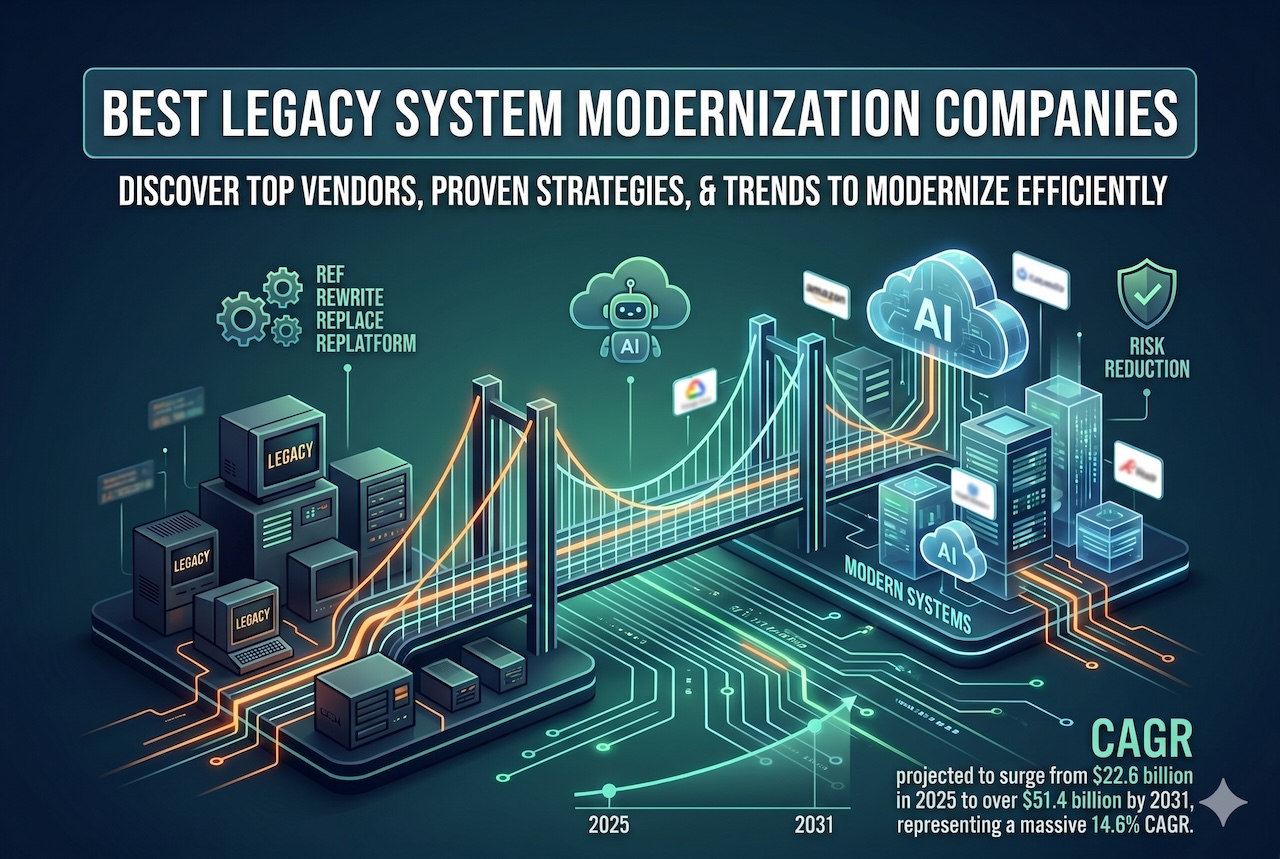
Analysts predict that global spending on application modernization will explode in the coming years. According to market forecasting by MarketsandMarkets, the modernization services market is projected to surge from $22.6 billion in 2025 to over $51.4 billion by 2031, representing a massive 14.6% CAGR.
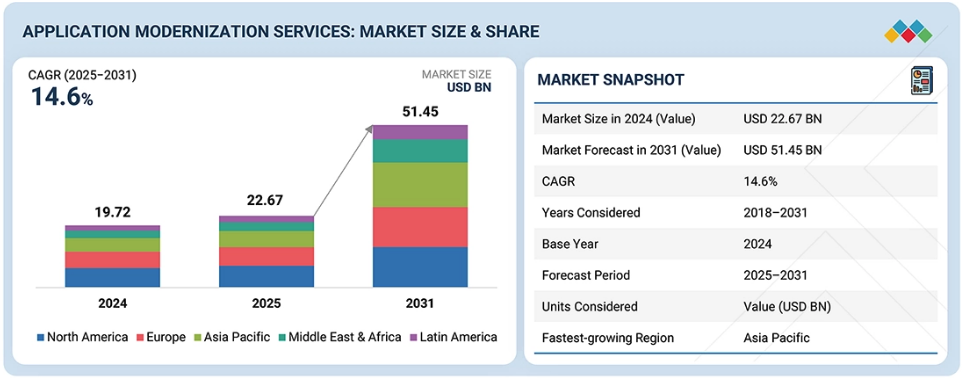
Source: Markets and Markets
AI-driven tooling will accelerate code remediation, but organizational complexity - approvals, change management, governance - will still dominate timelines. Successful vendors will therefore bundle transformation as an evergreen managed service, turning large capital projects into predictable operating-expense subscriptions.
Regulators will also play a larger role. Financial and energy sectors must demonstrate operational resilience under new stress scenarios. That pushes enterprises toward hybrid architectures capable of shifting workloads between providers in minutes, not days. Legacy system modernization companies able to design such portability - IBM, Techstack, and TCS already do - will gain market share.
Finally, sustainability moves from marketing to mandatory. Carbon reporting regulations effective in the EU and proposed in the US will force boards to quantify the environmental impact of every server. Modernization budgets that include decarbonization ROI will win faster approval, driving further demand for top legacy modernization companies with demonstrable ESG tooling.
Summary
Old systems discourage innovation, raise expenses, and put the business at risk of unwarranted risk. The eight vendors mentioned in this article are the most reliable ones that will be available in 2026. Both have demonstrated their ability to match modernization strategy and quantifiable business results.
By using a systematic selection model, confirming cultural and governance fit, and linking modernization KPIs with financial and sustainability indicators, executives will maximize ROI and reduce disruption. Modernizing can be overwhelming, and with the best legacy system modernization companies to choose, the way forward is not only viable but also lucrative.
 FAQs
FAQs
Migration transfers workloads to a new environment, usually the cloud, with little or no change. Modernization also extends to re-architecting, refactoring, or replacing components in order to allow the system to take on new functionality, scale elastically, and operate automatically.
Firstly, highly regulated sectors (banking, healthcare, utilities) and platforms of digital commerce are vulnerable to downtime since regulatory fines are high. Nevertheless, material benefits will be realized in any business whose maintenance expenses are on the increase or whose product development plans have been halted.
Major drivers are codebase size and complexity, the number of integrations, compliance, the volume of data migration, and the degree of refactoring versus replatforming. A systematic analysis, e.g., a two-week diagnostic of Techstack, determines costs before implementation.
Strategies involve blue-green deployments, strangler patterns, incremental data replication, and having parallel production environments with a controlled cut-over. Top legacy system modernization companies with experience develop rollback plans and automate regression testing to safeguard service levels.
Featured Image generated by Google Gemini.
Related Articles

October 2, 2024
How to Build a Custom Asset Tracking System: A Step-by-Step Guide
Asset tracking software is fundamental for companies that handle actual goods, tools, or inventory. It guarantees your knowledge of your assets, their current usage, and when they...
Read More
August 16, 2024
Preparation is Key: Anticipating Challenges Before Implementing an ERP System
Implementing an ERP (Enterprise Resource Planning) system is a major step for any business, often requiring significant time, resources, and strategic planning. An ERP implementati...
Read More
January 25, 2024
Five main functions that a modern LMS system should have
Learning Management Systems (LMS) are becoming an integral part of HR technologies in modern companies. They allow the optimization of one of the most essential HR processes - pers...
Read More
Comments
Comments are available to signed-in users and are moderated to keep the discussion useful and respectful. Spam, automated submissions, and low-value promotional comments are removed. Outbound links may be approved when they are relevant and genuinely helpful to readers, but they are displayed as plain text rather than clickable hyperlinks.
No comments have been published yet.
Please sign in to submit a comment.