

AI Visibility Tools 2026: Measuring Brand Exposure Across AI Search Engines

When someone asks ChatGPT, Gemini, or Google’s AI Overviews for advice, these systems decide which brands to mention. Some names appear repeatedly; others disappear entirely. That difference defines AI visibility—how often and in what contexts your brand appears in AI-generated responses.
Search visibility used to be about ranking positions. Now it’s about AI discoverability—being recognized, cited, and trusted by large language models. This shift has created a new category of AI visibility-tracking tools designed to measure brand presence within AI-generated answers rather than just on traditional SERPs.
These AI search visibility tools collect data from AI engines like ChatGPT, Gemini, Copilot, and AI Mode. They show where your brand appears, how often it’s mentioned, and how its visibility changes over time.
In this article, we’ll look at how AI visibility software works, which metrics matter, and what to expect from the best AI visibility tracking tools in 2026.
What Is AI Visibility and Why It’s the New SEO Metric
AI visibility is the measure of how often a brand appears inside AI-generated responses across models like ChatGPT, Gemini, and Copilot. It reflects the brand's inclusion in AI answers including the context, frequency, and prominence of each mention.
When an AI tool lists brands or references specific domains, it implicitly establishes a hierarchy of trust. Each mention signals authority. If your site is cited or linked, that’s measurable exposure, one that drives awareness even without a click. This shift has made AI visibility tracking a key part of modern SEO and analytics.
How AI Visibility Differs from SEO Visibility
| Focus | SEO Visibility | AI Visibility |
|---|---|---|
| What it measures | Keyword rankings in search results | Brand mentions and links in AI answers |
| Data source | Search engine result pages (SERPs) | AI responses from LLMs (ChatGPT, Gemini, Copilot) |
| Main goal | Improve positions and organic traffic | Increase inclusion and citation frequency in AI outputs |
| Typical tools | Rank trackers, keyword tools | AI visibility tracking tools, AI search visibility trackers |
In simple terms, SEO visibility ends where AI visibility begins. AI engines summarize information rather than listing websites, so visibility now depends on whether your content is referenced by the AI model at all.
Why It Matters
LLMs act as new gatekeepers between brands and audiences. When a model repeatedly cites your domain, it reinforces expertise. When it ignores you, visibility and trust fade. That’s why AI visibility tools are becoming part of every serious marketing tech stack.
They collect data on:
- Citation frequency: How often your brand appears across AI engines
- Context depth: Whether the mention is detailed or superficial
- Placement share: If your domain is among the top-cited sources
- Comparative visibility: How your exposure compares with competitors, with AI citation tracking tools providing additional benchmarking around mentions, citations, and source visibility.
This data makes AI exposure measurable. For marketing teams, it provides AI exposure analytics and LLM performance insights that go beyond rankings. Instead of guessing how AI systems perceive a brand, teams can finally track it and act on it.
Inside the Mechanics of AI Visibility Measurement
AI visibility tracking tools collect and score data on how brands appear inside AI-generated answers. Each AI engine, such as ChatGPT, Gemini, Copilot, or Claude, uses different data sources, so visibility measurement depends on understanding how these systems generate responses.
Model Mapping
Every AI search visibility tool sends structured prompts to models and records complete responses. It then identifies brand mentions, links, and citations. Repeating this daily builds a dataset showing how often and where each brand appears.
Scoring Logic
Tools translate mentions into measurable metrics. A typical AI presence index combines:
- Inclusion frequency: How often your brand appears
- Placement score: Position or prominence within the answer
- Context value: Type of mention (recommendation, citation, or list)
- Stability over time: Visibility consistency across updates
Data and Interpretation
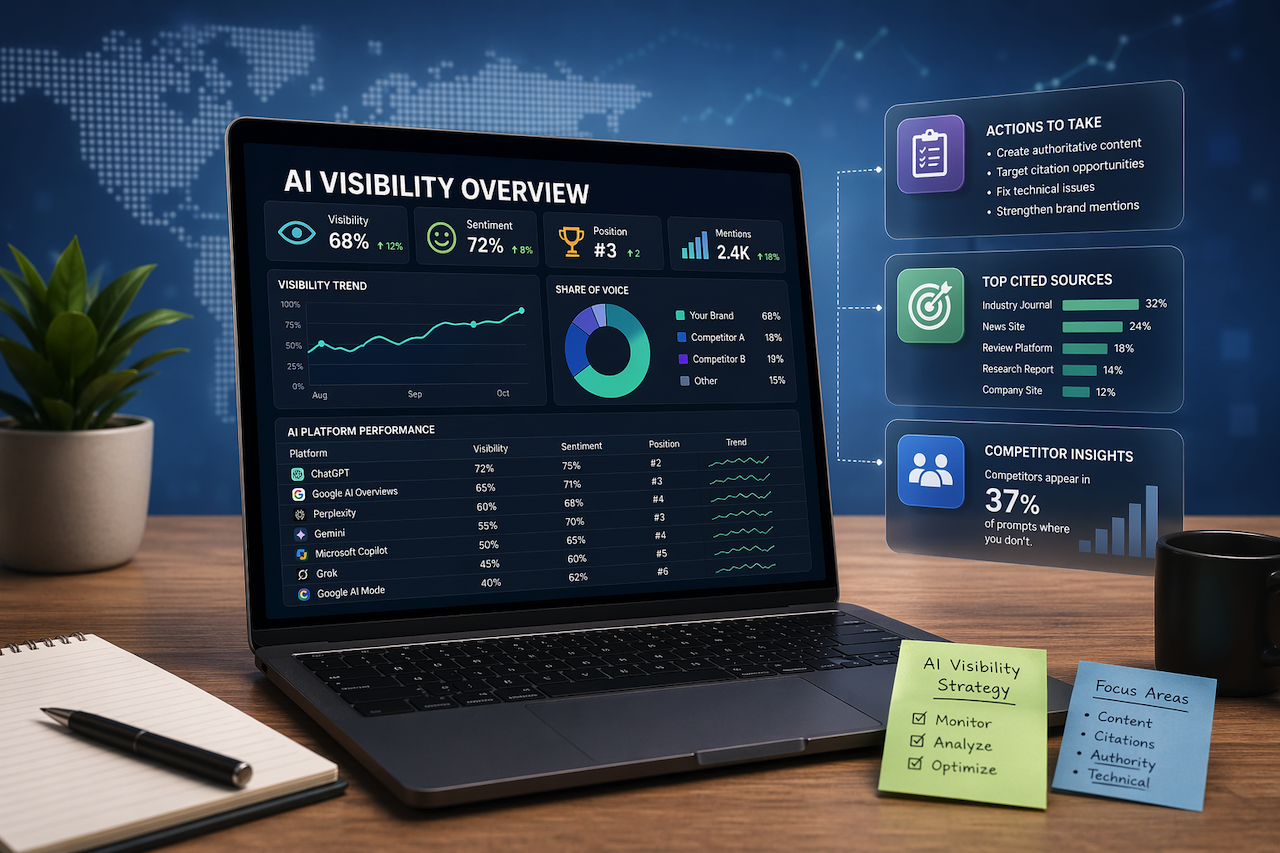
Collected data syncs automatically through APIs or prompt queries. Dashboards turn results into metrics like “Share of Mentions,” “Visibility by Model,” and “Top Cited Sources.” This helps teams see where their brand stands and which AI systems recognize it most often.
In short, AI visibility software turns AI-generated answers into comparable analytics, making AI exposure analytics and LLM performance insights as measurable as traditional SEO rankings.
2026 AI Visibility Comparison Grid
To make sense of the growing market, we compared leading AI visibility tracking tools available in 2026. In this table, we show how each tool measures brand exposure across AI engines, how often it updates data, and what makes it stand out.
| Tool | Visibility Models | Metrics Offered | Real-Time Updates | Historical Data | Pricing | Key Advantage |
|---|---|---|---|---|---|---|
| SE Ranking | AI Overviews, AI Mode, ChatGPT, Gemini | Mentions, links, competitor visibility, source citations | Daily | Yes | From $119/mo | Combines SEO and AI visibility in one platform |
| AI Monitor | AI Overviews, ChatGPT, Perplexity | Brand mentions, citation context, frequency trends | Hourly | Yes | From $99/mo | Strong real-time tracking for AI Overviews |
| Relevance AI | ChatGPT, Copilot, Gemini | Contextual sentiment, inclusion share, and AI visibility score | Daily | Yes | From $149/mo | Tracks visibility with tone and context analysis |
| GPT Visibility | ChatGPT | Mentions, ranking within responses | Weekly | Yes | From $89/mo | Focused LLM visibility scoring with exportable data |
| RankScale AI | ChatGPT, Gemini, Perplexity | Predictive visibility trends, citation forecasting | Daily | Limited | From $199/mo | Predictive visibility modeling |
| VisionMetric | AI Mode, Copilot, ChatGPT | Mention placement, cross-model score, competitor index | Daily | Yes | From $129/mo | Cross-model benchmark reports |
| Morningscore AI | ChatGPT, Gemini | Brand citation frequency, visibility trendlines | Daily | Yes | From $79/mo | Simple visibility dashboards for SMBs |
| TrendScope LLM | ChatGPT, Claude, Gemini | Mention tracking, source classification | Daily | Yes | From $149/mo | Tracks which sources most influence AI responses |
| RankinAI | ChatGPT, Google AI Overviews, Perplexity, Gemini | Brand mentions, citation frequency, placement quality, sentiment, E-E-A-T audit insights | Scheduled (prompt-based monitoring) | Yes | Free plan; Paid from $79/mo | Combines AI visibility tracking with actionable E-E-A-T optimization guidance |
Each AI search visibility tracker has a different focus. Some specialize in real-time analysis, others in predictive visibility, and others in competitor benchmarking. For SEO teams and digital marketers, the right choice depends on whether they need depth (cross-model data), speed (real-time updates), or strategic forecasting.
Top AI Visibility Tracking Tools 2026
Below, we’ll look at the best AI visibility tracking tools that help marketers measure and improve brand presence across large language models. Each tool is evaluated based on how it collects, scores, and visualizes AI search visibility data.
1. SE Ranking
Core Insight
SE Ranking tracks AI visibility across multiple large language models, showing exactly where and how a brand appears inside AI-generated answers. It monitors AI Overviews, AI Mode, Gemini, and ChatGPT, capturing mentions, links, and citations to build a complete picture of brand exposure across AI search ecosystems.
Visibility Intelligence Layer
The platform identifies which prompts trigger brand mentions and records their position within the AI response. Each mention is stored with its full answer text, so teams can review how AI systems describe their business and competitors.
SE Ranking also tracks competitor visibility, enabling side-by-side comparison of inclusion frequency, placement, and source overlap across different models.
Analytics and Reporting
All visibility data is summarized in dashboards showing Share of Mentions, Visibility by Model, and Top-Cited Sources. Daily updates and historical graphs reveal how brand presence changes over time.
Users can view cached AI responses to understand how their domain is represented in AI results and identify the content that most frequently gains citations. These analytics turn raw AI answer data into AI exposure insights that support content and link-building strategies.
Enterprise Readiness
Marketing teams can analyze any domain’s AI presence, export visibility reports, or integrate metrics directly into their analytics workflows through SE Ranking’s API. This supports agencies managing multiple clients and in-house teams, comparing cross-model visibility at scale.
Pricing Overview
AI visibility tracking is available in SE Ranking’s Pro plan ($119/month) and Business plan ($259/month). The optional AI Search add-on starts at $89/month for extended query tracking.
Competitive Edge
SE Ranking gives SEO professionals measurable data on how often and where their brands appear in AI-driven search results, combining traditional ranking metrics with real AI visibility analytics across ChatGPT, Gemini, and Google’s AI environments.
2. AI Monitor
Core Insight
AI Monitor focuses on real-time tracking of AI visibility. It helps marketing teams see how often their brand appears across AI Overviews, ChatGPT, and Perplexity. It captures visibility shifts hourly, so users can react quickly when AI-generated answers change or when a competitor gains exposure.
Visibility Intelligence Layer
The tool runs continuous prompt checks to detect brand mentions, links, and citation order. It records when each appearance occurs, assigns a confidence score based on position and wording, and updates dashboards in near real time.
Users can compare AI visibility by platform—seeing, for instance, whether ChatGPT mentions their brand more frequently than Google’s AI Overviews.
Analytics and Reporting
AI Monitor provides daily summaries, trend graphs, and alert-based notifications when visibility changes significantly. Reports highlight the prompts that include your brand, the number of times it was cited, and which competitors appear alongside you.
This data supports AI exposure analytics and short-term optimization decisions, such as adjusting content topics to align with frequently cited sources.
Enterprise Readiness
The system integrates through API and supports workspace-level reporting for teams tracking multiple brands. Historical data retention enables users to benchmark quarterly progress in visibility across models.
Pricing Overview
Plans start at $99/month, including hourly checks and 30-day visibility archives. Extended history and team access require custom pricing.
Competitive Edge
AI Monitor gives a faster update cycle than most AI visibility software, making it suitable for teams that need continuous monitoring of AI search visibility changes and immediate detection of brand fluctuations in generative answers.
3. Relevance AI
Core Insight
Relevance AI measures both AI search visibility and the context of brand mentions. Beyond tracking appearances in ChatGPT, Gemini, and Copilot, it evaluates tone and sentiment to understand how each AI system frames a brand.
Visibility Intelligence Layer
The tool classifies mentions as positive, neutral, or negative and assesses their prominence within the AI-generated text. Users can see how frequently their brand appears, how it’s described, and which themes or queries trigger mentions.
Combined with AI visibility tracking, this creates a deeper view of brand perception inside LLMs.
Analytics and Reporting
Dashboards display AI visibility scores, sentiment ratios, and source overlap. The comparison view shows which competitors are most referenced within the same AI responses.
Relevance AI also tracks changes in language use, helping users spot when their positioning shifts from “recommended” to “mentioned.”
Enterprise Readiness
Teams can export structured visibility data for analysis or integrate results with existing brand monitoring tools. Historical tracking helps identify whether AI-driven perception improves after content updates or PR campaigns.
Pricing Overview
Subscriptions start at $149/month, including daily scans across three AI engines and sentiment tracking. Additional models and more extended history periods are available on higher tiers.
Competitive Edge
Relevance AI is one of the few AI visibility-tracking tools that connects brand exposure metrics with tone and narrative context, showing not just how visible a brand is across LLMs, but also how it’s being represented.
4. GPT Visibility
Core Insight
GPT Visibility specializes in tracking how brands appear in ChatGPT-generated responses. It focuses on AI visibility tracking within the GPT ecosystem, providing detailed data on inclusion frequency, mention position, and response context for each monitored prompt.
Visibility Intelligence Layer
The platform queries ChatGPT using a controlled set of keywords and questions. It records all mentions, links, and citation patterns, then assigns a ranking score based on placement and relevance. This helps users understand how often the model references their domain or brand and how it compares with others in the same topic cluster.
Analytics and Reporting
The dashboard presents AI response presence scores, showing how visibility changes over time, by topic, or by keyword category. Users can view inclusion share, link placement statistics, and co-citation trends—how often their brand appears alongside competitors. The historical view helps teams connect spikes in GPT mentions with specific content or backlink activities.
Enterprise Readiness
Data exports allow agencies and larger teams to merge GPT visibility results with SEO or PR analytics. The platform supports API connections for automated monitoring and integrates easily into broader marketing data workflows.
Pricing Overview
Plans start at $89/month, with weekly updates and access to six months of historical data. Higher tiers offer daily tracking and custom prompt sets.
Competitive Edge
GPT Visibility is focused and precise, ideal for teams that want direct insight into LLM performance within ChatGPT itself. It turns AI-generated content into measurable visibility data that reflects a brand’s footprint inside the GPT ecosystem.
5. RankScale AI
Core Insight
RankScale AI combines AI visibility tracking with predictive analytics to forecast how a brand’s exposure across LLMs may change over time. It covers ChatGPT, Gemini, and Perplexity, analyzing not just current mentions but also likely visibility growth or decline based on content and link trends.
Visibility Intelligence Layer
The system calculates visibility probability scores using data from past mentions, topic momentum, and AI citation patterns. It predicts how algorithmic changes or competitor updates might impact AI search visibility. Each model’s data—ChatGPT, Gemini, and Perplexity—is tracked independently, allowing teams to compare visibility performance across ecosystems.
Analytics and Reporting
Dashboards visualize predictive visibility curves and show which prompts or topics drive the most growth. Teams can filter by domain, keyword category, or competitor to focus on high-opportunity areas. The tool’s AI visibility tracker also flags volatility, alerting users when their presence is likely to drop in upcoming model cycles.
Enterprise Readiness
RankScale AI integrates with internal BI systems and supports scheduled exports for executive reporting. Marketing departments use it, and agencies focused on long-term AI exposure analytics do too.
Pricing Overview
Plans start at $199/month, with daily data collection and predictive visibility projections updated weekly. Enterprise users can add extra model tracking for an additional fee.
Competitive Edge
RankScale AI is one of the few AI visibility-tracking tools offering predictive insights—helping teams anticipate visibility changes rather than react after they happen. It’s designed for strategists who want forward-looking insights into LLM performance across multiple AI engines.
6. VisionMetric
Core Insight
VisionMetric focuses on comparing AI search visibility across different models. It tracks how brands appear in AI Mode, Copilot, and ChatGPT, giving users a clear view of which systems mention their brand most often and how consistently.
Visibility Intelligence Layer
The tool checks daily prompts from multiple AI engines and records every mention, link, and citation. Each appearance is scored for prominence within the generated text and categorized by topic or intent. VisionMetric’s cross-model index shows how visibility differs across AI systems, helping teams understand where their content has a greater influence.
Analytics and Reporting
Dashboards present AI visibility scores, Cross-Model Share of Mentions, and Visibility Trends by Source. Users can view which queries trigger brand mentions, identify missing coverage areas, and export visual reports for internal or client use.
A comparison module highlights when competitors gain or lose visibility across engines, revealing where the balance of exposure is shifting.
Enterprise Readiness
VisionMetric supports team access, multi-domain tracking, and scheduled reporting. Data can be exported to external analytics systems or integrated via an API to enable broader AI visibility tracking within enterprise environments.
Pricing Overview
Plans start at $129/month with daily tracking for three AI engines. Expanded coverage and longer historical access are available under higher-tier subscriptions.
Competitive Edge
VisionMetric provides a clear, side-by-side view of AI visibility across multiple LLMs. Its cross-model benchmarking makes it a practical choice for agencies and digital teams that need to measure visibility distribution between ChatGPT, Copilot, and AI Mode in a single interface.
7. Morningscore AI
Core Insight
Morningscore AI is built for smaller teams that want straightforward AI visibility tracking without complex setup. It tracks brand mentions and links in ChatGPT and Gemini, focusing on clarity and usability over depth.
Visibility Intelligence Layer
The tool runs prompt checks for selected keywords, capturing how and where a brand is referenced inside AI-generated answers. It assigns visibility scores based on mention frequency and position. This helps users quickly see which topics or content areas bring the most exposure across AI search engines.
Analytics and Reporting
Users get simple dashboards showing Visibility Trendlines, Top Mentions, and Competitor Comparison. Reports summarize data in weekly snapshots, helping smaller teams monitor AI visibility progress without spending time on technical setup. The platform highlights which pages or topics attract the most AI citations, supporting quick content adjustments.
Enterprise Readiness
Although lighter than enterprise tools, Morningscore AI allows multiple projects per account and data exports for internal reporting. It’s often used by agencies managing small clients who need visibility updates without the need for large-scale infrastructure.
Pricing Overview
Subscriptions start at $79/month and include daily tracking and 1 month of historical data. Extended history and extra tracked prompts are available in higher plans.
Competitive Edge
Morningscore AI offers accessible, budget-friendly AI search visibility tracking with transparent visual reporting. It’s ideal for small marketing teams that want to measure their AI discoverability and keep an eye on competitors inside ChatGPT and Gemini without overcomplicating the process.
8. TrendScope LLM
Core Insight
TrendScope LLM tracks AI visibility across ChatGPT, Claude, and Gemini, focusing on how often brands are cited and which sources most influence AI-generated answers. It’s designed for teams that want to understand not just if they appear in AI responses, but why.
Visibility Intelligence Layer
The platform scans daily AI responses for brand mentions, links, and citations. Each mention is classified by visibility type—direct citation, inferred mention, or contextual reference—and tied to the pages or sources that shaped the AI’s answer. This helps users identify which of their own or external pages contribute most to AI search visibility.
Analytics and Reporting
TrendScope LLM provides structured dashboards with metrics like Share of Mentions, Source Impact, and Citation Frequency by Model.
Users can analyze how visibility shifts across topics or time and see which content types, such as guides, reviews, or research pages, get cited most often. The tool also tracks which competing domains dominate AI references. Reports can be exported or scheduled automatically for clients or internal teams.
Enterprise Readiness
TrendScope LLM integrates with BI tools and supports multi-domain tracking. Agencies can monitor multiple clients within one workspace, view each brand’s AI response presence scoring, and segment visibility data by model or query group.
Pricing Overview
Plans begin at $149/month for three AI engines with daily tracking. Enterprise plans include unlimited prompts and extended visibility history.
Competitive Edge
TrendScope LLM focuses on AI exposure analytics—mapping which sources and content pieces feed into AI answers. It’s best for SEO and content strategists who need to trace the real influence chain behind LLM-generated mentions and benchmark their performance across ChatGPT, Claude, and Gemini.
9. RankinAI
Core Insight
RankinAI tracks AI visibility across ChatGPT, Google AI Overviews, Perplexity, and Gemini by monitoring brand mentions and citation frequency in AI-generated answers. The platform combines visibility tracking with E-E-A-T website audits, giving teams both measurable insights and actionable optimization recommendations.
Visibility Intelligence Layer
The system runs structured prompts across multiple AI engines and captures brand mentions, links, and citations with contextual analysis. It identifies which prompts trigger brand appearances and tracks citation sources that influence AI model outputs. Each mention is scored based on placement quality and sentiment, not just raw frequency.
Analytics and Reporting
Interactive dashboards display visibility scores, share of mentions by platform, and competitive positioning metrics with historical trendlines. Users can review full AI response transcripts and citation intelligence reports that highlight trusted sources. Automated prompt scheduling and alerting notify teams when visibility patterns change significantly.
Enterprise Readiness
RankinAI supports multi-brand tracking, scheduled reporting, and data exports for agencies and enterprises managing multiple clients. Website audits deliver prioritized fix lists with step-by-step recommendations and impact scores. Visibility data can be segmented by region, language, or AI platform.
Pricing Overview
The platform offers a free Scout plan with limited tracking, including 20 prompt executions per month across two AI providers. Paid plans begin at $79/month for Pathfinder (5 brands, 750 executions) and $199/month for Nexus (10 brands, 1,500 executions). Cognito enterprise pricing includes unlimited usage and custom features.
Competitive Edge
RankinAI differentiates itself by combining AI visibility tracking with actionable E-E-A-T optimization guidance. It identifies specific technical issues and content gaps that prevent AI citations and provides concrete implementation steps to improve rankings across AI platforms. The free tier makes professional AI visibility tracking accessible to businesses evaluating value before upgrading.
Using AI Visibility Data Strategically
Tracking visibility is only half the job. What makes AI visibility tools valuable is how teams interpret and act on that data. Once you know how your brand appears across ChatGPT, Gemini, or AI Overviews, the next step is to use these insights to guide content and SEO strategy.
1. Turn Visibility Data Into Content Direction
If your brand appears in ChatGPT but not in AI Overviews, the issue likely comes from content type or source authority. AI engines reference structured, credible, and well-cited pages more often. By reviewing which content gets mentioned and which doesn’t, you can identify topics worth strengthening—especially those that already generate AI citations for competitors.
2. Identify New Link and Partnership Opportunities
AI search visibility tools reveal which external pages AI models most often pull from. Reaching out to those high-frequency sources can increase your chance of future mentions. Building relationships with these domains often translates directly into higher AI presence scores over time.
3. Track and Improve Brand Framing
LLMs summarize brands differently depending on available data. If an AI engine describes your product vaguely or incorrectly, visibility data highlights where re-optimization is needed. Updating structured data, product information, and high-authority references helps AI engines retrieve more accurate context about your brand.
4. Benchmark Competitors
Visibility dashboards make it easy to see how your exposure compares with others in your market. Brands can analyze AI exposure analytics to determine who dominates a niche and which LLMs favor them most. From there, content teams can prioritize channels and topics where their presence is weakest.
5. Integrate With Traditional SEO Metrics
AI visibility doesn’t replace ranking; it expands it. Combining AI visibility-tracking data with keyword and traffic metrics provides a fuller picture of discoverability across search and AI ecosystems. Over time, visibility trends can even predict organic growth or decline before it appears in Google Analytics.
Conclusion — Embracing the AI Visibility Frontier
The shift toward AI-driven search means visibility is no longer limited to rankings. The real competition happens inside AI-generated answers—where trust, citations, and context decide which brands get seen.
The best AI visibility tracking tools turn that hidden layer into measurable data. They show when, where, and how AI systems mention your brand and what drives those mentions.
For marketers, this information bridges SEO and AI analytics. It transforms LLM performance insights into strategy, guiding everything from content planning to brand communication. As AI continues to shape discovery, tracking your AI visibility is the new foundation of digital presence.
 FAQs
FAQs
They track mentions and citations directly within AI-generated responses. These tools send structured prompts to AI engines such as ChatGPT, Gemini, and AI Overviews, then capture and analyze the responses. Mentions, links, and citation sources are recorded and scored by frequency, context, and prominence.
An AI visibility tracker measures visibility inside AI-generated answers, while SEO tools measure traditional rankings and traffic. SEO analytics stop at the SERP level, while AI search visibility tools go deeper—revealing how often and in what context LLMs mention your brand.
Yes, some AI visibility software forecasts visibility trends. Tools like RankScale AI analyze historical data and content signals to predict which topics or pages are likely to gain or lose visibility in AI-generated results.
SE Ranking and VisionMetric are the strongest enterprise options. Both combine scalable tracking, cross-model reporting, historical data, and integration with analytics dashboards—making them well-suited for agencies and in-house teams managing multiple brands.
AI visibility should be tracked at least weekly. LLMs and AI Overviews evolve rapidly, so regular monitoring helps detect visibility shifts early and maintain stable exposure across AI search platforms.
Yes, when they rely on structured data collection and consistent prompts. The most accurate AI visibility tracking tools combine automated prompt testing with API-based results to produce stable visibility trendlines rather than isolated readings.
Featured Image generated by Google Gemini.
Related Articles
April 23, 2026
Best GEO Tools in 2026: 7 Platforms That Actually Track How AI Search Sees Your Brand
Search your brand in ChatGPT and Perplexity right now. You will likely get two different answers. Generative Engine Optimization (GEO) tools track this systematically across thousa...
Read More
December 16, 2025
9 Best ChatGPT Rank Tracking Tools for 2026
Tracking rankings in Google is no longer enough. Marketers now need to understand how often their brand appears inside ChatGPT's responses and whether it's mentioned as a trust...
Read More
August 6, 2025
How SEO Tools Are Shifting With Modern Search
Search has never been static. From ten blue links to voice search, AI summaries, and visual SERPs, the way people discover content online keeps transforming. As search evolves, so...
Read More
Comments
Comments are available to signed-in users and are moderated to keep the discussion useful and respectful. Spam, automated submissions, and low-value promotional comments are removed. Outbound links may be approved when they are relevant and genuinely helpful to readers, but they are displayed as plain text rather than clickable hyperlinks.
No comments have been published yet.
Please sign in to submit a comment.