
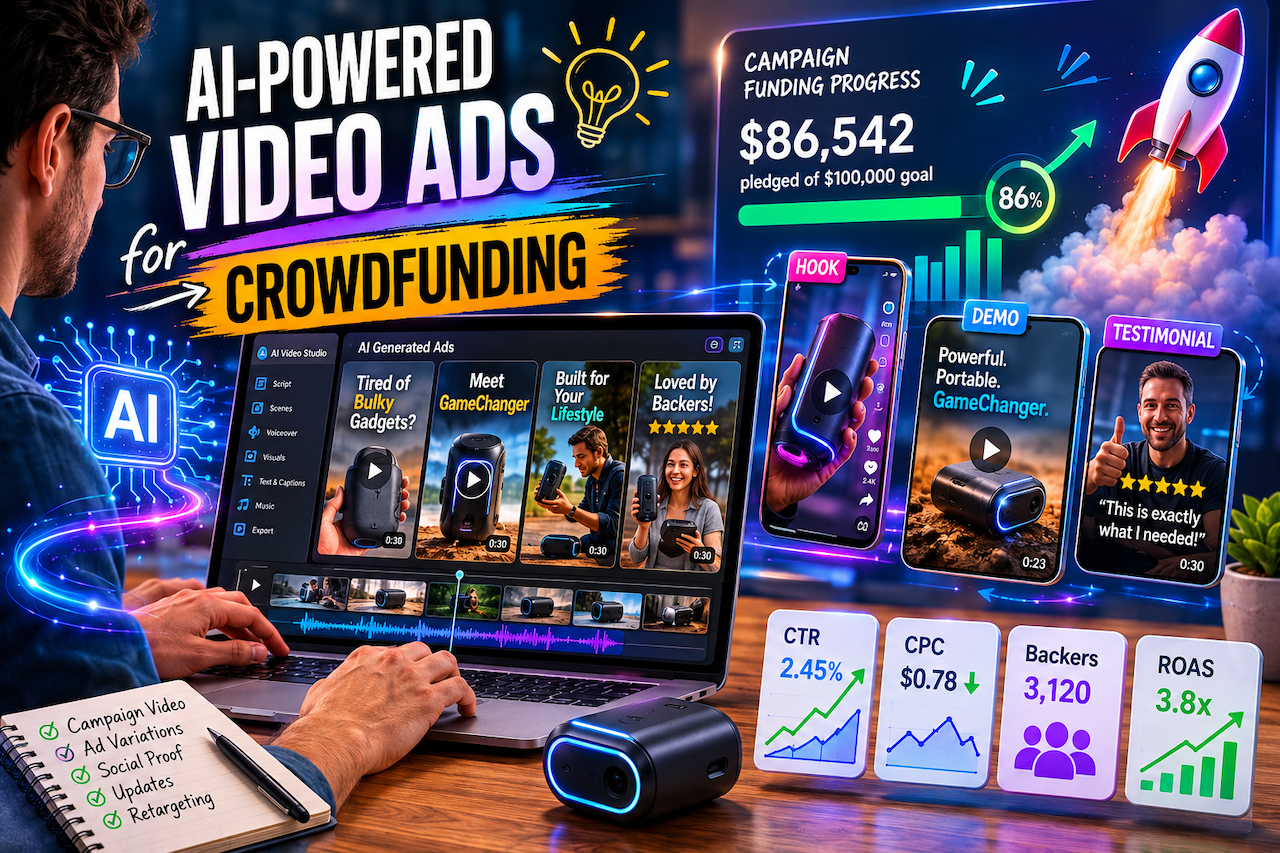
Crowdfunding lives and dies by video. Kickstarter's own data shows that campaigns with video raise 105% more money than those without. On Indiegogo, campaigns with a compelling video are 85% more likely to reach their funding goal. And once your campaign is live, paid video ads on Facebook, Instagram, YouTube, and TikTok are the primary driver of external traffic, accounting for 60-70% of total pledge revenue for successful six, and seven-figure campaigns, according to Funded Today's 2026 Crowdfunding Marketing Report.
But here's the challenge every crowdfunding creator faces: you need video before you have revenue. Traditional video production for a crowdfunding campaign costs 3,000-15,000 for a professional campaign page video, plus another 1,000-5,000 for ad creative variations. For a first-time creator launching a consumer product, that's a massive upfront investment with zero guarantee of return.
AI video generation has fundamentally changed this equation. In 2026, creators can produce professional-quality campaign videos and ad variations for a fraction of the traditional cost — and in a fraction of the time. Instead of one expensive hero video and two or three ad cuts, you can create dozens of creative variations, test them in real time, and scale the winners.
This guide covers everything: the types of videos every crowdfunding campaign needs, how to create them with AI, platform-specific ad strategies, and the testing frameworks that separate campaigns that hit 100% funding from those that stall at 15%.
The Video Assets Every Crowdfunding Campaign Needs
Successful crowdfunding campaigns don't rely on a single video. They need a system of video assets, each serving a different purpose:
1. Campaign Page Video (The Hero Video)
Purpose: Convince visitors who land on your Kickstarter or Indiegogo page to pledge.
Length: 2-4 minutes (data from Kickstarter's most-funded projects shows the sweet spot is 2:30-3:30).
Structure:
- Hook (0-15 sec): Show the problem or the product in action — something visually compelling that makes visitors stop scrolling.
- Problem (15-45 sec): Articulate the pain point your product solves. Make the viewer feel understood.
- Solution (45-90 sec): Introduce your product. Show it working. Highlight the "aha moment."
- Features & Benefits (90-150 sec): Detail 3-5 key features with visual demonstrations.
- Social Proof (150-180 sec): Testimonials, press mentions, expert endorsements, and prototype feedback.
- Team & Story (180-200 sec): Brief introduction to the creator or team to build trust.
- Call to Action (200-210 sec): Clear pledge CTA with urgency ("Back us now — early bird pricing ends soon").
AI approach: Use a video tool such as Topview to generate a polished campaign video from your product description, photos, and key messaging points. The AI can create professional narration, visual transitions, text overlays, and a structured narrative — all from input materials that would otherwise sit in a Google Doc.
2. Paid Ad Videos (The Growth Engine)
Purpose: Drive cold traffic from social media platforms to your campaign page.
Length: 15-60 seconds (platform-dependent).
You Need Multiple Variations: Top-performing crowdfunding campaigns test 15-30 ad creative variations in the first two weeks. AI makes this feasible.
3. Social Proof Videos
Purpose: Build credibility and overcome skepticism.
Formats: Testimonial compilations, unboxing reactions, press coverage highlights, and prototype demonstrations.
4. Update and Stretch Goal Videos
Purpose: Re-engage existing backers and attract new ones during the campaign.
Timing: Published at key milestones — 50% funded, 100% funded, stretch goal announcements, and the final 48 hours.
5. Retargeting Videos
Purpose: Convert visitors who viewed your page but didn't pledge.
Length: 15-30 seconds with a specific objection-handling message.
Creating Crowdfunding Ad Videos with AI: The Complete Process
Step 1: Define Your Ad Creative Framework
Before generating any video, establish your creative framework. The most successful crowdfunding ad campaigns use a matrix approach:
| Ad Angle | Hook Style | Target Audience | Funnel Stage |
|---|---|---|---|
| Problem-focused | Pain point question | Problem-aware | Cold traffic |
| Product demo | Visual wow moment | Solution-aware | Cold/warm |
| Social proof | Testimonial quote | Considering | Warm |
| Urgency/scarcity | Deadline countdown | Ready to buy | Warm/hot |
| Comparison | Before/after or vs. competitor | Evaluating alternatives | Warm |
| Story/founder | Personal narrative | Values-driven buyers | Cold |
Plan to create at least 2-3 video variations for each angle. That's 12-18 creative variations minimum — a volume that's only practical with AI tools.
Step 2: Write Ad Scripts That Convert
Crowdfunding ad scripts follow a tight structure. Every second matters. Here are proven frameworks:
The Problem-Agitate-Solve (PAS) Script (30 sec):
[0-5 sec] "Tired of [specific problem]?" [5-15 sec] "You've tried [common solution]. It doesn't work because [reason]. Meanwhile, [consequence of unsolved problem]." [15-25 sec] "Meet [Product Name]. It [key benefit] in [timeframe]. [Supporting feature]. [Supporting feature]." [25-30 sec] "Back us on Kickstarter — early bird pricing starts at [price]."
The Demo-First Script (15-30 sec):
[0-3 sec] Show the product doing something impressive — no words, pure visual hook [3-15 sec] "This is [Product]. It [primary benefit]. Watch this: [demo moment]." [15-25 sec] "[Feature 1]. [Feature 2]. [Feature 3]. Starting at [price]." [25-30 sec] "Live on Kickstarter now. Link in bio."
The Social Proof Script (30 sec):
[0-5 sec] "[Quote from reviewer/tester]: 'This is the best [category] I've ever used.'" [5-15 sec] "[Number] backers agree. [Product] raised [amount] in [timeframe]." [15-25 sec] Show product highlights with testimonial audio continuing [25-30 sec] "Join [number] backers. Early bird still available."
Step 3: Generate Video Variations with AI
This is where AI transforms crowdfunding marketing. Instead of producing one ad and hoping it works, you create a library of variations.
Using AI Video tools for crowdfunding ads:
Feed your product photos, descriptions, and ad scripts into video tool such as the TopView AI. The platform generates complete video ads with:
- Professional voiceover in your chosen tone (energetic for consumer products, authoritative for tech, or warm for lifestyle).
- Dynamic product visuals with zoom, rotation, and lifestyle context.
- Text overlays synchronized with key selling points.
- Platform-optimized formatting (9:16 for TikTok/Reels, 1:1 for Facebook Feed, and 16:9 for YouTube).
Batch production workflow:
- Write 15-20 ad scripts using the frameworks above, covering various angles and hooks.
- Generate all variations in a single AI session.
- Export videos in multiple aspect ratios for each platform.
- Total Time: Approximately 2-3 hours to create 15-20 ad variations, compared to 3-5 days with traditional production.
Step 4: Build Your Testing Matrix
Don't just launch ads randomly. Structure your testing to find winners fast:
Phase 1: Hook testing (Days 1-3) Run 6-8 different hooks with the same body content. Spend 10-20 per variation. Kill anything below 3% CTR after 1,000 impressions. This identifies which angles resonate with your audience.
Phase 2: Body testing (Days 4-7) Take your top 2-3 hooks and test them with different body content — different feature emphasis, different social proof, different CTAs. This optimizes the full viewing experience.
Phase 3: Scaling (Days 8+) Take your top 3-5 complete ads and scale budget gradually. Increase spend by 20-30% per day on winners. Create "iteration" variations of your winners — same angle, slightly different visuals or script tweaks — to combat ad fatigue.
Key metrics to track:
| Metric | Goal | Action if Below Goal |
|---|---|---|
| Hook rate (3-sec views / impressions) | 30%+ | Change opening visual/text |
| CTR (link clicks / impressions) | 1.5-3%+ | Strengthen CTA, adjust targeting |
| CPC (cost per link click) | Under 1.50 | Improve CTR or adjust audience |
| Landing page conversion rate | 5-12% | Improve campaign page, not the ad |
| Cost per acquisition (backer) | Under 25 | Optimize full funnel |
| ROAS (return on ad spend) | 2.5x+ | Scale winners, kill losers |
Step 5: Platform-Specific Ad Strategy
Each advertising platform has different strengths for crowdfunding:
Facebook & Instagram
Still the largest paid channel for crowdfunding. Facebook's targeting capabilities allow you to reach specific interest groups (gadget enthusiasts, eco-conscious consumers, design lovers) with precision.
- Format: 1:1 for feed and 9:16 for Stories/Reels.
- Length: 15-30 seconds for cold traffic and 30-60 seconds for retargeting.
- Budget Allocation: 40-50% of total ad spend.
Pro tip: Use Facebook's Advantage+ creative to let the algorithm test your AI-generated variations automatically. Upload 5-10 variations per ad set
TikTok
The fastest-growing channel for crowdfunding in 2026. TikTok's audience skews younger but has increasingly strong purchasing intent — TikTok Shop and in-app commerce have trained users to buy from video content.
- Format: 9:16 only.
- Length: 15-30 seconds, with the hook front-loaded in the opening moments.
- Budget Allocation: 20-30% of total ad spend.
Pro tip: Make ads that look like organic TikTok content, not polished commercials. AI-generated ads can produce dynamic, visually native short-form content that blends into the feed naturally
YouTube
Best for longer-form storytelling and high-intent audiences. YouTube viewers who watch a 30-60 second pre-roll ad about your product are highly qualified prospects.
- Format: 16:9.
- Length: 15-second bumper ads for awareness and 30-60 second skippable ads for conversions.
- Budget Allocation: 15-25% of total ad spend.
Pro tip: Use your campaign page video (shortened to 60 sec) as a YouTube ad. The storytelling format matches how YouTube viewers consume content
Underrated for crowdfunding. Reddit's community-specific targeting lets you reach hyper-relevant audiences (r/gadgets, r/kickstarter, r/shutupandtakemymoney) who are already predisposed to backing projects.
- Format: 16:9 or 1:1.
- Length: 15-30 seconds.
- Budget Allocation: 5-10% of total ad spend.
Pro tip: Reddit users hate obvious ads. Frame your video as a product showcase or demo, not a hard sell
Campaign Timeline: When to Deploy Each Video Type
| Campaign Phase | Timeline | Video Type | Purpose | Daily Ad Budget |
|---|---|---|---|---|
| Pre-launch | 30-7 days before | Teaser clips, email signup videos | Build email list | 20-50 (list building) |
| Launch day | Day 1 | Campaign page video + 5-8 ad variations | Initial funding surge | 100-300 |
| Early momentum | Days 2-7 | Top-performing ads, social proof clips | Hit 30% funding | 200-500 |
| Mid-campaign | Days 8-21 | New creative variations, stretch goal videos | Combat the "dead zone" | 150-400 |
| Final push | Last 72 hours | Urgency/countdown ads, retargeting | Close strong | 300-800 |
The "dead zone" (mid-campaign) is where most campaigns stall. Having a library of AI-generated ad variations ready to deploy keeps momentum going when initial excitement fades.
Budget Planning: Traditional vs. AI Production
| Video Asset | Traditional Cost | AI Cost | Savings |
|---|---|---|---|
| Campaign page video (3 min) | 5,000-15,000 | 100-300 | 94-98% |
| 15 ad creative variations | 3,000-7,500 | 50-150 | 97-98% |
| 5 social proof compilation videos | 1,500-3,000 | 30-100 | 95-97% |
| 3 update/stretch goal videos | 1,000-3,000 | 30-80 | 96-97% |
| 5 retargeting video variations | 1,000-2,500 | 30-80 | 96-97% |
| Total video production | 11,500-31,000 | 240-710 | 94-98% |
The savings aren't just financial — they're strategic. With traditional budgets, creators agonize over every video decision because reshoots are expensive. With AI, you can test freely, iterate quickly, and let performance data guide your creative direction.
Advanced Techniques for Crowdfunding Video Ads
Dynamic Creative Testing at Scale
Top crowdfunding campaigns don't just test different ads — they test different combinations of elements:
- 5 Hooks × 3 Body Sections × 3 CTAs = 45 possible ad combinations to test and optimize.
AI tools make it feasible to generate all 45 variations. Run them through Facebook's dynamic creative optimization or test them manually across platforms. After 48 hours, you'll have clear data on which hooks, which value propositions, and which CTAs drive the most pledges.
The "Unboxing Preview" Video
Create an AI-generated simulation of what the unboxing experience will look like. Show the packaging, the product reveal, the included accessories — all visualized before the product is manufactured. This is especially effective for retargeting visitors who showed interest but didn't pledge.
Using tools such as the Topview Drama Studio to generate realistic product motion sequences — showing the product from multiple angles with natural camera movements — creates an emotional "I want that" response that static renders can't match.
Localized Ad Campaigns
If your product has global appeal, create ad variations in multiple languages. AI video tools generate localized voiceover and text overlays without the cost of hiring translators and native-speaking voice actors for each market.
Key crowdfunding markets to consider:
- United States (largest market, English).
- Germany (strong backer community, German).
- Japan (high-value backers, Japanese).
- United Kingdom (high engagement, English with localized references).
- France (growing crowdfunding market, French).
With AI tools, generating the same ad in five languages takes minutes rather than the days required for traditional multilingual production.
Retargeting Video Sequences
Don't show the same retargeting ad to everyone who visited your page. Create a sequence based on how far they got:
- Visited Page but Didn't Scroll: Show the product demo video because they likely didn't see enough information about the product.
- Scrolled to Features but Didn't Pledge: Show a social proof video featuring testimonials, reviews, or endorsements because they need additional validation.
- Clicked "Back This Project" but Abandoned: Show an urgency-focused video with a specific pledge tier, deadline reminder, or limited-time offer because they need a final push to convert.
- Personalized Retargeting: Each audience segment receives a different AI-generated video designed to address its specific hesitation point.
Common Mistakes to Avoid
- Spending your entire video budget on one hero video. Your campaign page video matters, but your ad creative library drives revenue. Allocate budget 40/60 — 40% on the campaign video, 60% on ad variations and testing.
- Launching ads with only 2-3 creative variations. You need volume to find winners. Ad fatigue hits crowdfunding campaigns hard because you're targeting a finite audience repeatedly for 30 days. Start with 10-15 variations minimum.
- Making ads that look like ads. Especially on TikTok and Instagram, overly polished commercial-style ads underperform compared to content that feels organic and authentic. AI tools can produce both styles — choose the one that matches the platform.
- Ignoring the mid-campaign slump. Most campaigns see a dramatic drop in daily pledges after the first week. Plan for this by having fresh creative ready to deploy in week two. AI lets you create new variations in response to real-time performance data.
- Not testing hooks separately. The first 3 seconds of your ad determine whether the rest gets watched. Test hooks as isolated variables before optimizing the body content. A great hook with a mediocre body outperforms a mediocre hook with a great body — every time.
- Setting and forgetting your ads. Crowdfunding is a 30-day sprint. Check ad performance daily. Kill underperformers within 48 hours. Scale winners aggressively. Generate new AI variations to replace fatigued creatives weekly.
- Skipping retargeting. 95% of campaign page visitors don't pledge on their first visit. Retargeting ads — especially video retargeting with objection-handling messages — typically deliver 3-5x better ROAS than cold traffic ads. Always reserve 20-30% of your ad budget for retargeting.
 FAQs
FAQs
The standard benchmark is 25-35% of your funding goal for total marketing spend, with 60-70% of that going to paid ads. For a campaign targeting 50,000 in funding, that's roughly 7,500-12,000 in ad spend over 30 days. With AI-generated creative, your production costs are minimal — the vast majority of your budget goes directly to ad placement rather than video production.
Both. Run pre-launch ads 2-4 weeks before to build an email list. This is critical because a strong email list drives 30-40% of first-day funding. Then scale up ad spend on launch day and maintain it throughout the campaign. The pre-launch list-building phase typically has a lower CPA because you're collecting emails, not asking for money.
Cost per acquisition (CPA), specifically the cost to acquire a new backer, is the most important metric. Track this daily and by creative variation. Your target CPA depends on your average pledge amount; a general rule is to keep CPA below 25% of your average pledge value. A product with a 100 average pledge should aim for under 25 CPA.
Yes, they should be fundamentally different. Your campaign page video is for people who have already clicked, so they need depth, detail, and trust-building content in a 2-4 minute format. Your ad videos are for cold audiences who have not heard of you, so they need a hook, a quick value proposition, and a reason to click in 15-60 seconds. Never use your full campaign video as an ad.
This is one of AI's greatest strengths for crowdfunding. Use product renders, CAD files, prototype photos, and descriptions to generate polished video content that shows the product as it will look when manufactured. AI tools can create lifestyle context, demonstrate use cases, and present your product professionally, even from limited source materials. Just be transparent with backers about the product's development stage.
Start with English, then add German and Japanese because these three markets account for approximately 75% of global crowdfunding pledge volume. If your campaign gains traction, add French, Spanish, and Italian. With AI video generation, the marginal cost of adding each language is near zero, so the decision is more about managing ad campaigns in each market than about production cost.
Featured Image generated by ChatGPT.
Share this post
Author

Read the latest articles from Olivia
Nano Banana API Documentation Compared: 9 Platforms That Make Integration Easier in 2026
June 10, 2026
When choosing an API provider for Google's Gemini 3.1 Flash Image (Nano Banana 2) or Gemini 3 Pro Image (Nano Banana Pro), most comparisons focus on price or speed. But there's a quieter factor that often determines whether a project ships on time or stalls for days: documentation quality. Clear docs mean [...]
Learn moreTop 10 Custom AI Development Companies

June 5, 2026
Financial institutions no longer struggle to identify AI use cases. They struggle to move those use cases into production while meeting compliance requirements, integrating with legacy systems, and maintaining customer trust.
Learn moreLeave a comment
All comments are moderated. Spammy and bot submitted comments are deleted. Please submit the comments that are helpful to others, and we'll approve your comments. A comment that includes outbound link will only be approved if the content is relevant to the topic, and has some value to our readers.
Comments (0)
No comment