
Quick Summary
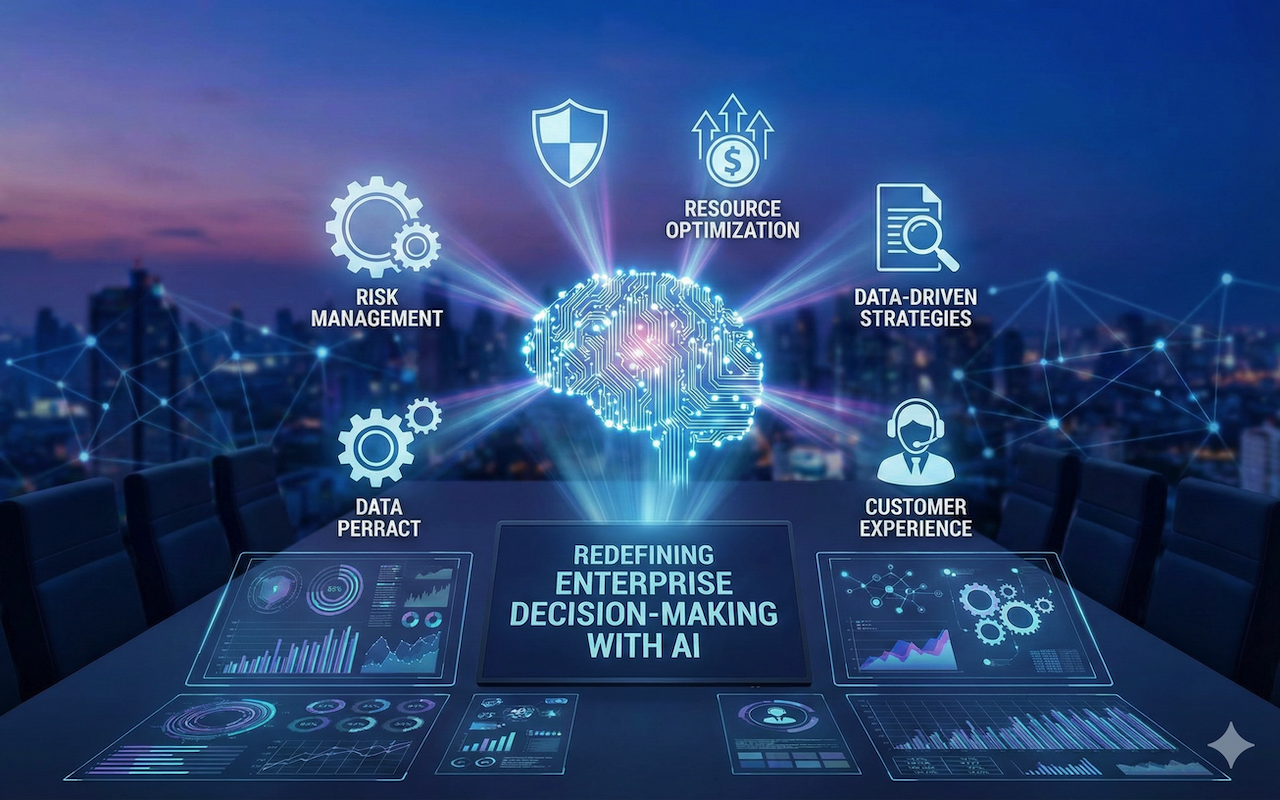
Enterprises are undergoing a significant shift as artificial intelligence reshapes how decisions are made. By enabling real-time insights, predictive analytics, and intelligent automation, AI helps organizations move faster, allocate resources more effectively, manage risk, and improve customer experiences. As data volumes and operational complexity increase, AI-driven decision-making supports more accurate, adaptive, and forward-looking business strategies.
Key Takeaways
- Data-Driven Decisions: AI analyzes large and diverse datasets to support strategic planning and operational choices.
- Risk Awareness: AI helps detect anomalies, identify potential compliance issues, and reduce operational risk.
- Resource Optimization: Predictive insights improve how time, capital, and workforce resources are allocated.
- Customer Experience: AI supports personalization and process efficiency across customer touchpoints.
- Future Readiness: AI enables scenario modeling and adaptive planning in rapidly changing markets.
As modern enterprises evolve, artificial intelligence has become a practical necessity rather than a theoretical concept. Organizations face increasing data volumes, faster market shifts, and rising customer expectations. Decision-making based solely on intuition or historical reporting is no longer sufficient.
AI is changing how enterprises gain insight into operations, evaluate risk, plan strategically, and remain competitive. By processing information at scale and in near real time, AI allows leaders to make informed decisions with greater confidence and speed.
Understanding AI in Enterprise Decision-Making
AI in enterprise decision-making refers to the use of technologies such as machine learning, natural language processing, and predictive analytics to support core business functions. These technologies analyze large datasets and surface insights that help organizations move from reactive decision-making to proactive planning.
One of the most impactful capabilities of AI is predictive analysis. By identifying patterns and trends, AI can forecast market behavior, operational challenges, and customer responses. This allows business leaders to assess potential outcomes before committing resources, reducing uncertainty and improving strategic alignment.
Key Areas Where AI Is Transforming Decision-Making
1. Creating Data-Driven Strategies
Enterprises generate vast amounts of data across operations, finance, supply chains, and customer interactions. AI helps organize and analyze this information efficiently, turning complex datasets into actionable insights.
This enables leaders to track performance in real time and adjust strategies based on current conditions rather than delayed reporting.
2. Risk Management and Compliance
AI supports risk awareness by identifying anomalies, irregular transaction patterns, and potential compliance gaps. AI-driven workflows use machine learning models to highlight unusual activity across financial operations, logistics, and regulatory workflows.
By improving visibility and accuracy, these systems help enterprises respond to risks earlier and maintain stronger governance practices.
3. Optimized Resource Allocation
Allocating time, personnel, and capital effectively is a constant challenge for large organizations. AI-driven forecasting helps predict where resources will have the greatest impact, supporting better budgeting, workforce planning, and operational efficiency.
This leads to more balanced decision-making and improved returns on investment.
4. Improved Customer Experience
By analyzing customer behavior, engagement patterns, and feedback, AI helps organizations understand individual preferences and expectations. These insights support more personalized interactions and smoother processes across digital and operational touchpoints.
In areas such as global trade and logistics, AI-driven insights can also help anticipate delays and improve transparency.
5. Scenario Planning and Forecasting
AI enables enterprises to model multiple scenarios based on changing market conditions. Predictive modeling allows leaders to test strategies virtually, compare outcomes, and select approaches with lower risk and higher potential value.
This strengthens long-term planning and supports more resilient decision-making.
Advantages of AI in Enterprise Decision-Making
Integrating AI into enterprise decision-making processes offers several benefits:
- Improved Accuracy: AI identifies patterns that may be overlooked in manual analysis.
- Faster Decisions: Near real-time insights support quicker responses to market changes.
- Greater Flexibility: Enterprises can adapt more easily to unexpected challenges.
- Operational Efficiency: Automation reduces repetitive workloads and frees resources for strategic initiatives.
- Competitive Advantage: Data-driven insights support innovation and differentiation.
Challenges and Considerations
Despite its benefits, AI adoption presents challenges that enterprises must address:
- Data Quality: AI outcomes depend on accurate and reliable data.
- Integration: Existing systems must support AI-driven workflows.
- Bias: Models require regular evaluation to avoid biased outcomes.
- Skills Gap: Organizations need expertise to manage and interpret AI insights effectively.
Addressing these challenges requires strong data governance, ethical oversight, and ongoing education.
The Future of Enterprise Decision-Making with AI
As advances in machine learning, natural language understanding, and real-time analytics continue, AI will become more deeply embedded in enterprise operations. Rather than serving as a standalone tool, AI is increasingly viewed as part of organizational culture and decision-making frameworks.
Industries such as logistics, finance, healthcare, manufacturing, and eCommerce are expected to gain significant value from AI-driven insights that improve efficiency, resilience, and responsiveness.
Conclusion
Artificial intelligence is redefining how enterprises make decisions. By transforming raw data into meaningful insights, AI supports faster, more accurate, and more strategic choices. As markets grow more complex, AI enables organizations to plan ahead, manage risk, and improve customer experiences.
Enterprises that adopt AI thoughtfully are better positioned to remain competitive, adapt to change, and build sustainable growth in the years ahead.
 FAQs
FAQs
AI in enterprise environments supports more accurate analysis, faster decision-making, improved agility, and better use of resources. By processing large volumes of data, AI helps organizations identify patterns, reduce manual effort, and respond more effectively to changing business conditions.
AI-powered customs processes use automation and data analysis to support tasks such as compliance checks, documentation review, and shipment tracking. These capabilities can reduce errors, improve accuracy, and simplify complex international trade workflows.
Common challenges include maintaining high data quality, integrating AI with existing systems, managing potential bias in models, and ensuring teams have the skills required to interpret and act on AI-generated insights.
Predictive analytics applies machine learning techniques to historical and real-time data to identify trends in market behavior, operational risk, and customer activity. This enables organizations to anticipate outcomes and make proactive decisions rather than reacting after issues occur.
AI-driven decision-making is widely used across industries such as logistics, finance, healthcare, manufacturing, and ecommerce. Any sector that relies on large datasets, operational efficiency, or risk management can benefit from AI-supported insights.
Featured Image generated by Google Gemini.
Share this post
Author

Leave a comment
All comments are moderated. Spammy and bot submitted comments are deleted. Please submit the comments that are helpful to others, and we'll approve your comments. A comment that includes outbound link will only be approved if the content is relevant to the topic, and has some value to our readers.
Comments (0)
No comment