
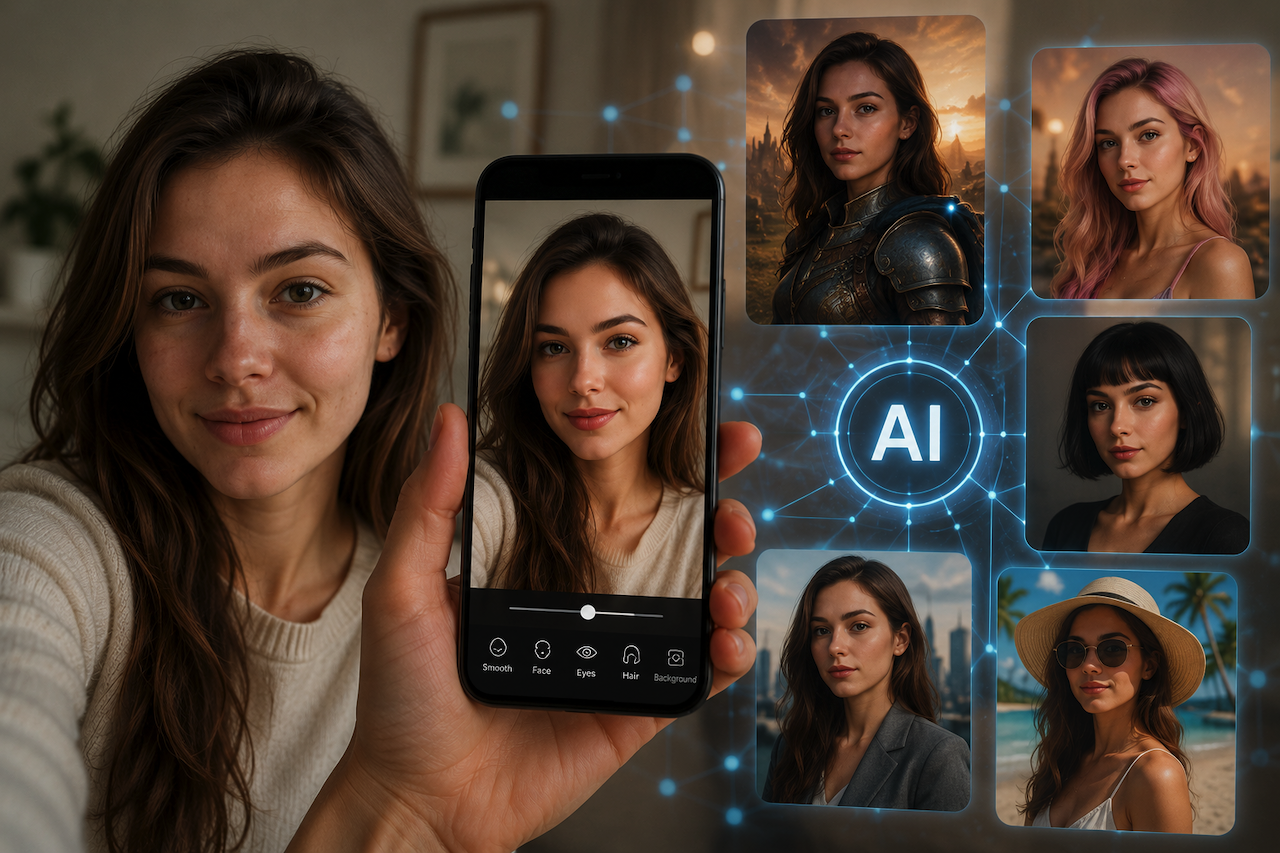
Taking a selfie in the past and taking it now are two wildly different things. Before, it was enough to point a camera at yourself, snap a picture, and share it with your friends and family. Today, a lot of people use a ton of filters to adjust lighting, smooth their skin, change their hairstyles, and so on.
At first, using AI to enhance our selfies was just a new, fun-filled activity, but now it’s become the norm. This poses a question, though: where does authenticity end and AI begin? Are AI-enhanced selfies still us, or do they portray someone else?
Why AI-Enhanced Selfies Became Popular
There are three main reasons explaining why AI-enhanced selfies have gained such unprecedented popularity.
1. Self-Expression
People love experimenting and presenting themselves in different contexts. The introduction of AI-powered selfie tools, such as the AI Selfie Generator, enabled users to pose against new and exciting backgrounds, step into fantasy worlds, create stylized headshots, and more. It’s similar to cosplay: people express their dreams, fantasies, and ideas through digital tools, feeling like the main character in a fictional world. Specifically:
- AI-enhanced selfies allowed individuals to experiment with artistic styles they wouldn’t have dared to try in real life, such as turning their hair pink or reimagining themselves with a large tattoo.
- New AI tools created opportunities to create unique identities shaped by cultural or historical influences. For instance, we can portray ourselves as warriors and dress in traditional clothing from our countries.
- With AI, it became easy to highlight specific aspects of our personality and appearance, such as brightening and widening our smile or deepening the color of our eyes.
People always look for ways to express themselves, and enhancing photos with AI is much like dressing up or painting a self-portrait.
2. Accessibility
A lot of us would love to get professional pics, but unfortunately, such photography is expensive. Few people can afford it, especially regularly; AI tools, in turn, are either free or cheap.
Even if you lack designer skills, you can still easily alter your selfies with AI. The interface of such apps is always user-friendly so that you can edit and enhance your images in multiple ways and as many times as you like.
3. Confidence Exploration
Some people don’t like the way they look. Using AI to enhance their selfies can give them the confidence boost they want. For example:
- A user can improve their selfies until they see an idealized version of themselves and feel genuine appreciation. Slowly, they grow to love themselves more.
- By trying new hairstyles or makeup through AI, users can pick the look they like most and implement it in real life.
- After sharing an enhanced selfie and receiving multiple positive comments, people can gradually feel more confident.
These are the positive sides of AI enhancements, but there is another, darker side to this trend.
When AI Enhancement Becomes Fabrication
Unfortunately, many people don’t know when to stop, and step by step, they move away from their real selves and adopt a new, artificial identity. The capabilities of AI have evolved rapidly, making it possible to dramatically alter appearance, age, and body features with minimal effort.
Some of the most common examples include:
- Changing body proportions to appear slimmer or more muscular
- Altering facial structure, including nose shape, jawline, lips, or forehead size
- Using AI tools to appear significantly younger or older than in reality
These changes can blur the line between enhancement and fabrication. In some cases, people become deeply attached to idealized AI-generated versions of themselves instead of focusing on real-life changes or self-acceptance.
This issue is especially noticeable on dating platforms and social media, where heavily altered selfies may create unrealistic expectations. In some situations, people may struggle to recognize each other in real life after interacting only through edited photos.
AI-generated alterations can also make it easier to misrepresent age or identity online. While older edited photos were once easier to identify, modern AI tools can create highly realistic images that make verification more difficult.
The easiest way to distinguish self-expression from fabrication is to consider the context and intent behind the image. Using AI-enhanced photos creatively or artistically is very different from intentionally misleading other people about appearance or identity.
Expressing Yourself While Staying Authentic
AI has become a helpful tool that allows us to express ourselves in new ways and boosts our confidence. However, we should never overuse it and forget about boundaries.
Enhancing your selfies to look your best and sharing them online is fine. Actively turning yourself into a new person to mislead a hopeful partner or employer is not.
The key lies in our perception of things. Start treating AI as the tool it is, not a crutch or a ticket into a new, better world. Use it for inspiration, but never try to pretend to be someone you are not. Put your ethics above everything else, and you’ll remain yourself no matter what.
Conclusion
AI-enhanced selfies have changed the way people present themselves online, offering new opportunities for creativity, experimentation, and confidence-building. For many users, these tools function as a modern form of self-expression rather than an attempt to hide their real identity.
At the same time, the growing realism of AI-generated edits raises important questions about authenticity, trust, and personal boundaries. The difference between creative enhancement and deception often depends on intent, context, and transparency. As AI image tools continue to evolve, maintaining a balance between self-expression and honesty will become increasingly important in digital spaces.
Disclaimer
The information provided in this article is for general informational and editorial purposes only. The views and opinions expressed do not constitute professional psychological, medical, or legal advice. Readers should use their own judgment when interpreting or applying the information discussed regarding AI-generated content, online identity, and digital self-expression.
References to third-party tools, platforms, or services are included solely as examples within the broader discussion of AI-enhanced selfies and digital media trends. iplocation.net does not endorse, guarantee, or assume responsibility for any third-party products, services, content, or websites referenced in this article.
iplocation.net shall not be held liable for any losses, misunderstandings, damages, or consequences resulting from the use of AI image tools, edited media, third-party services, or reliance on the information presented in this article.
Featured Image generated by ChatGPT.
Share this post
Author

Read the latest articles from Taras Tymoshchuk
How to Build an Unbreakable Industrial Network in 2026

April 23, 2026
A three-minute network outage on an automated production line used to be an IT problem. Now, it costs millions of dollars in lost productivity and triggers severe safety hazards. When the connection drops, teleoperated machinery stops.
Learn moreIP Geolocation for Gaming Security and Compliance
March 5, 2026
Online gaming works worldwide. Every day, millions of players connect to play games, trade items, and talk to each other. That size creates problems, though — cheating, fraud, and rule-breaking or lawbreaking happen a lot.
Learn moreLeave a comment
All comments are moderated. Spammy and bot submitted comments are deleted. Please submit the comments that are helpful to others, and we'll approve your comments. A comment that includes outbound link will only be approved if the content is relevant to the topic, and has some value to our readers.
Comments (0)
No comment